The Future of the International Space Station
What is the future of the International Space Station? Explore its history, the science conducted aboard, plans for decommissioning by 2030, and what commercial stations will replace it.
What is the future of the International Space Station? Explore its history, the science conducted aboard, plans for decommissioning by 2030, and what commercial stations will replace it.
It is, depending on how you look at it, either the most expensive object ever built or the most remarkable cooperative achievement in human history. Probably both. The International Space Station — a structure roughly the size of an American football field, assembled piece by piece in low Earth orbit over more than a decade — has been continuously inhabited since November 2, 2000. No place beyond Earth’s surface has been home to human beings for longer.
The International Space Station is getting old. The ciritical components have exceeded their design lifetimes. In year 2022, NASA and its international partners decided to operate the station only until 2030. After that, the station will be guided into controlled reentry over the Pacific Ocean in the early 2031.
The International Space Station did not appear all at once. It was assembled in orbit over a period of 13 years, through 42 assembly flights by American Space Shuttles and Russian Soyuz and Proton rockets. The first module, the Russian-built Zarya (meaning “sunrise”), launched in November 1998. The American Unity module followed two weeks later, joined to Zarya by Space Shuttle Endeavour’s crew.
The construction required, over subsequent years, more than 40 assembly flights. Astronauts and cosmonauts conducted over 200 spacewalks — totaling more than 1,300 hours of extra-vehicular activity — to bolt, connect, and configure the expanding station. Solar arrays unfurled. Laboratories attached. Truss segments extended the station’s span to 109 meters, wider than the wingspan of a Boeing 747.
The partnership behind this achievement is extraordinary in its own right. Fifteen nations contributed hardware, funding, or crew: the United States, Russia, Canada, Japan, and eleven member states of the European Space Agency. At the height of the Cold War, NASA and the Soviet space program were bitter rivals. By the late 1990s, they were bolting hardware together in orbit.
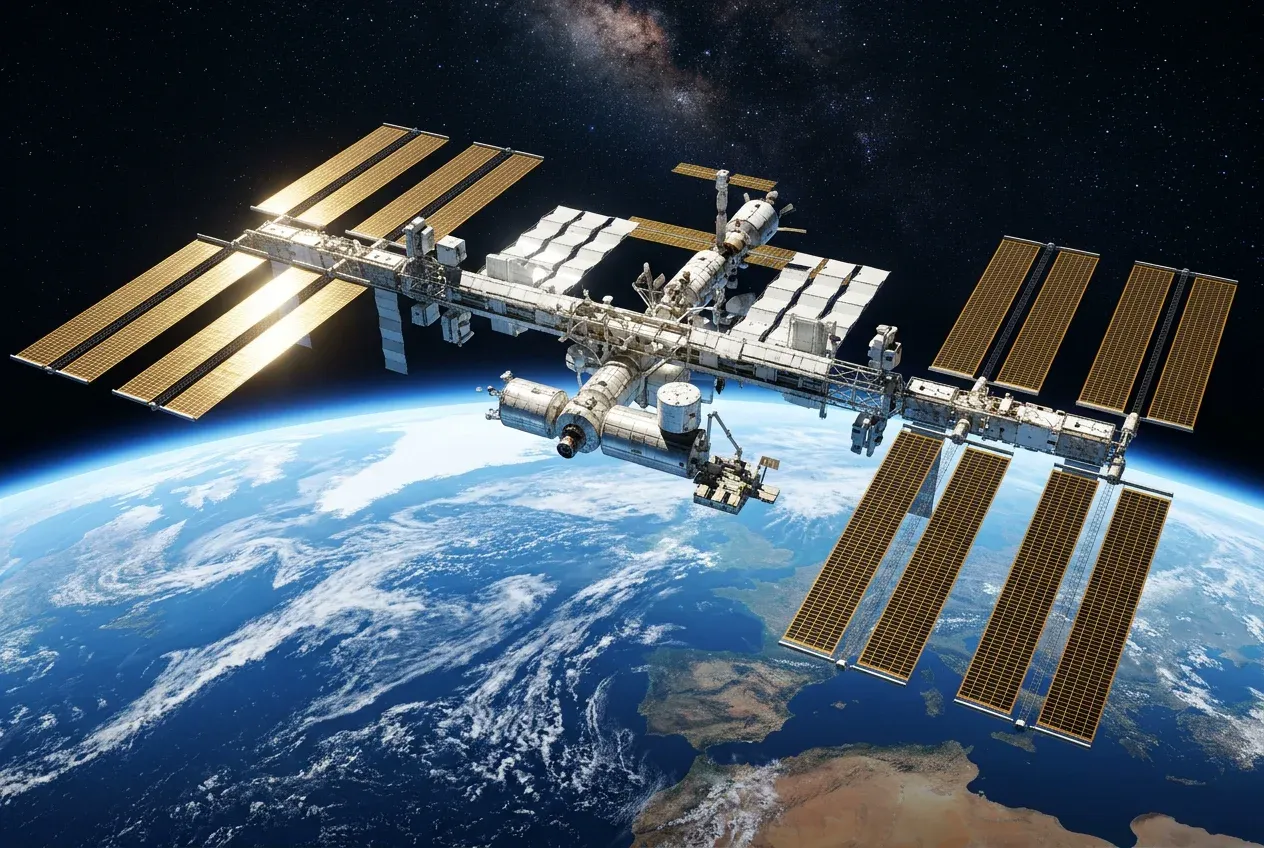
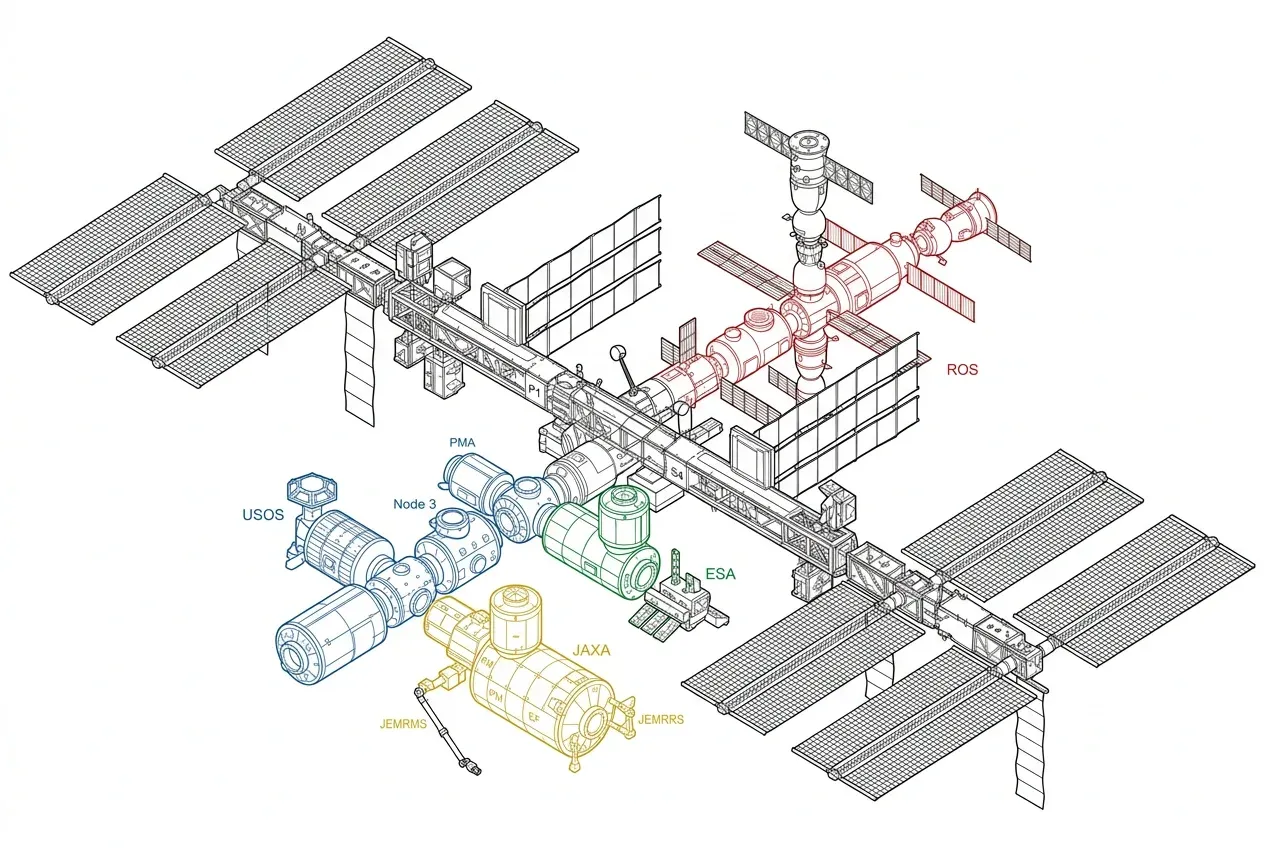
The ISS is not a single vessel but a collection of interconnected pressurized modules, each serving distinct functions.
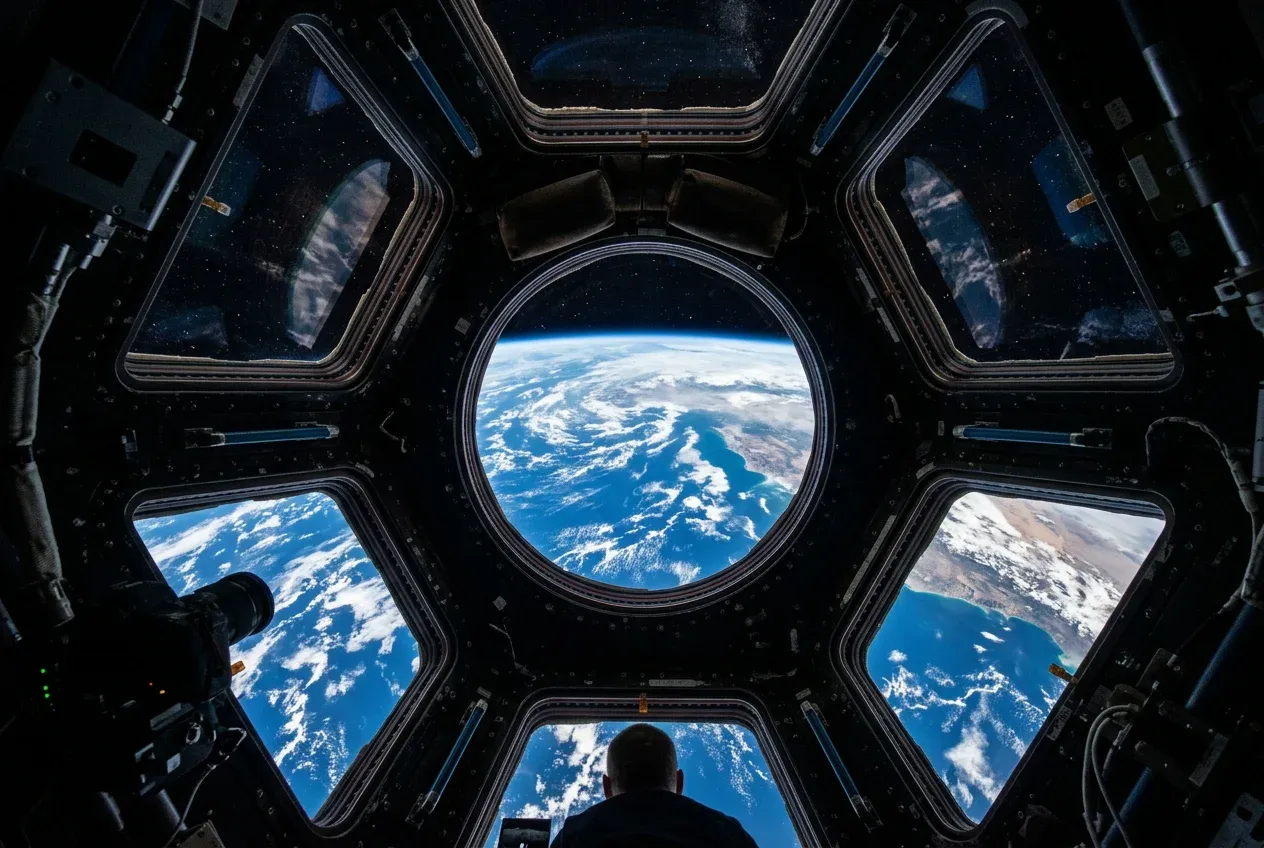
The Destiny laboratory is NASA’s primary research module, hosting experiments in physics, biology, and materials science. The Columbus module, contributed by ESA, focuses on life sciences, fluid physics, and Earth observation. Kibo, Japan’s contribution and the largest module on the station, includes an external exposed facility where experiments can be deployed directly to the vacuum of space. The Tranquility module houses life support systems and the cupola — a seven-window dome that offers the most spectacular view of Earth available to any human being.
Russia’s Zvezda module serves as the station’s living quarters for Russian cosmonauts and hosts the main propulsion system used to maintain the station’s orbital altitude. Without periodic reboosts — either from Zvezda’s thrusters or from visiting spacecraft — atmospheric drag would cause the ISS to reenter within months.
[!NOTE] The International Space Station orbits Earth at an altitude of approximately 400 kilometers, traveling at about 7.7 kilometers per second. At that speed, it completes one orbit every 90 minutes, meaning astronauts experience roughly 16 sunrises and 16 sunsets every day.
Living on the ISS is nothing like living on Earth, and not primarily because of the view. The defining characteristic of life aboard the station is weightlessness — or more precisely, microgravity. The station and everything inside it are in continuous free fall around Earth, creating an environment where there is no meaningful “up” or “down.”
This affects everything. Astronauts sleep strapped into sleeping bags attached to walls. They eat food from pouches to prevent crumbs from floating into electronics. Water forms spheres in midair. Showers are replaced by wet towels. Exercise is not a leisure activity but a medical requirement: without gravity’s constant resistance, muscles atrophy and bones lose density at a rate that would be debilitating after six months without countermeasures. Astronauts are required to exercise two hours per day on resistance machines and treadmills adapted for microgravity.
The cardiovascular system adapts too—and not always in positive ways. In microgravity, fluids shift toward the upper body. This fluid shift causes the face to puff and intracranial pressure to increase. Long-duration astronauts have reported vision changes, potentially linked to this pressure increase. Understanding and mitigating these effects remains one of the most pressing research problems on the ISS.
Psychological adaptation is also significant. Living in a confined space with the same small group of people for six months — with no ability to leave, in an environment that could kill you within seconds if a seal failed — demands extraordinary psychological resilience and interpersonal skill.
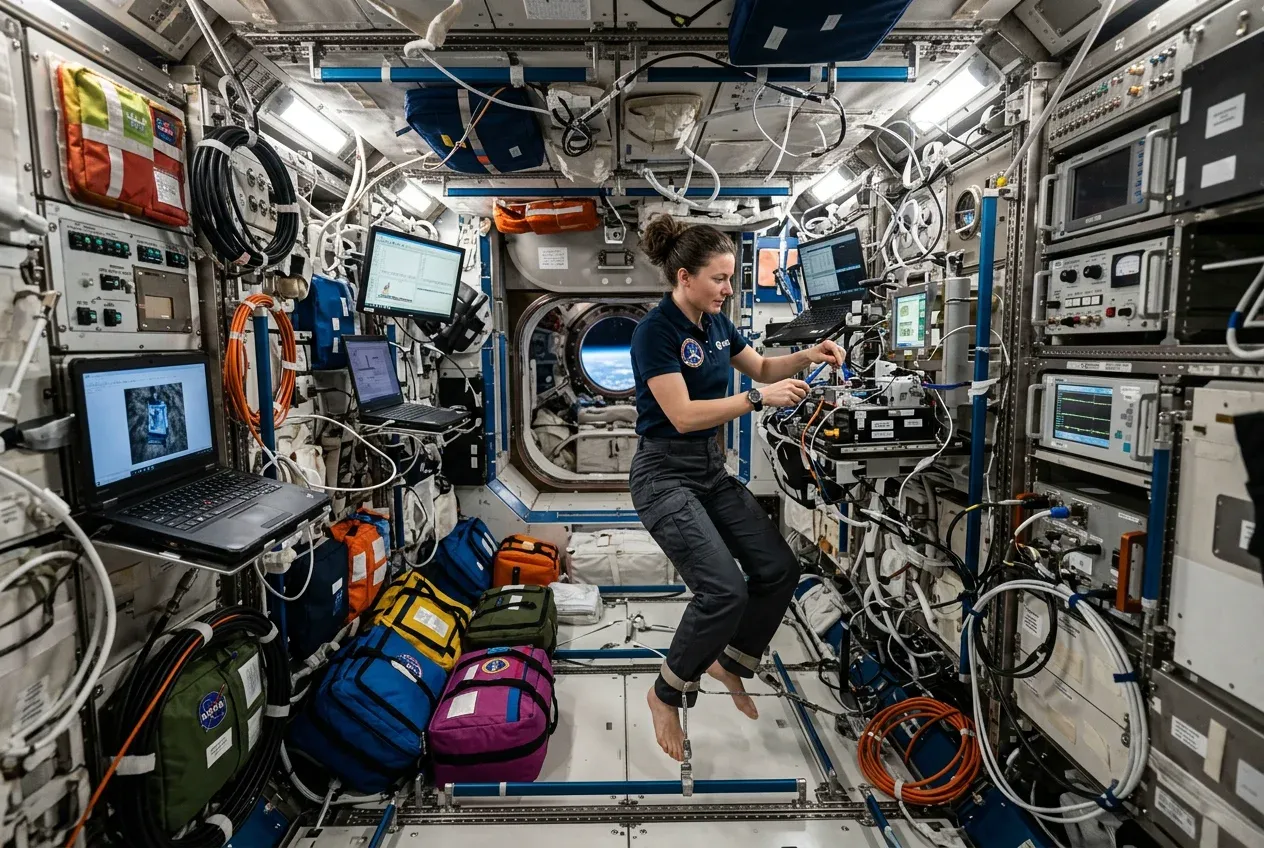
With more than 3,000 experiments from over 100 countries conducted during its operational lifetime, the research aboard the ISS spans a staggering range of disciplines.
The microgravity environment of the ISS accelerates biological processes that on Earth take years. Protein crystals grow larger and with fewer defects in microgravity, potentially yielding better drug targets.
Researchers have grown cancer cells in three-dimensional structures on the ISS. These structures more closely resemble tumors in the human body than the flat cultures grown in Earth laboratories, providing new implications for drug testing.
The NASA Twin Study — in which astronaut Scott Kelly spent one year aboard the ISS while his identical twin brother Mark Kelly remained on Earth — provided unprecedented data on the physiological and genomic effects of spaceflight. Scott Kelly’s telomeres (chromosome end-caps) temporarily lengthened in space, his gene expression changed, and his gut microbiome shifted. Most changes reversed after his return to Earth, but some persisted.
Experiments in combustion science aboard the ISS have revealed “cool flames” — a type of slow, low-temperature combustion that does not occur under Earth’s gravity and that may have implications for understanding engine efficiency and fire safety. Studies of fluid physics in microgravity have improved models used in engineering applications ranging from heat exchangers to nuclear reactors.
The Cold Atom Lab, a NASA instrument aboard the ISS, creates Bose-Einstein condensates — quantum states of matter that exist only at temperatures near absolute zero — in microgravity, allowing scientists to study quantum phenomena for durations impossible on Earth.
Paradoxically, one of the most valuable functions of a space station is looking back at Earth. ISS instruments and crew photography have produced decades of data on urban growth, deforestation, glacial retreat, flooding, and agricultural change. The ECOSTRESS instrument monitors plant water stress and land surface temperature with high spatial and temporal resolution. ISS-mounted instruments have also contributed to atmospheric chemistry research and monitoring of methane emissions.
The NASA ISS was not designed to last forever, and an eventual ISS decommission was built into its planning from the beginning. Original plans envisioned operations through 2015. Extensions have pushed that date back repeatedly, and a formal agreement between NASA and its partners in 2022 committed to operations through 2030.
After 2030, the plan is controlled deorbitation — a deliberate, precisely managed reentry that directs debris away from populated areas. The target is the “spacecraft graveyard” in the South Pacific Ocean, a remote region of open water thousands of kilometers from any land. This area is used for controlled reentries of large satellites and the Russian Mir space station, which reentered there in 2001.
The deorbit process itself will be complex. A SpaceX Dragon spacecraft, contracted by NASA as the U.S. Deorbit Vehicle, will be used to provide the final controlled retrorocket burns. The station’s own propulsion cannot fully manage the deorbit of a structure this massive. Parts of the ISS that do not burn up in the atmosphere — some structural elements and large metal components — will fall into the ocean.

The cost of the ISS has been estimated at approximately $150 billion over its lifetime, making it the most expensive single object ever constructed. Whether the return on that investment — in scientific knowledge, international cooperation, and technological advancement — has been worth it is a question that depends on how you weight intangibles like human spaceflight capability and geopolitical diplomacy alongside hard scientific outputs.
For perspective on why this kind of investment makes sense, see our article on why we explore space.
NASA has no intention of abandoning low Earth orbit in 2030. Instead, it is pursuing a fundamentally different model: rather than owning and operating its own station, NASA plans to be a customer of commercially owned and operated space stations.
This mirrors the model that transformed crew and cargo transportation to the ISS. NASA’s Commercial Crew Program — which developed SpaceX’s Dragon and Boeing’s Starliner — successfully ended U.S. dependence on Russian Soyuz capsules for crew transportation. A similar commercialization of the space station itself is the next step.
Axiom Space, a Houston-based company, has signed agreements with NASA to attach commercial modules to the ISS before 2030, gaining operational experience in orbit. When the ISS is decommissioned, the Axiom modules will detach and operate independently as a free-flying commercial station. Axiom has already hosted four private astronaut missions to the ISS.
Blue Origin — Jeff Bezos’s space company — is leading a consortium that includes Sierra Space to build Orbital Reef, a mixed-use commercial space station targeting government agencies, commercial research, tourism, and manufacturing. The station is designed to operate at roughly the same altitude as the ISS and could support a crew of up to 10.
Northrop Grumman, in partnership with other companies, is developing a separate commercial station concept. Starlab, led by Voyager Space and Airbus, is designing a single large-volume station module. Several of these projects have received NASA development funding through the Commercial Low Earth Orbit Destinations (CLD) program.
None of these commercial stations will be owned or operated by NASA. The agency’s role will be as an anchor customer — guaranteeing a certain number of crew slots and research time, providing the financial certainty that makes private investment possible. Whether commercial demand beyond NASA will materialize — from tourism, manufacturing, media, or other industries — remains to be seen.
For the longer vision of humanity’s presence beyond low Earth orbit, see our article on intergalactic colonization and what it means for humanity’s future.
NASA and its international partners have committed to operating the ISS through 2030. After that, a controlled deorbit is planned, with the station's debris directed into the South Pacific Ocean — the same remote region used for the controlled reentry of the Russian Mir station in 2001.
The ISS is typically crewed by six to seven astronauts and cosmonauts at any given time, though the station can support up to thirteen people for short periods when visiting spacecraft are docked. Crew members stay for missions typically lasting three to six months.
It is difficult to single out one discovery, as the ISS has contributed to thousands of experiments across many disciplines. Among the most cited are findings from the NASA Twin Study on how spaceflight affects the human body, discoveries about cool flame combustion that do not occur on Earth, and Bose-Einstein condensate research in the Cold Atom Lab.
The total cost of the ISS over its lifetime has been estimated at approximately $150 billion, making it the most expensive single object ever built. This figure includes design, construction, launch, and operations costs spread across NASA and its international partners over more than 25 years.
Several commercial space stations are in development to replace the ISS in low Earth orbit. These include Axiom Station (by Axiom Space), Orbital Reef (by Blue Origin and Sierra Space), and Starlab (by Voyager Space and Airbus). NASA plans to be a customer of these stations rather than their owner and operator.