Mars Rovers: Exploring the Red Planet
A complete guide to Mars rovers — from Sojourner to Perseverance — covering what each discovered, the Ingenuity helicopter, and the future of Mars exploration.
A complete guide to Mars rovers — from Sojourner to Perseverance — covering what each discovered, the Ingenuity helicopter, and the future of Mars exploration.
Mars has been watching us for as long as we have watched it. Ancient astronomers tracked its blood-red wandering across the sky and named it for the god of war. Modern telescopes resolved it into a world — a desert world, strewn with craters and volcanoes and canyons that dwarf anything on Earth. Mars rovers have transformed our understanding of this alien landscape. And then, on July 4, 1997, a small six-wheeled robot the size of a microwave oven bounced to a halt on the Ares Vallis floodplain, rolled down a ramp, and began to move.
Sojourner was the first Mars rover, and it changed everything. Not because of what it found — though its findings were real — but because of what it proved: that machines could rove, that geology could be done remotely, and that humans could do science on another planet by proxy.
In the nearly three decades since, four more rovers have followed. Each has been smarter, more capable, and more ambitious than the last.
Before discussing individual rovers, it is worth asking why we bother. Mars has been observed from orbit since the 1960s. Orbital missions have mapped its surface to resolutions of less than a meter, measured its atmospheric composition, and detected subsurface ice with ground-penetrating radar. Why send a rover?
The answer is geology. From orbit, you can see that a rock exists. From a rover, you can drive up to it, brush the dust off, grind into its surface, and read its chemical composition with a laser. You can tell whether that rock formed in flowing water, in a volcanic eruption, or in a meteorite impact. You can measure its age. Geology requires close inspection of material in context, and no orbital instrument — however sophisticated — can replace a geologist on the ground. A rover is the next best thing.
The scientific case for Mars rests on a simple, powerful observation: billions of years ago, Mars was not the frozen desert we see today. It had liquid water on its surface. It had a thicker atmosphere. It may have had conditions suitable for life. Whether life arose — and if so, what trace it left behind — is one of the most profound unanswered questions in all of science.
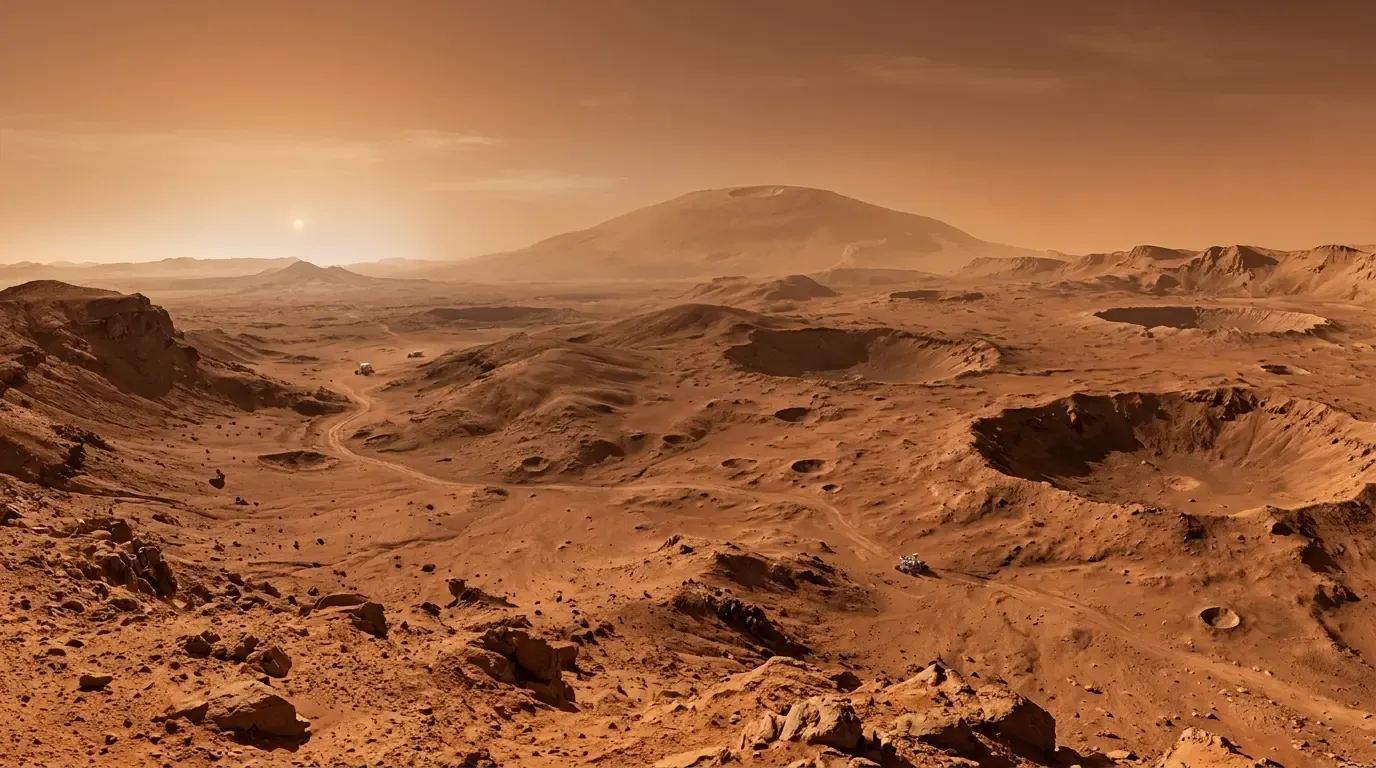
On July 4, 1997, NASA’s Mars Pathfinder mission delivered Sojourner to the surface inside a cocoon of airbags, bouncing and rolling across the Martian rock field before coming to rest. The lander and the rover together demonstrated a then-novel approach: instead of engineering a spacecraft to land on legs (expensive and complex), wrap it in airbags and let it bounce.
Sojourner weighed just 10.6 kilograms and was roughly the size of a skateboard. It was not designed to travel far — its maximum range was about 10 meters from the lander, constrained by the need to keep the camera in line of sight. Over 83 Martian days (sols), it traveled a total of 100 meters and analyzed 15 rocks.
What Sojourner found at Ares Vallis confirmed what orbital data had suggested: the landing site was an ancient floodplain, shaped by catastrophic floods billions of years ago. Rocks of multiple compositions — granite-like, volcanic — had been swept together from distant regions. This diversity told geologists that the ancient floods had carried material from a wide area, making Ares Vallis a geological sampling ground.
Sojourner’s primary contribution was not any single discovery but its proof of concept. Rover technology worked. Remote science worked. The door was open.
[!NOTE] Sojourner was designed for a planned 7-sol (Martian day) mission. It lasted 83 sols before communications were lost — a pattern of rovers dramatically exceeding their design lifetimes that would continue with every subsequent mission.
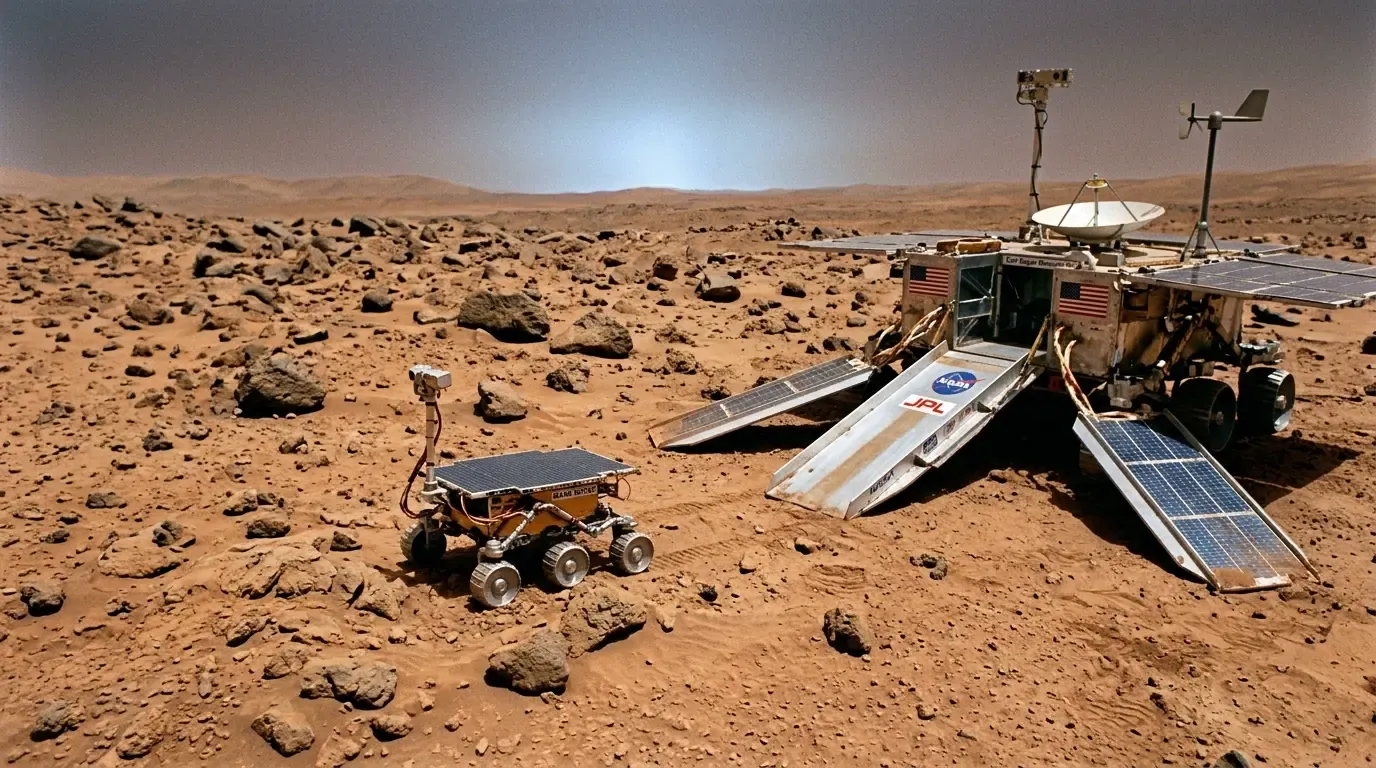
If Sojourner was a proof of concept, Spirit and Opportunity were a coming of age. Launched separately in June and July 2003, the twin Mars Exploration Rovers arrived on opposite sides of the planet in January 2004. Both were designed for a 90-sol primary mission. Spirit lasted 2,208 sols. Opportunity lasted 5,111 sols — more than 14 years.
Spirit landed in Gusev Crater, a 166-kilometer depression that geologists believed might have once held a lake. It rolled for months across what appeared to be a volcanic plain, finding little evidence of water. Then, 3.5 kilometers from its landing site, it climbed the Columbia Hills — and everything changed.
In the hills, Spirit found rocks altered by water. Minerals formed in hydrothermal environments. Evidence of ancient volcanic springs, where hot water had percolated through rock. The Columbia Hills had once been a geologically active, water-altered environment — not the open lake scientists had hoped for, but a genuine record of Mars’s watery past.
Spirit’s mission ended in 2010 when the rover became stuck in soft soil and could no longer orient its solar panels toward the Sun. Contact was lost in March 2010. It had traveled a total of 7.73 kilometers.
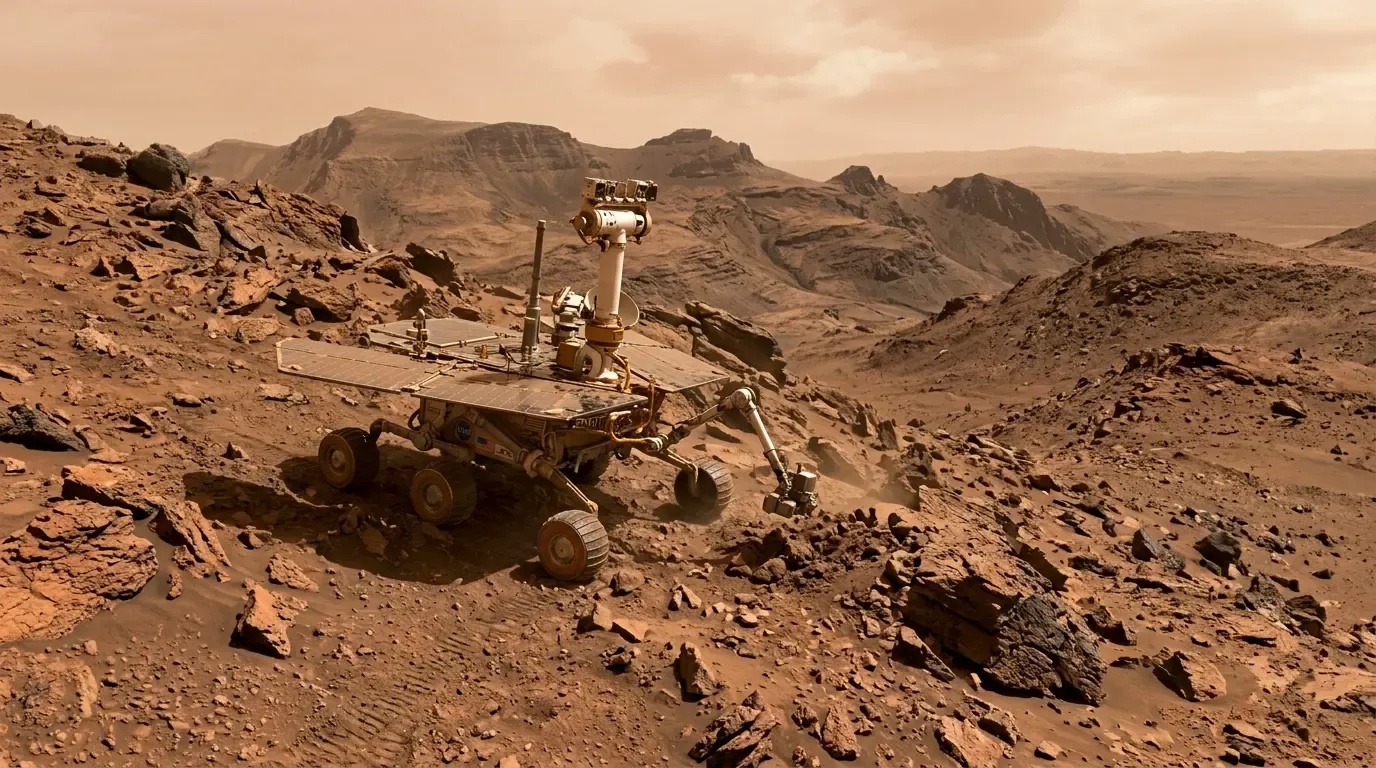
Opportunity landed in Eagle Crater, a small impact site that immediately revealed something extraordinary: the walls of the crater exposed outcrops of bedrock. And that bedrock contained spherical hematite concretions — nicknamed “blueberries” — that form in watery environments on Earth. Opportunity had landed in a place where water had once flowed.
Over the following years, Opportunity investigated numerous craters and rock formations across Meridiani Planum, finding consistent evidence for ancient standing water: sulfate-rich rocks formed in evaporating brines, layered sedimentary structures, mineral veins deposited by flowing water. It drove south to Endeavour Crater — a 22-kilometer-wide ancient impact site — finding even older rocks altered by more neutral water, suggesting that billions of years ago, the environment might have been more hospitable to life.
Opportunity’s mission ended on June 10, 2018, during a planet-wide dust storm that blocked sunlight from its solar panels. NASA attempted to contact the rover for eight months before declaring the mission over in February 2019. Total distance traveled: 45.16 kilometers — a marathon and then some.
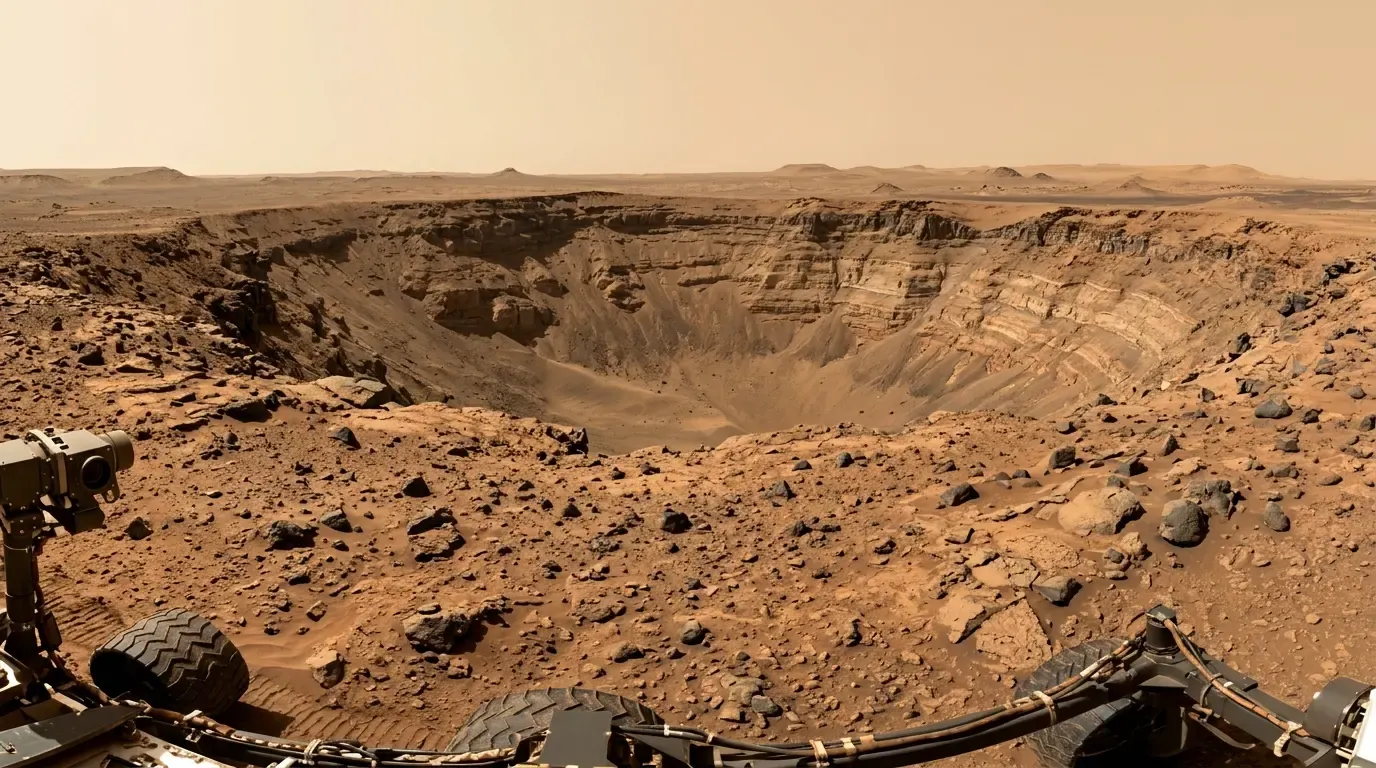
If Spirit and Opportunity established that water once existed on Mars, Curiosity’s mission was more specific: not just to find evidence of water, but to determine whether Mars ever had conditions capable of supporting life as we know it. The question NASA framed was “habitability” — the scientific term for whether an environment has the necessary ingredients for life.
Curiosity landed on August 6, 2012, inside Gale Crater — the site chosen because it contains a central mountain, Mount Sharp (officially Aeolis Mons), whose layered sediments record billions of years of Martian history. Reading those layers is like reading pages of a geological book.
Curiosity is a car-sized nuclear-powered rover weighing 899 kilograms — much larger than its predecessors.
It carries ten scientific instruments, including a drill that can bore into rock, a laser that can vaporize rock at a distance for chemical analysis, and an organic chemistry laboratory capable of detecting carbon-based molecules.
Within months of landing, Curiosity drove to a region called Yellowknife Bay and drilled into a rock called John Klein. The sample contained clay minerals, calcium sulfate veins, and sulfur and nitrogen compounds — exactly what you would expect in a habitable environment. The clays had formed in neutral-pH water, not the acidic brines suggested by Opportunity’s sites. The chemical energy sources necessary for microbial life were present.
In March 2013, NASA announced the conclusion: Mars once had the conditions to support life. Not life itself — that remained undetected — but habitability. The ingredients were there.
Subsequent years of exploration have added to the picture. In 2018, Curiosity detected organic molecules — carbon-based compounds — in 3-billion-year-old rock in the Murray Formation. These are not necessarily biological in origin; organic molecules form through many non-biological processes. But their survival over billions of years suggests Mars’s subsurface may preserve organic material.
The rover also detected seasonal variations in methane in the Martian atmosphere — methane that could be geological or, intriguingly, biological in origin. The methane mystery remains unresolved as of 2026 and is one of the most actively debated questions in Mars science.
Curiosity is still operating on Mount Sharp, reading the geological record layer by layer. Its nuclear power source means it will not face the fate of solar-powered rovers during dust storms.
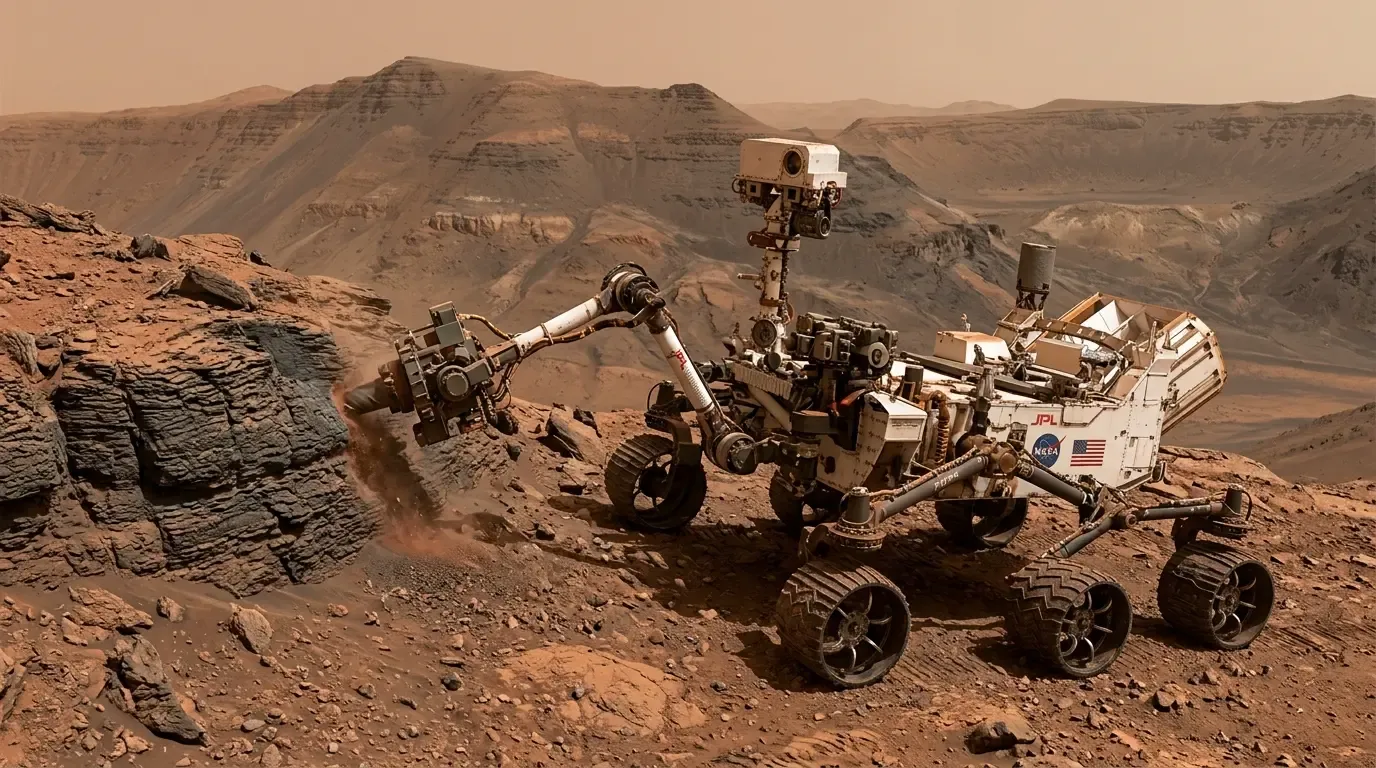
On February 18, 2021, NASA landed its most sophisticated rover yet inside Jezero Crater — an ancient river delta that was once a lake roughly 45 kilometers wide. If Curiosity asked whether Mars was habitable, Perseverance is looking for the fossils.
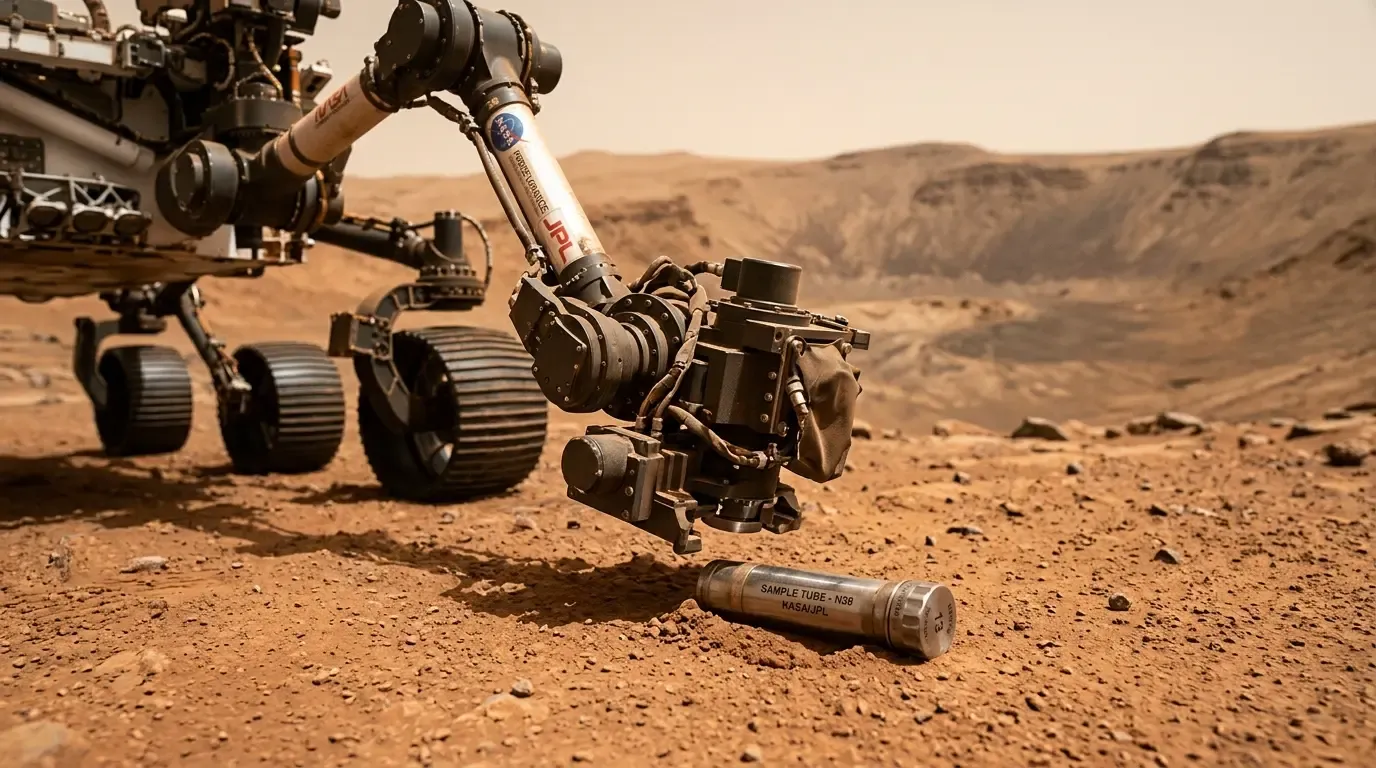
Perseverance carries 23 cameras, a 2-meter robotic arm, a ground-penetrating radar, and a sophisticated organic chemistry instrument called SHERLOC, which uses ultraviolet Raman spectroscopy to hunt for signs of ancient life. But perhaps its most important function is sample caching: Perseverance drills cores of rock and deposits them in titanium tubes on the Martian surface, where a future sample-return mission may retrieve them.
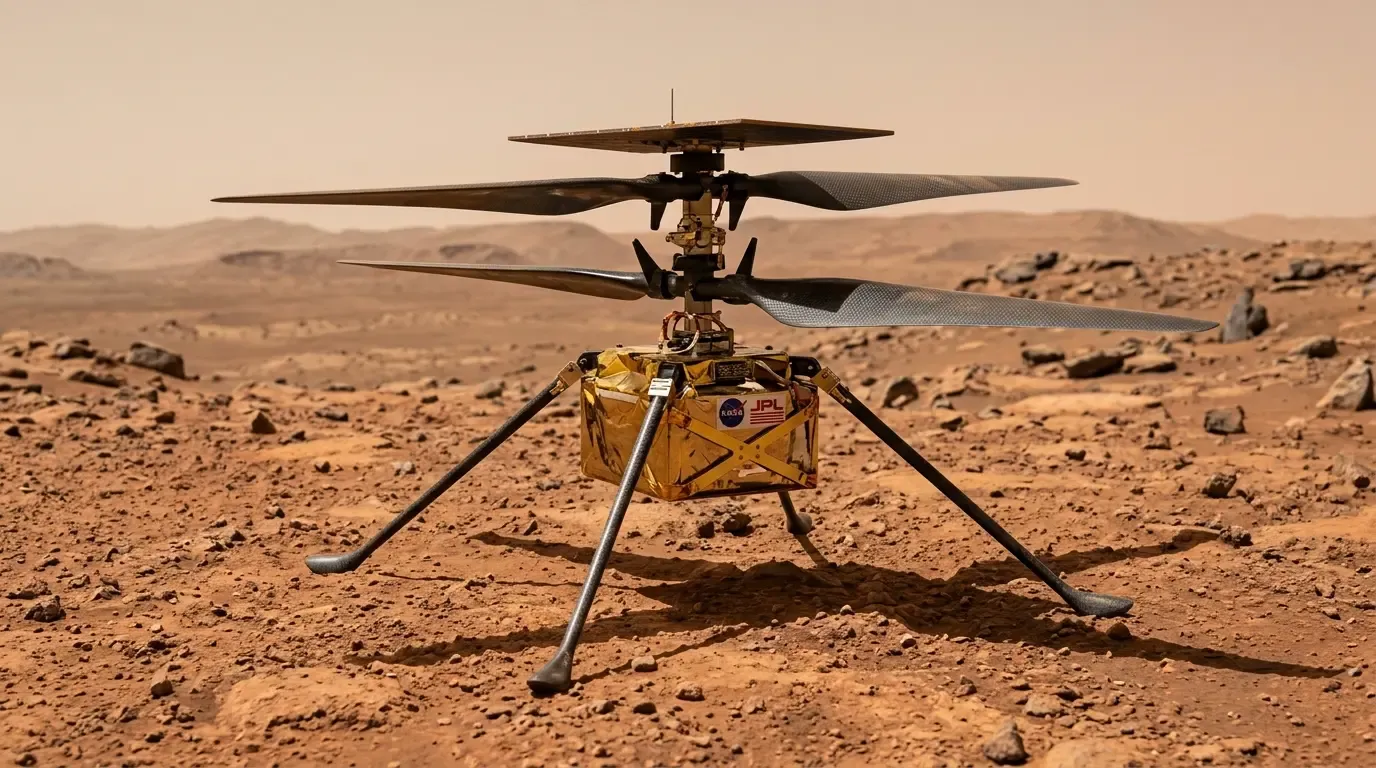
Tucked beneath Perseverance’s belly was a 1.8-kilogram helicopter named Ingenuity. On April 19, 2021, Ingenuity achieved powered, controlled flight on another planet for the first time in history — rising 3 meters above the Martian surface and hovering for 39 seconds in an atmosphere 99% thinner than Earth’s.
It was designed for five flights. Over three years of extended operations, Ingenuity completed 72 flights, covering nearly 18 kilometers and reaching altitudes up to 24 meters. It served as a scout for Perseverance, photographing terrain ahead of the rover’s path. The mission ended in January 2024 when the helicopter sustained damage to a rotor blade on landing, but its legacy transformed the concept of Mars exploration. Future Mars missions will almost certainly include aerial vehicles.
Perseverance has confirmed that Jezero Crater was indeed a lake with a river delta — the rock textures and sedimentary structures are unmistakable. It has collected dozens of rock cores that represent some of the most scientifically valuable material ever assembled for potential return to Earth.
In the igneous (volcanic) rocks of Jezero’s floor, SHERLOC has detected organic molecules associated with aromatic compounds. In sedimentary rocks of the delta, it has detected organics in higher concentrations. Neither detection constitutes evidence of life — organics form through many processes — but both indicate conditions were present for preservation.
The Mars Sample Return mission, planned as a joint NASA-ESA mission, aims to retrieve Perseverance’s cached samples and return them to Earth in the early 2030s. On Earth, the samples could be analyzed with instruments far more powerful than any we could send to Mars.
To understand the bigger picture of why we invest in Mars exploration, you may want to read why we explore space and the long-term vision of interplanetary colonization.
The rover era is far from over. China’s Zhurong rover, which landed on Utopia Planitia in May 2021, returned data on subsurface structure and surface composition. Future missions in development include ESA’s Rosalind Franklin rover, which carries a drill capable of penetrating 2 meters below the surface — deep enough to access material shielded from the sterilizing effects of radiation, where ancient life signatures are more likely to be preserved.
The ultimate question — whether life ever arose on Mars — may not be answered by rovers alone. It may require those Perseverance samples back on Earth, where the world’s best laboratories can search for microscopic fossils, isotopic signatures, and chemical patterns that no rover instrument, however sophisticated, can fully resolve.
And beyond robotic exploration lies the even more ambitious question: could humans one day go to Mars themselves? The scientific case for human Mars exploration is straightforward — humans can do in an hour what it takes a rover weeks to accomplish. The engineering, medical, and logistical challenges are formidable but not insurmountable.
While NASA focuses on the Artemis program to return humans to the Moon as a stepping stone, commercial spaceflight companies have set their sights directly on the Red Planet. Chief among them is SpaceX, founded by Elon Musk with the explicit goal of making humanity a multi-planetary species.
The cornerstone of Musk’s Mars colonization plan is the Starship — a fully reusable, super-heavy-lift launch vehicle. Unlike traditional rockets that are discarded after a single use, Starship is designed to fly, land, and fly again, dramatically lowering the cost of transporting mass to space. Musk envisions sending fleets of Starships to Mars, initially uncrewed to deliver cargo, habitats, and propellant-generating infrastructure, followed eventually by crewed missions.
SpaceX’s approach heavily relies on In-Situ Resource Utilization (ISRU) — specifically, harvesting Martian water ice and atmospheric carbon dioxide to synthesize liquid methane and oxygen propellant for the return journey. While the timeline for these missions remains highly ambitious and fluid, the scale and rapid testing of the Starship architecture have fundamentally shifted the conversation around human Mars exploration from a distant sci-fi dream to an active engineering endeavor.
As of 2026, five rovers have successfully landed on Mars: NASA's Sojourner (1997), Spirit and Opportunity (2004), Curiosity (2012), and Perseverance (2021). China's Zhurong also landed in 2021, bringing the total to six if you include non-NASA rovers. Several others have been lost during landing attempts.
No. Perseverance has detected organic molecules — carbon-based compounds — in ancient rocks at Jezero Crater, but these do not constitute evidence of life. They may have formed through geological processes. The search for biosignatures continues, and the cached rock samples may provide clearer answers when returned to Earth.
After completing 72 flights over nearly three years, Ingenuity sustained damage to a rotor blade during landing in January 2024. NASA declared the mission over, though the helicopter remains on the Martian surface. It greatly exceeded its planned five-flight demonstration mission.
Mars rovers communicate with Earth primarily through NASA's Deep Space Network (DSN) — a system of large radio dish antennas in California, Spain, and Australia. Data is often relayed via orbiting spacecraft like the Mars Reconnaissance Orbiter, which can handle higher data rates than direct rover-to-Earth links.
Radio signals travel at the speed of light, and the distance between Earth and Mars varies from about 54 million to 401 million kilometers depending on orbital positions. This means signal travel time ranges from roughly 3 to 22 minutes one-way, making real-time control impossible — rovers must operate autonomously for many tasks.