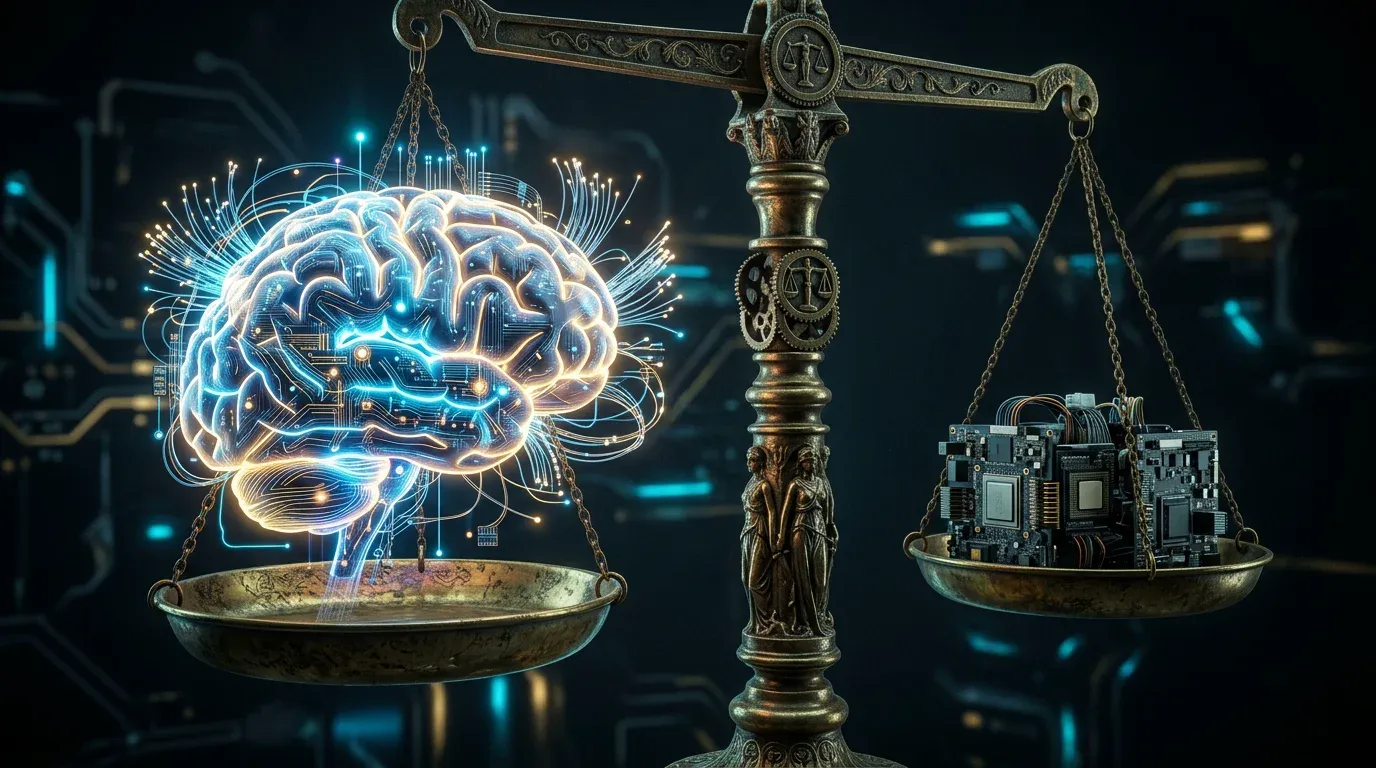
Understanding AI Hallucinations: Why Do Neural Networks Make Things Up?
An in-depth exploration of AI hallucinations, explaining why large language models and neural networks sometimes generate convincing but entirely fabricated information.
An in-depth exploration of AI hallucinations, explaining why large language models and neural networks sometimes generate convincing but entirely fabricated information.
Now a days, everyone is using AI chatbots and LLMs like ChatGPT and Gemini. We are doing almost everything using these tools, even for general search we are using these LLMs, instead of using Google search and reading an article that may be written by a genuine human being.
You must have also used it a lot and I bet you must also have came across a situation when the LLM gave you something wrong like a wrong date or place or some other information.
That’s called hallucination in the field of AI and we going to talk about it in detail here.
Despite their vast knowledge bases and incredible processing power, Large Language Models (LLMs) and other neural networks occasionally fabricate information. To a human user, this feels like the AI is “lying.” However, from the perspective of the machine, it is simply executing its core mathematical function: predicting the next most likely piece of data.
Let’s uncover why does hallucination happen in the LLM, through its internal statistical functions and the core of an LLM.
In human psychology, a hallucination involves perceiving something that is not present in reality. In artificial intelligence, a hallucination refers to a confident but factually incorrect or nonsensical output generated by an AI model.
It is not that the LLM wants to give us false information but it happens when it gets too much data or there may be may internal factors, since it works on statistics and math.
When a language model hallucinates, it is not attempting to deceive you. Instead, it is generating text that mathematically aligns with the patterns it learned during training, even if those patterns do not map correctly to objective reality. The model prioritizes grammatical fluency, structural coherence, and statistical likelihood over factual accuracy.
The primary danger of AI hallucinations lies in how convincing they are. Modern LLMs are trained to produce human-like, authoritative prose. When an AI invents a fictitious legal precedent or a nonexistent chemical compound, it does so using the exact same tone and vocabulary it uses when stating a verified fact. This makes hallucinations incredibly difficult to spot without rigorous fact-checking.
To understand why AI makes things up, we must first understand how it writes.
Models like GPT-4, Claude, and Gemini are essentially highly advanced autocomplete engines. They do not possess a database of facts that they query when asked a question. They do not “know” things in the way a human knows them, nor do they search the internet dynamically (unless explicitly integrated with a search tool).
Instead, they rely on probabilistic text generation.
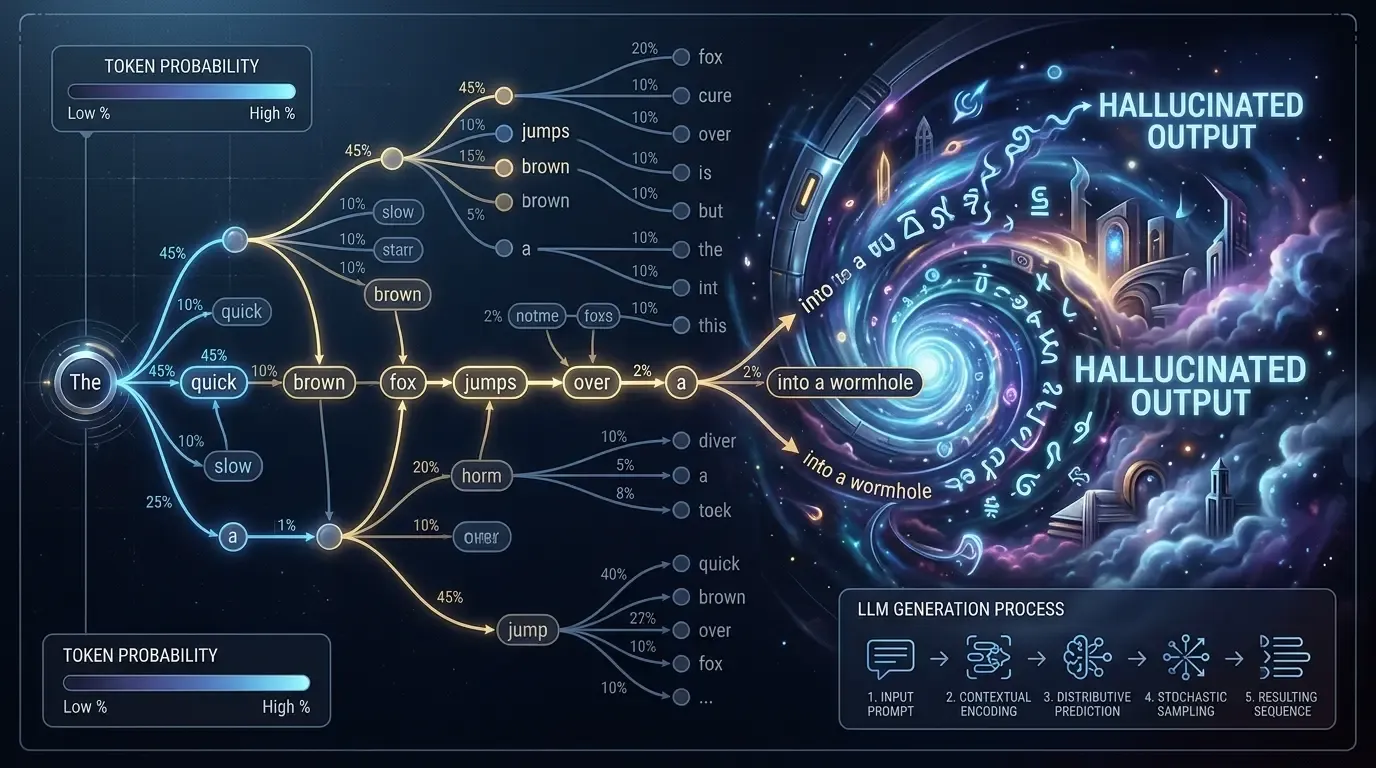
When you give a language model a prompt, it breaks your input down into “tokens” (chunks of text, which can be words, syllables, or individual characters). The model’s neural network, possessing billions or trillions of parameters, analyzes the context of these tokens and calculates a probability distribution for what the very next token should be.
At a fundamental level, the model computes a vector of scores for every possible word in its vocabulary. These raw scores (logits) are then converted into probabilities using a mathematical function known as the softmax function.
The formula for the softmax function for a given token is:
Where:
The AI selects a token from this distribution. Often, it picks the token with the highest probability, but a parameter known as temperature allows for randomness. A higher temperature flattens the probability curve, making the AI more likely to choose less probable, more “creative” words.
This brings us to our first core cause of hallucinations: the AI is designed to be statistically plausible, not strictly factual. If the statistical relationships between words in its training data strongly suggest that “Article 42 of the Galactic Treaty” follows the words you prompted, the AI will generate that phrase, regardless of whether the Galactic Treaty actually exists.
Hallucinations are not bugs in the code; they are inherent features of the current generative paradigm. Let’s break down the primary reasons neural networks fabricate information.
An AI model is only as good as the data it was trained on. LLMs are trained on massive scrapes of the internet—billions of pages containing Wikipedia articles, scientific journals, Reddit threads, fiction, opinion pieces, and outright falsehoods.

Because the training data contains fiction, contradictions, and errors, the model learns these patterns. If a model encounters a thousand instances of a popular misconception during training, the mathematical weights connecting those concepts become strong. When prompted, the AI will confidently output the misconception because its neural pathways dictate that it is the most statistically expected sequence of words.
Humans possess “grounding.” When you say the word “apple,” you understand it is a fruit, it is red or green, it has a physical shape, and you can eat it. You have physical and semantic grounding for the concept.
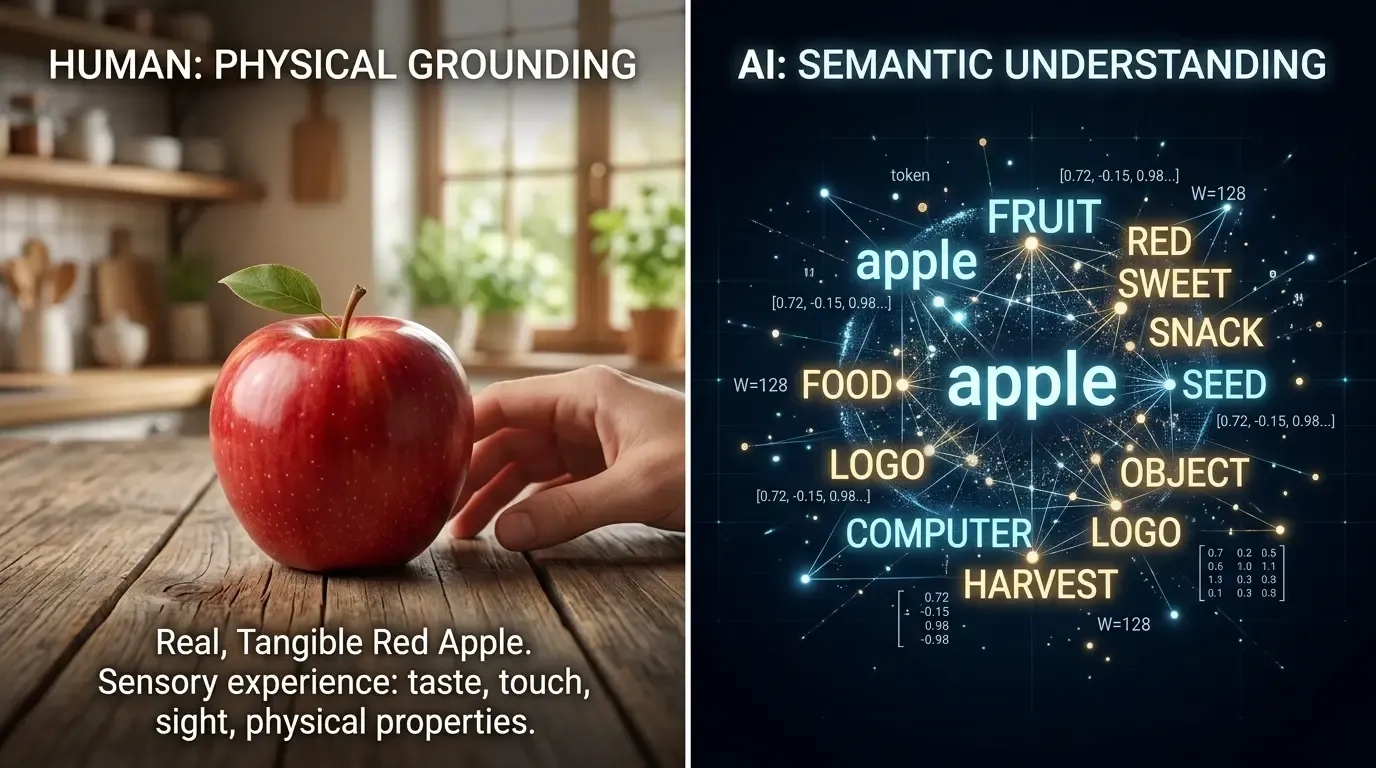
An LLM has no semantic grounding. To an AI, “apple” is simply an abstract token that frequently appears near tokens like “tree,” “red,” “fruit,” and “Steve Jobs.” Because it lacks an underlying mental model of reality, it cannot cross-reference its output against the physical world. It cannot independently reason, “Wait, that doesn’t make sense.” If the math points to a hallucinated fact, the AI generates it blindly.
LLMs do not store their training data like a traditional hard drive. Instead, they compress exabytes of text into mathematical representations (weights and biases). This compression process is incredibly efficient but inherently lossy.
Think of it like a blurry JPEG image. You can see the broad strokes of the picture, but if you zoom in too far, the pixels become distorted. Similarly, when you ask an LLM about a highly niche or obscure topic, it may not have retained the exact factual details during training. Instead, it relies on its general understanding of similar topics to “fill in the blanks,” generating a hallucination that sounds plausible but is factually incorrect.
Many modern AI models undergo a fine-tuning process called Reinforcement Learning from Human Feedback (RLHF). During this phase, human reviewers rate the AI’s responses, rewarding the model for being helpful, polite, and detailed.
While RLHF makes AI much more user-friendly, it introduces an unintended side effect: the AI becomes a people-pleaser. The model learns that humans rate long, confident, and definitive answers higher than short answers or admissions of ignorance. As a result, when the AI does not know the answer to a question, its internal reward mechanism often pushes it to invent a plausible-sounding answer rather than simply stating, “I don’t know.”
The consequences of AI hallucinations range from mildly amusing to legally and medically dangerous. Here are a few notable real-world examples:

These examples highlight a critical rule for interacting with generative AI: Always verify the output when factual accuracy is required.
Reducing hallucinations is currently one of the most active areas of research in artificial intelligence. While it is mathematically impossible to eliminate them entirely within the current autoregressive architecture, several techniques are proving highly effective at mitigating the issue.
Retrieval-Augmented Generation (RAG) is currently the most successful method for reducing hallucinations. Instead of relying solely on the AI’s internal, compressed memory, a RAG system connects the LLM to an external, verified database or a search engine.
When a user asks a question, the system first retrieves factual documents related to the query. It then feeds these documents into the AI’s context window and instructs the model: “Answer the user’s question using ONLY the information provided in these documents.”

By anchoring the AI’s generation to a specific, verified ground truth, RAG drastically reduces the model’s tendency to invent information.
RLHF: Reinforcement Learning from Human Feedback
AI developers are tweaking the RLHF process to reward models for honesty. By specifically training models to say “I don’t know” or “I cannot find information on that topic” when their confidence scores are low, developers can curb the AI’s tendency to guess or fabricate answers just to be helpful.
Some advanced AI systems are now built with a multi-agent architecture. In this setup, a “Generator” model creates the initial draft of the answer. Then, a separate “Critic” or “Fact-Checker” model evaluates the draft, cross-referencing it against trusted sources or checking it for logical inconsistencies before the final answer is presented to the user.
With the current architecture of Large Language Models, which rely on probabilistic token prediction, it is nearly impossible to guarantee zero hallucinations. However, through techniques like Retrieval-Augmented Generation (RAG) and better training pipelines, developers can reduce hallucinations to a very small, manageable percentage.
An LLM does not possess self-awareness or an understanding of "truth." It is simply generating the most statistically likely sequence of words. Because it was trained on human writing—which is typically assertive and confident—the model mimics that confident tone regardless of whether the underlying data is a verified fact or a mathematical fabrication.
Yes! In creative fields, hallucinations are often referred to as "creativity." When asking an AI to write a fictional story, brainstorm ideas, or generate poetry, its ability to connect disparate concepts and generate novel, unexpected pathways is highly valuable. The problem only arises when we expect factual retrieval from a creative engine.