How AI is Analyzing the Cosmos: Machine Learning in Modern Astronomy
Discover how machine learning and artificial intelligence are revolutionizing astronomy, from discovering exoplanets to classifying galaxies and predicting gravitational waves.
Discover how machine learning and artificial intelligence are revolutionizing astronomy, from discovering exoplanets to classifying galaxies and predicting gravitational waves.
For centuries, astronomy was an observational science constrained by the limits of human vision and the physical size of telescopic lenses. Early astronomers would spend long, cold nights at the eyepiece, hand-drawing their observations of planetary positions, lunar craters, and fuzzy nebulae. Today, the field of astronomy has undergone a radical transformation. With the advent of massive digital sky surveys, space-based observatories, and international collaborations, astronomy has transitioned from a discipline defined by a scarcity of data to one overwhelmed by an absolute deluge of it.
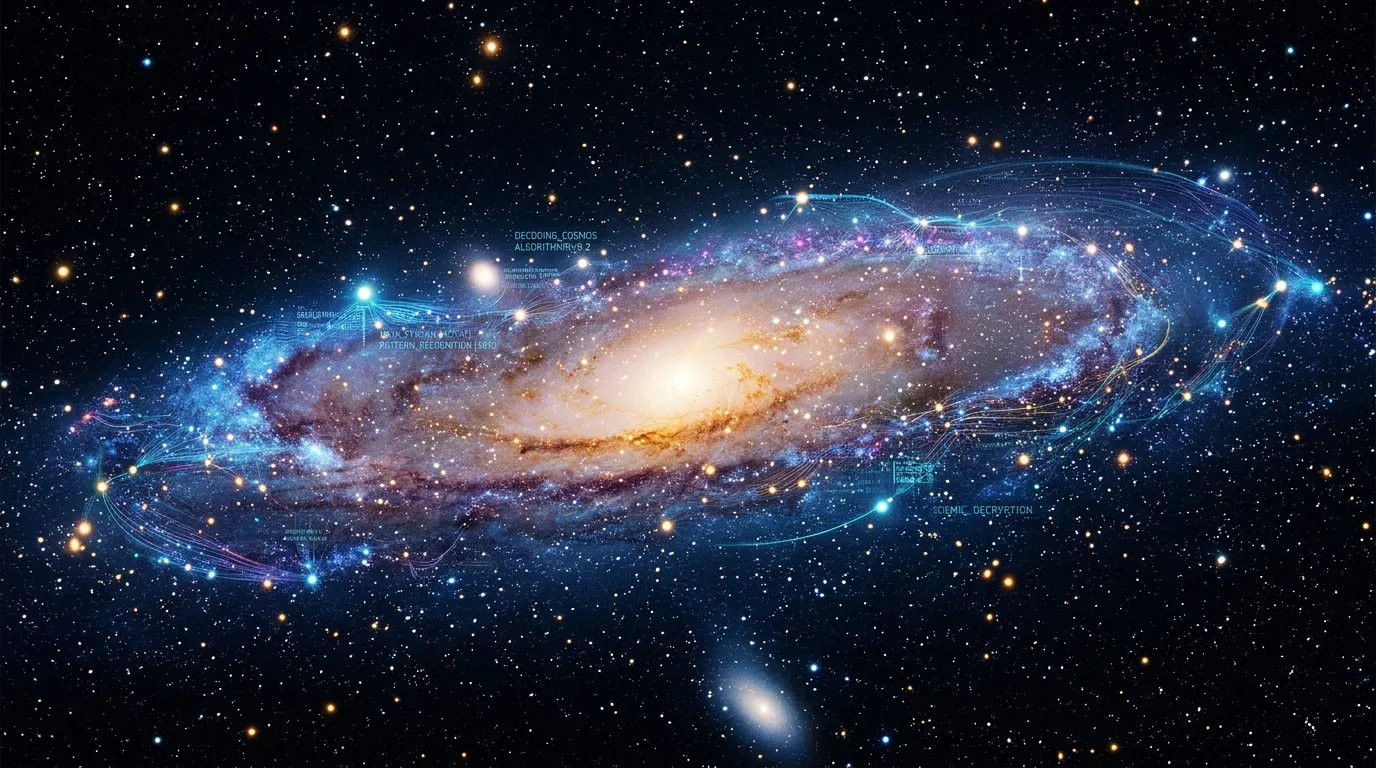
Modern telescopes are no longer just mirrors and lenses; they are colossal digital cameras and sophisticated sensors capturing terabytes of data every single night. Consider the Vera C. Rubin Observatory, currently under construction in Chile. Once fully operational, its Legacy Survey of Space and Time (LSST) will capture the entire visible sky every few nights, generating an astounding 20 terabytes of raw data daily. Similarly, the Square Kilometre Array (SKA), an intercontinental radio telescope project, is expected to produce data at a rate exceeding the global internet traffic of the early 2020s. The sheer volume, velocity, and variety of this information have pushed traditional data analysis methods past their breaking point.
Artificial Intelligence (AI) and Machine Learning (ML) are powerful computational tools are perfectly suited to tackle the “Big Data” problem in astronomy. Instead of relying solely on human researchers to manually sift through endless spreadsheets or visually inspect millions of images, modern astronomers are training sophisticated algorithms to do the heavy lifting. By employing neural networks, deep learning architectures, and advanced statistical models, AI can process massive datasets at blistering speeds, uncover hidden patterns, and make complex predictions with unprecedented accuracy.
Now, let’s start to dive deeper in the various sub-fields of astronomy where ai is being used at scale and giving remarkable progress.
The transition from classical observational astronomy to data-driven astrophysics represents a paradigm shift in how we understand the universe. Historically, the scientific method in astronomy involved forming a hypothesis, making targeted observations, and manually analyzing the resulting data. This hypothesis-driven approach worked well when datasets were manageable. However, when you are dealing with catalogs containing billions of stars and galaxies, this manual approach becomes mathematically and practically impossible.
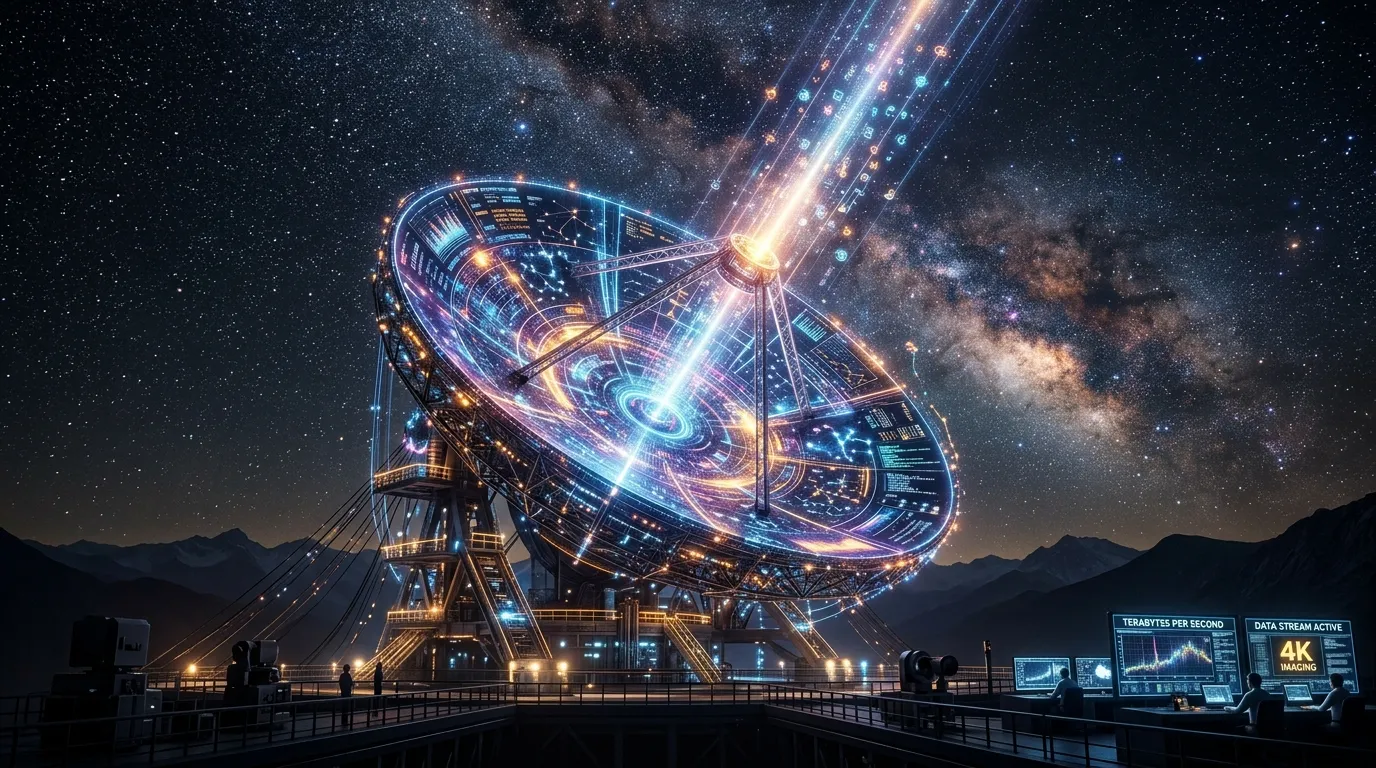
Machine learning introduces a data-driven approach: allowing the algorithms to find the models and relationships inherent within the data itself. In supervised learning, algorithms are trained on meticulously labeled datasets (e.g., thousands of images of spiral galaxies labeled by human experts). Once trained, the AI can rapidly classify millions of new, unseen galaxies with high accuracy. Unsupervised learning, on the other hand, allows algorithms to cluster data without predefined labels, potentially leading to the discovery of entirely new classes of astronomical objects that humans didn’t even know to look for.
Furthermore, the introduction of Deep Learning—a subset of ML utilizing artificial neural networks with multiple layers—has been particularly transformative. Convolutional Neural Networks (CNNs), which excel at image recognition, are now standard tools in the astrophysicist’s toolkit. They are used for tasks ranging from identifying the faint, wispy structures of distant nebulae to removing instrument noise from raw telescope feeds. This shift is not just about speed; it is about extending human capability. AI can detect subtle correlations in high-dimensional space that would be invisible to the human eye, thereby opening up entirely new avenues of cosmological research.
One of the most exciting applications of AI in astronomy is in the search for exoplanets—planets orbiting stars outside our solar system. The primary method for discovering these distant worlds is the transit method. As an exoplanet passes (or transits) in front of its host star from our line of sight, it blocks a tiny fraction of the star’s light. This causes a characteristic, temporary dip in the star’s brightness, known as a light curve.
The mathematical representation of the fractional drop in stellar flux, or transit depth (), can be approximated by the ratio of the planet’s area to the star’s area:
where is the radius of the planet and is the radius of the star. While the physics is straightforward, detecting this minuscule signal—often a drop in brightness of less than 1%—amidst the inherent “noise” of stellar flares, sunspots, and instrument jitter is incredibly challenging.
Missions like NASA’s Kepler Space Telescope and the Transiting Exoplanet Survey Satellite (TESS) have monitored millions of stars, generating vast numbers of light curves. Initially, astronomers relied on traditional signal-processing algorithms combined with human vetting to identify true planet candidates. However, this process was slow and prone to human error, particularly when dealing with small, Earth-sized planets whose signals are deeply buried in the noise.
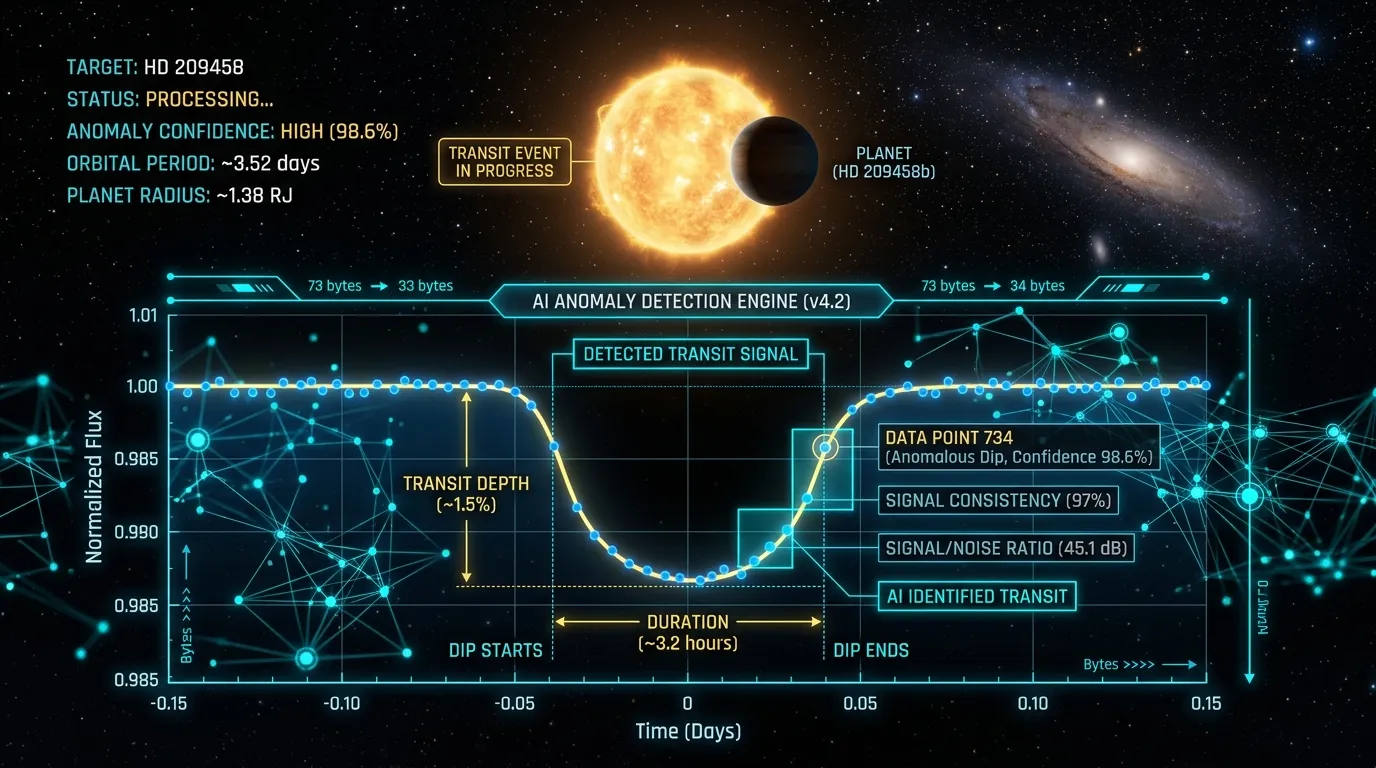
To overcome these challenges, astronomers have turned to deep learning. Researchers have developed CNNs specifically designed to analyze the one-dimensional time-series data of stellar light curves. By training these models on known exoplanet transits (both real and simulated) as well as known false positives (like eclipsing binary stars), the AI learns to distinguish the subtle signature of a true planet.
A landmark moment occurred in 2017 when researchers at Google AI collaborated with astronomers to apply a neural network to archived Kepler data. The AI successfully identified a previously missed eighth planet orbiting the star Kepler-90, making it the first known planetary system with as many planets as our own. Today, machine learning pipelines are integrated directly into the data processing streams of major missions. AI algorithms can triage millions of light curves in a matter of hours, flagging the most promising candidates for follow-up observation. Furthermore, ML is being used to characterize exoplanet atmospheres by analyzing transmission spectra, helping us determine their chemical composition and potential habitability.
Our universe is teeming with galaxies of diverse shapes and sizes—spirals, ellipticals, lenticulars, and irregulars. The morphology (shape) of a galaxy provides critical clues about its formation history, age, and dynamic evolution. Traditionally, galaxy classification was a painstaking manual task. In the early days of the Sloan Digital Sky Survey (SDSS), astronomers realized they had far too many galaxy images to classify themselves. This led to the creation of Galaxy Zoo, a citizen science project where hundreds of thousands of volunteers helped classify millions of galaxies by eye.
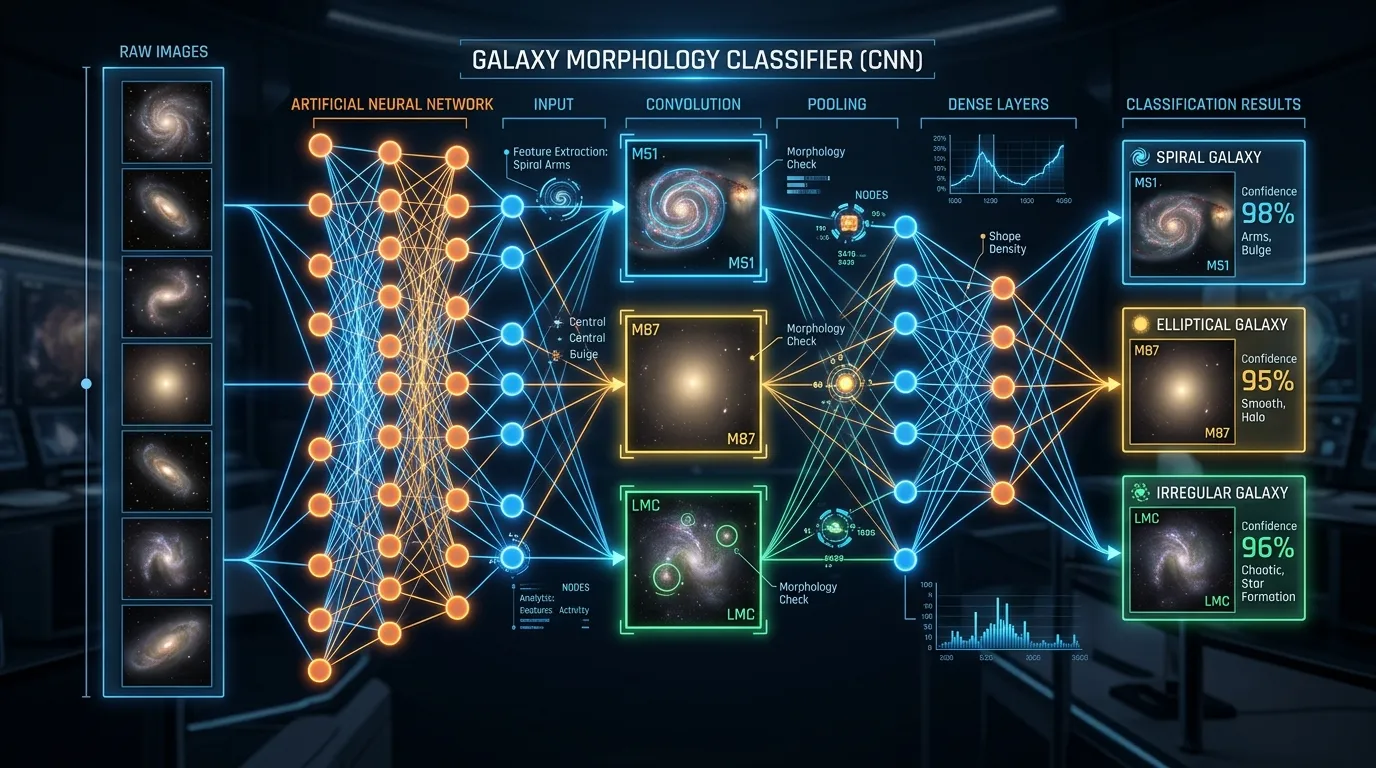
While incredibly successful, even citizen science cannot scale to the multi-billion galaxy catalogs expected from upcoming surveys like LSST. Here, Artificial Intelligence steps in. Using the robust labeled datasets generated by Galaxy Zoo volunteers, researchers have trained powerful CNNs to perform morphological classification automatically.
These AI models break down galaxy images into hierarchical features. The initial layers of the network might detect basic edges and bright spots, while deeper layers recognize complex structures like spiral arms, galactic bars, and dust lanes. Modern AI classifiers can achieve accuracies exceeding 90%, matching or even surpassing human performance. More importantly, they can process millions of images in a fraction of the time it would take a human crowd, ensuring that future surveys will not be bottlenecked by data analysis.
Beyond static galaxies, AI is revolutionizing the study of the transient universe—astronomical events that change over short timescales, such as supernovae (exploding stars), tidal disruption events (black holes tearing apart stars), and variable stars. Detecting these fleeting events requires repeatedly imaging the same patches of sky and looking for differences.
When a new transient is detected, astronomers must quickly determine its nature to decide if it warrants rapid follow-up with other telescopes before it fades away. Machine learning algorithms, particularly Random Forests and Recurrent Neural Networks (RNNs), are highly adept at real-time transient classification. By analyzing the object’s light curve (how its brightness changes over time) and its host galaxy context, the AI can predict whether a newly discovered point of light is a mundane variable star or a rare, scientifically priceless type of supernova, triggering automated alerts to observatories worldwide.
One of the greatest triumphs of modern physics was the first direct detection of gravitational waves in 2015 by the LIGO (Laser Interferometer Gravitational-Wave Observatory) collaboration. Predicted a century earlier by Albert Einstein’s General Theory of Relativity, gravitational waves are ripples in the fabric of spacetime caused by some of the most violent and energetic processes in the universe, such as the collision of two black holes or neutron stars.
Detecting these ripples is a monumental engineering challenge. The gravitational wave signals that reach Earth are incredibly faint, stretching and squeezing spacetime by a fraction of the diameter of a proton over a distance of several kilometers. The LIGO and Virgo detectors must separate these minute cosmic signals from an overwhelming background of terrestrial noise, including seismic activity, thermal fluctuations, and even microscopic laser variations.
Traditional gravitational wave detection relies on a technique called matched filtering, where the incoming data stream is constantly compared against a vast bank of theoretical templates representing possible gravitational wave waveforms. While effective, this process is computationally extremely expensive. As detectors become more sensitive and observe a larger volume of space, the rate of detections is increasing rapidly, threatening to overwhelm current computational resources.
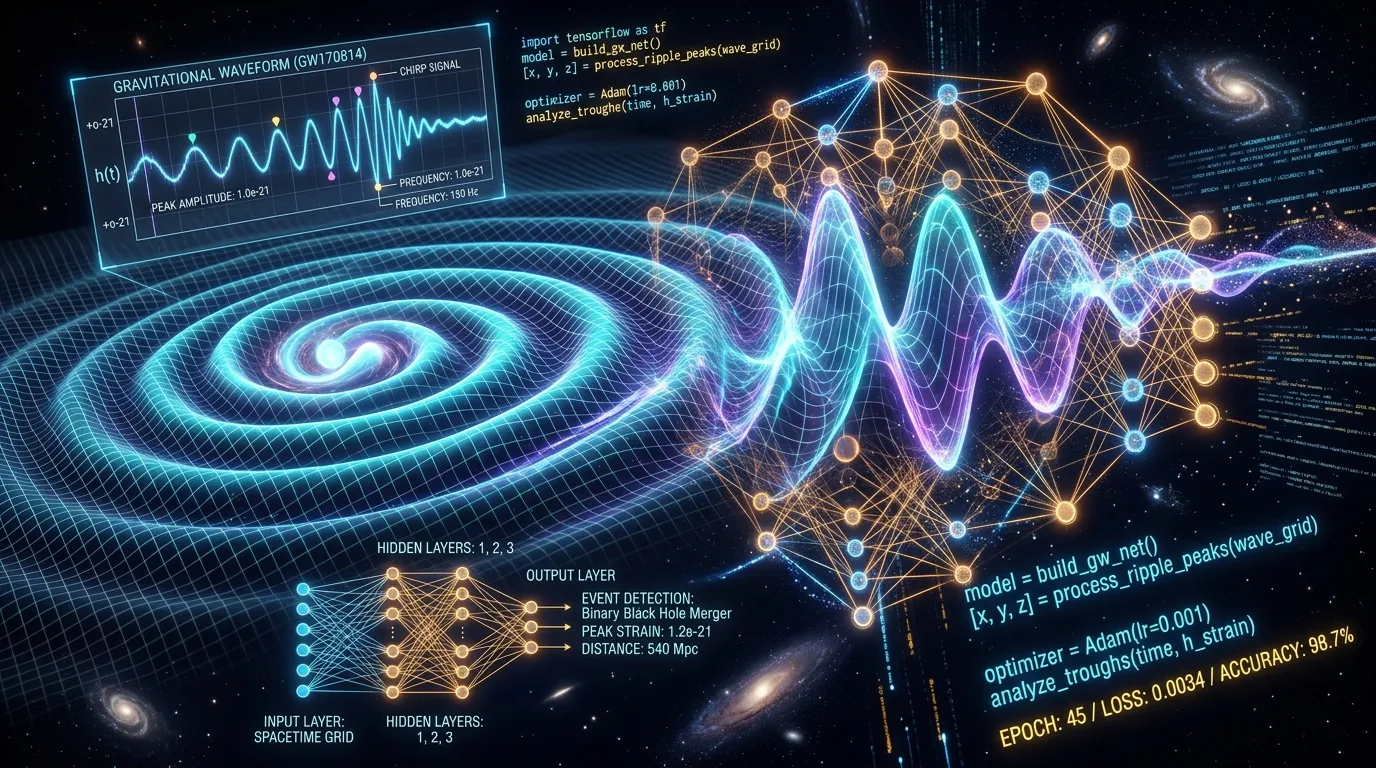
AI is providing a powerful alternative. Researchers are training deep convolutional neural networks to directly process the raw time-series strain data from the interferometers. These AI models learn to recognize the characteristic “chirp” signature of a black hole merger amidst the noise without needing to cross-correlate against thousands of templates.
Recent studies have shown that AI can detect gravitational wave signals orders of magnitude faster than traditional matched filtering, effectively operating in real-time. This speed is crucial for multi-messenger astronomy. If a neutron star merger is detected, an ultra-fast AI alert can be sent to traditional telescopes, allowing them to point at the source and capture the accompanying flash of electromagnetic radiation (light) before it fades. Furthermore, machine learning is being used to quickly estimate the parameters of the binary system (such as the masses and spins of the merging objects) directly from the signal, streamlining the entire astrophysical analysis pipeline.
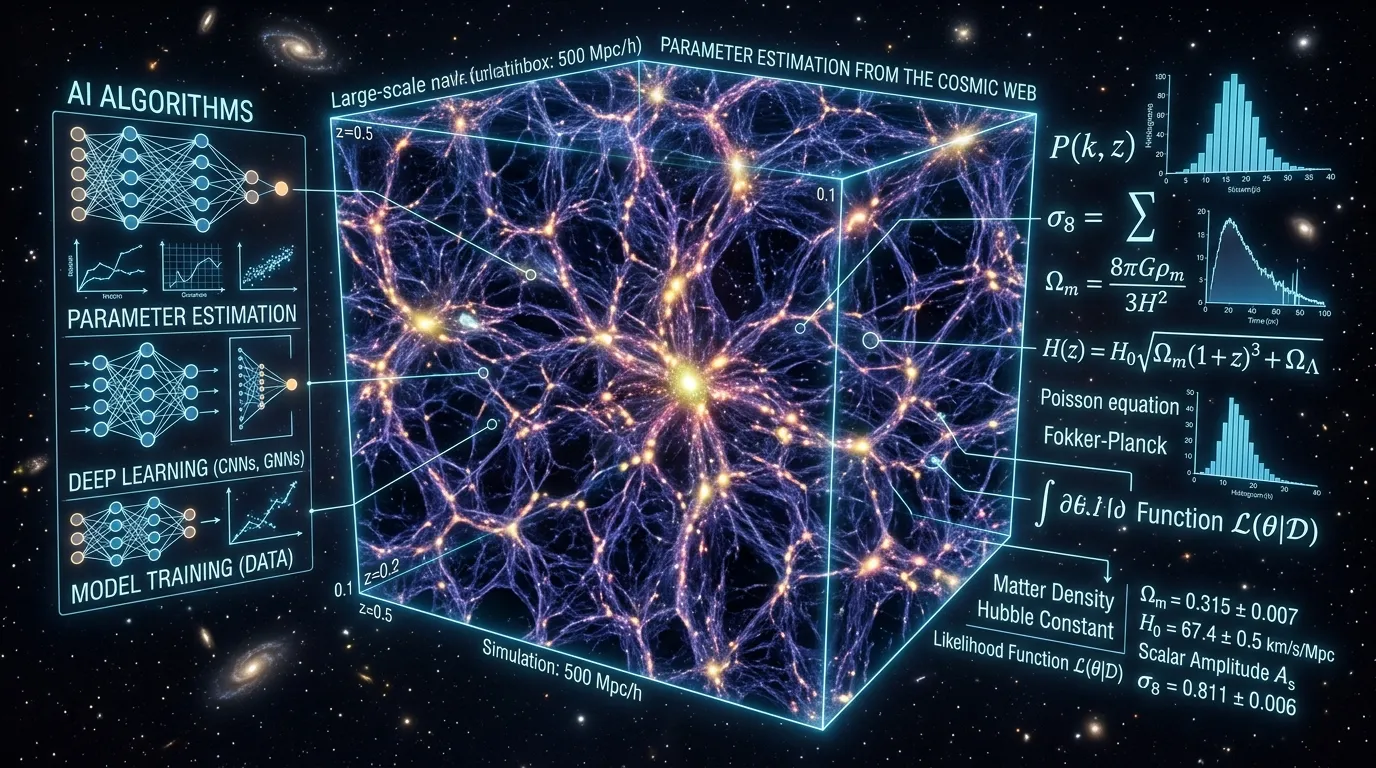
The ultimate goal of cosmology is to understand the origin, evolution, and eventual fate of the entire universe. To do this, cosmologists construct theoretical models governed by a set of fundamental numbers known as cosmological parameters. These parameters define the very fabric of reality, including the total amount of normal matter, the density of mysterious dark matter (), the accelerating force of dark energy (), and the amplitude of primordial density fluctuations ().
Determining these values requires comparing observations of the universe—such as the distribution of galaxies across vast cosmic web filaments or the temperature fluctuations in the Cosmic Microwave Background (CMB)—against complex theoretical predictions. Generating these theoretical predictions traditionally requires running massive cosmological simulations on supercomputers. A single high-resolution N-body simulation, tracking the gravitational interactions of billions of dark matter particles over cosmic time, can take millions of CPU hours to complete.
Because cosmologists need to test thousands of different parameter combinations to find the one that best matches observations, running full simulations for every possibility is computationally prohibitive. This is where AI “emulators” come into play.
Machine learning models, particularly neural networks, can be trained on a limited set of full-blown cosmological simulations. Once trained, the neural network acts as a highly accurate, ultra-fast emulator. You input a set of cosmological parameters (e.g., a universe with slightly more dark matter and slightly less dark energy), and the AI instantly outputs the predicted observable statistics, such as the matter power spectrum or the galaxy correlation function.
These AI emulators bypass the need to solve complex differential equations for every iteration, accelerating cosmological parameter inference by factors of thousands or even millions. This allows researchers to perform rigorous statistical analyses, like Markov Chain Monte Carlo (MCMC) sampling, to tightly constrain the values of , , and the Hubble constant (). As next-generation surveys like Euclid and the Nancy Grace Roman Space Telescope map the large-scale structure of the universe with unprecedented precision, AI emulators will be essential for translating that observational data into fundamental physical knowledge.
As we look to the future, the role of artificial intelligence in astronomy will only deepen. We are moving toward an era of fully automated, intelligent observatories. In this vision, an AI system not only analyzes the data but also controls the telescope itself. The AI could dynamically schedule observations, prioritize targets based on real-time weather conditions and scientific value, and instantly redirect the telescope to observe a sudden transient event (like a gamma-ray burst) detected by another instrument, all without human intervention.
Furthermore, Large Language Models (LLMs) and advanced natural language processing are beginning to assist astronomers in navigating the vast ocean of scientific literature. AI assistants can synthesize research papers, extract relevant datasets, and even help write code for data analysis pipelines, serving as indispensable co-pilots for researchers.
However, the increasing reliance on AI also brings significant challenges. The primary concern is the “black box” nature of deep learning. While a neural network might classify a galaxy or predict a cosmological parameter with high accuracy, it is often difficult to understand how it arrived at that conclusion. In a rigorous science like astrophysics, interpretability is crucial. If an AI discovers a new type of stellar explosion, physicists need to understand the physical mechanisms driving it, not just accept the output of an algorithm.
Therefore, the development of Explainable AI (XAI) is a major frontier in astronomical machine learning. Researchers are developing techniques to peek inside the black box, attempting to map the AI’s learned features back to underlying physical properties. By ensuring that our algorithms are transparent and interpretable, we can build trust in AI-driven discoveries and ensure that machine learning serves as a tool for generating true physical insight.
Currently, AI is primarily used to find patterns in data based on known physics. However, the field of 'AI Physicists'—where algorithms are designed to infer underlying equations from observational data—is an active area of research, though we are not yet at the point where AI is deriving new fundamental laws of nature.
Absolutely. While AI is incredibly fast at processing data and finding correlations, it lacks physical intuition. It cannot formulate a hypothesis or ask 'why' a pattern exists. The human astronomer is essential for designing the AI's architecture, selecting the training data, and interpreting the physical meaning behind the AI's results.
The upcoming Vera C. Rubin Observatory, for example, is expected to generate about 20 terabytes of data every single night. Over its ten-year survey, it will compile a database exceeding 15 petabytes. This astronomical volume is the primary driver for adopting machine learning.