The Water Cycle Explained
A complete guide to the water cycle — how water moves through evaporation, condensation, precipitation, and groundwater, and why it matters for life on Earth.
A complete guide to the water cycle — how water moves through evaporation, condensation, precipitation, and groundwater, and why it matters for life on Earth.
Water is the only naturally occurring compound that exists as a solid, liquid, and gas within the normal temperature ranges on Earth’s surface. Unlike many natural resources, water is never truly consumed. The water you drink today might have fallen as rain on ancient Rome, carved a Jurassic riverbed, or drifted in a prehistoric glacier. Water constantly moves—through the atmosphere, across land, and underground—in a continuous planetary recycling loop called the water cycle (or hydrologic cycle).
This system drives climatology, hydrology, agriculture, and ecology. Today’s major environmental challenges—drought, flooding, shrinking glaciers, groundwater depletion—stem from disruptions within this cycle. Forests, oceans, clouds, rivers, and underground aquifers aren’t isolated entities; they are active, deeply connected participants in a single integrated loop.
The water cycle begins — or rather, continues, since it has no true starting point — with evaporation. When solar energy heats a water surface, molecules at the surface gain enough kinetic energy to break free of the liquid and escape into the atmosphere as water vapour, an invisible gas. The ocean is the dominant source: roughly 86% of all atmospheric water vapour comes from ocean evaporation. Lakes, rivers, reservoirs, puddles, and even wet soil all contribute to the rest.
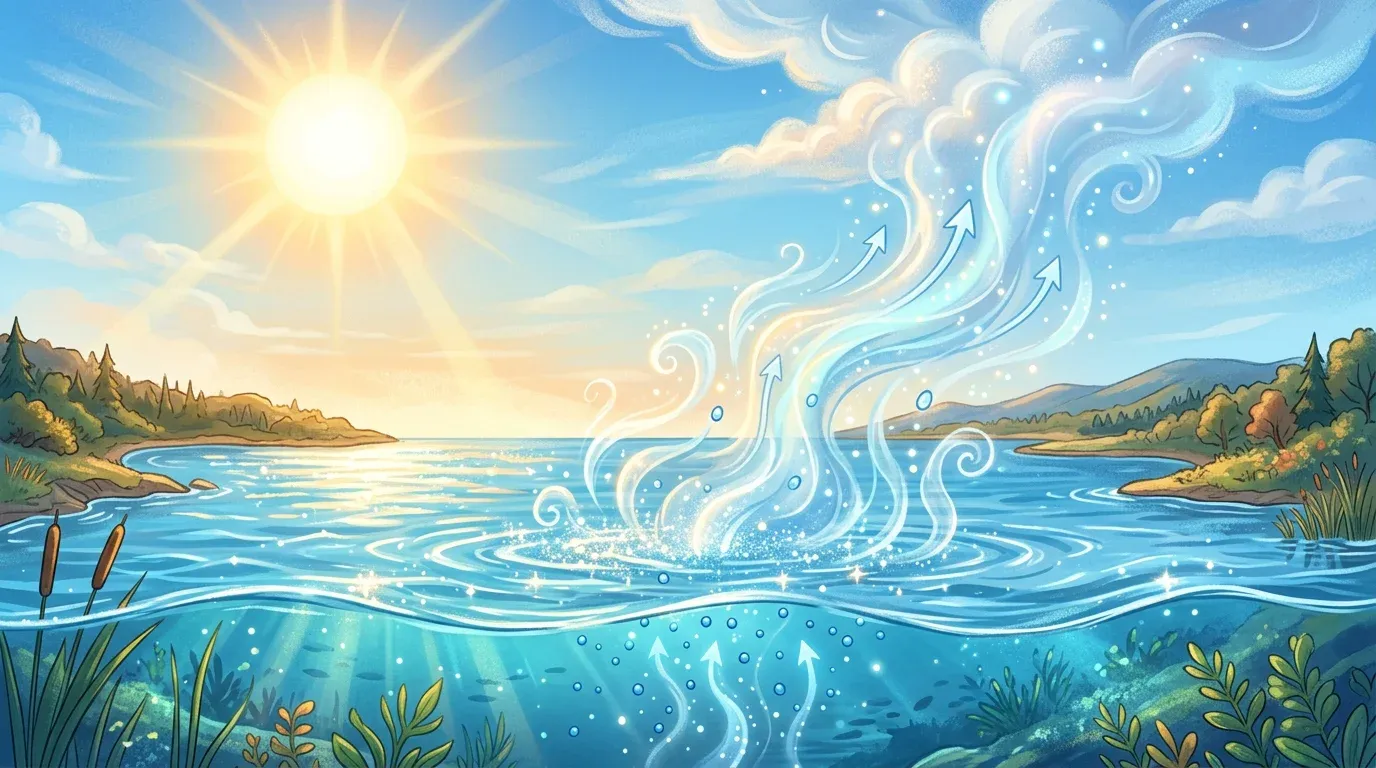
The rate of evaporation depends on several factors: temperature, wind, humidity, and surface area. Warmer water evaporates faster. Wind removes water vapour from above the surface, maintaining the concentration gradient. Meanwhile, drier air can absorb more vapour.
The tropics, with their intense solar heating, are major evaporation zones. Even the arid Sahara Desert evaporates enormous quantities of water whenever it does rain. In fact, almost all of that rain returns to the atmosphere within hours.
Globally, the oceans lose an estimated 425,000 km³ of water to evaporation every year — an almost incomprehensible volume. This energy-rich water vapour is the fuel of storms, the source of rainfall, and a key regulator of Earth’s temperature.
Plants are not passive bystanders in the water cycle. Through a process called transpiration, they actively pump enormous quantities of water vapour into the atmosphere. A single large tree can transpire hundreds of litres of water per day. Forests, collectively, are among the largest contributors of atmospheric moisture over land.
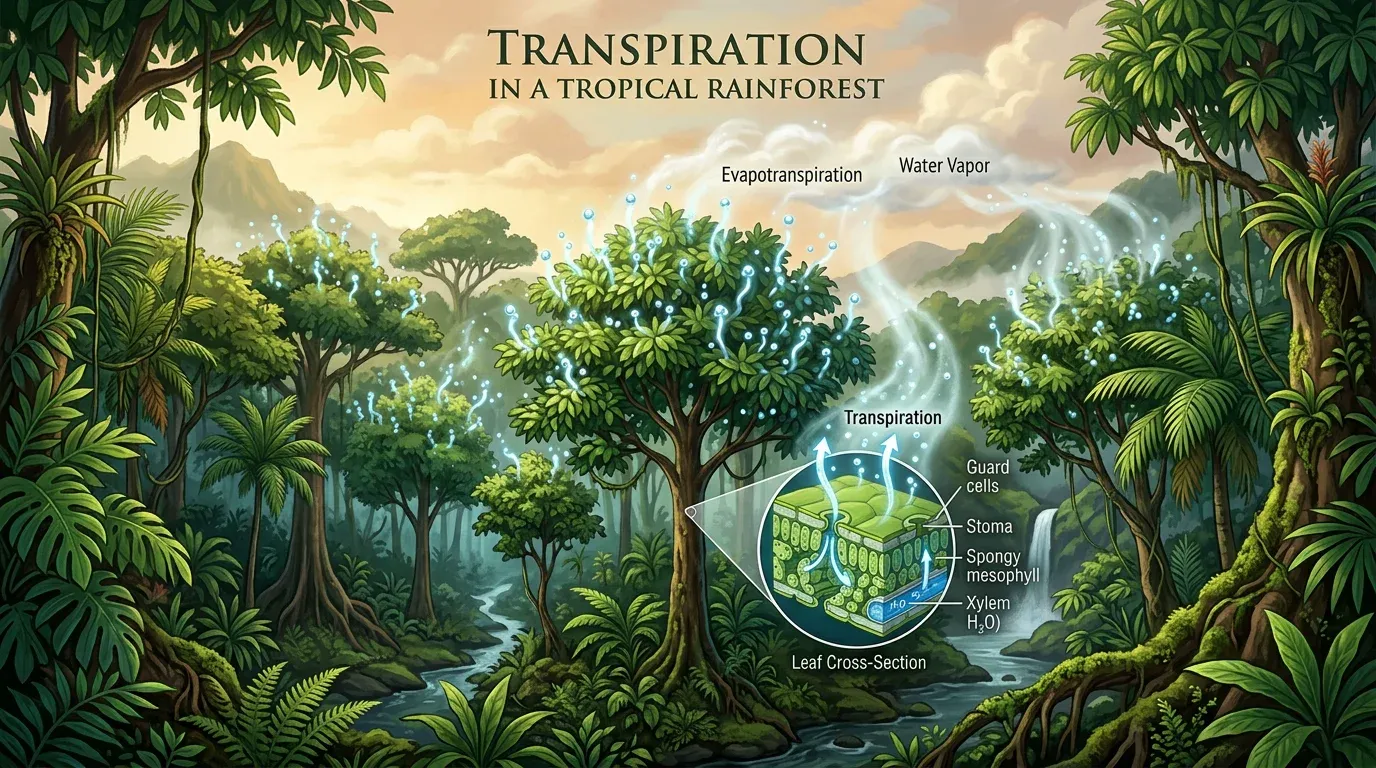
Water is drawn up from the soil through a plant’s roots, transported up its vascular system (the xylem), and released as vapour through tiny pores in the leaves called stomata. This process is partly driven by the need to cool leaves in sunlight and partly by the physical process of evaporation creating a suction that pulls water upward from the roots.
In practice, evaporation from soil and transpiration from plants are so intertwined that hydrologists often combine them into a single term: evapotranspiration. Over densely forested regions — the Amazon basin, the Congo rainforest, Southeast Asian forests — evapotranspiration is so intense that these regions generate their own rainfall. The Amazon is often described as a “flying river,” pumping as much water vapour into the atmosphere as the Amazon River carries to the sea.
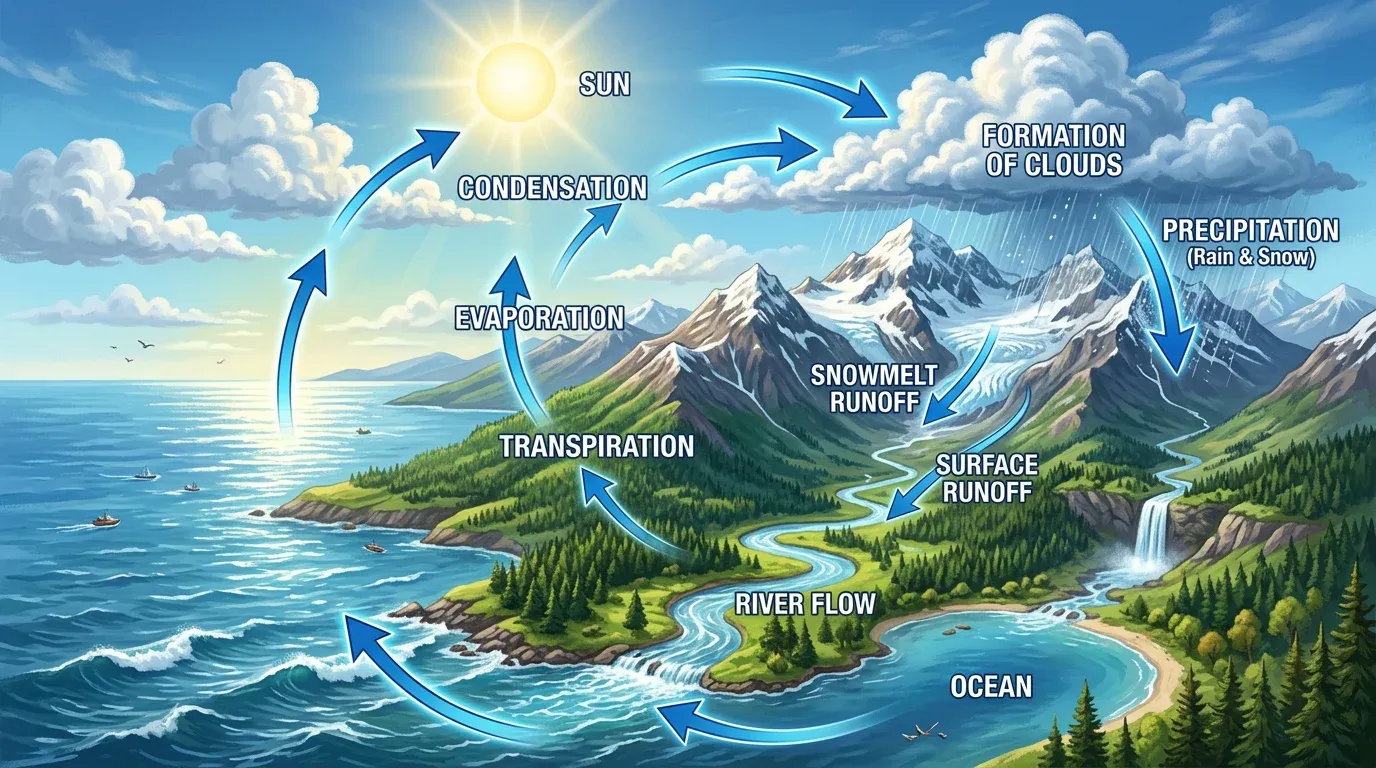
Thus, deforestation carries serious consequences for regional and global water cycles. Forests are really important part of the entire water cycle. There’s a term known as evapotranspiration, it refers to the complete process of water movement through evaporation of water from all kinds of water bodies on Earth as well as the transpiration from the leaves of plant and trees.
Once water vapour rises into the atmosphere, it encounters cooler temperatures at higher altitudes. Cool air holds less water vapour than warm air — a property described by the concept of relative humidity. When air cools enough to reach its dew point (the temperature at which it becomes saturated), water vapour condenses around tiny particles of dust, sea salt, pollen, or combustion products called condensation nuclei. These droplets, individually microscopic, collectively form clouds.
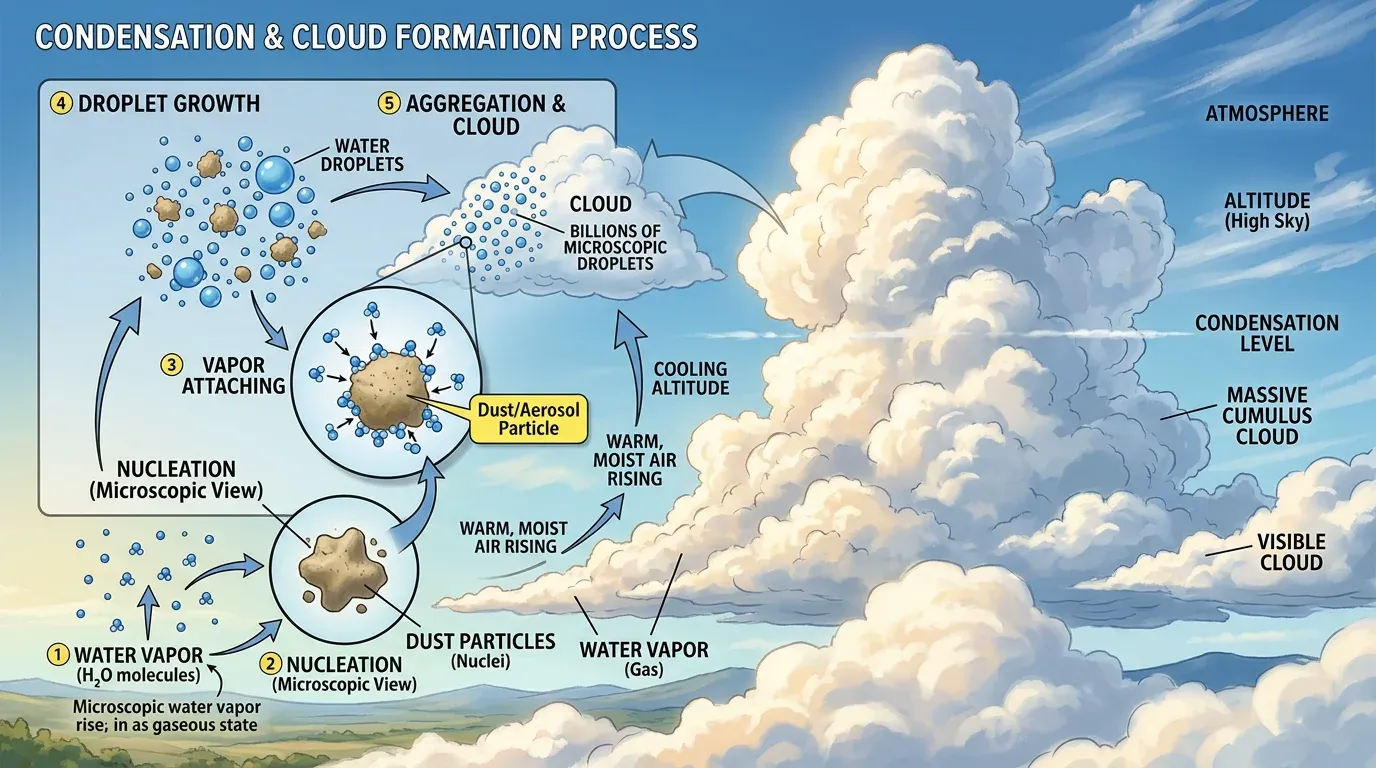
Clouds are visible concentrations of liquid water droplets or ice crystals suspended in the atmosphere. A single cumulus cloud can contain hundreds of thousands of tonnes of water — yet the droplets are so tiny and light that they remain suspended in the air for hours or days. The type of cloud that forms depends on the altitude, temperature, and how rapidly the air is rising. Towering cumulonimbus clouds develop when air rises rapidly, as in thunderstorms. Stratus clouds form in layers of stable, slowly cooling air.
[!NOTE] A typical thunderstorm cloud can contain more than 500,000 tonnes of water — yet the water droplets are so fine that the cloud still floats. Each droplet is only about 20 micrometres across, roughly one-fifth the width of a human hair.
When cloud droplets grow heavy enough, they fall as precipitation — rain, snow, sleet, or hail, depending on temperature conditions in the atmosphere. For a droplet to fall as rain, it typically needs to grow to about 2 millimetres in diameter through collision and coalescence with other droplets. In cold clouds, ice crystals grow preferentially (a phenomenon called the Bergeron process) and eventually fall, melting into rain if the air below is warm enough.
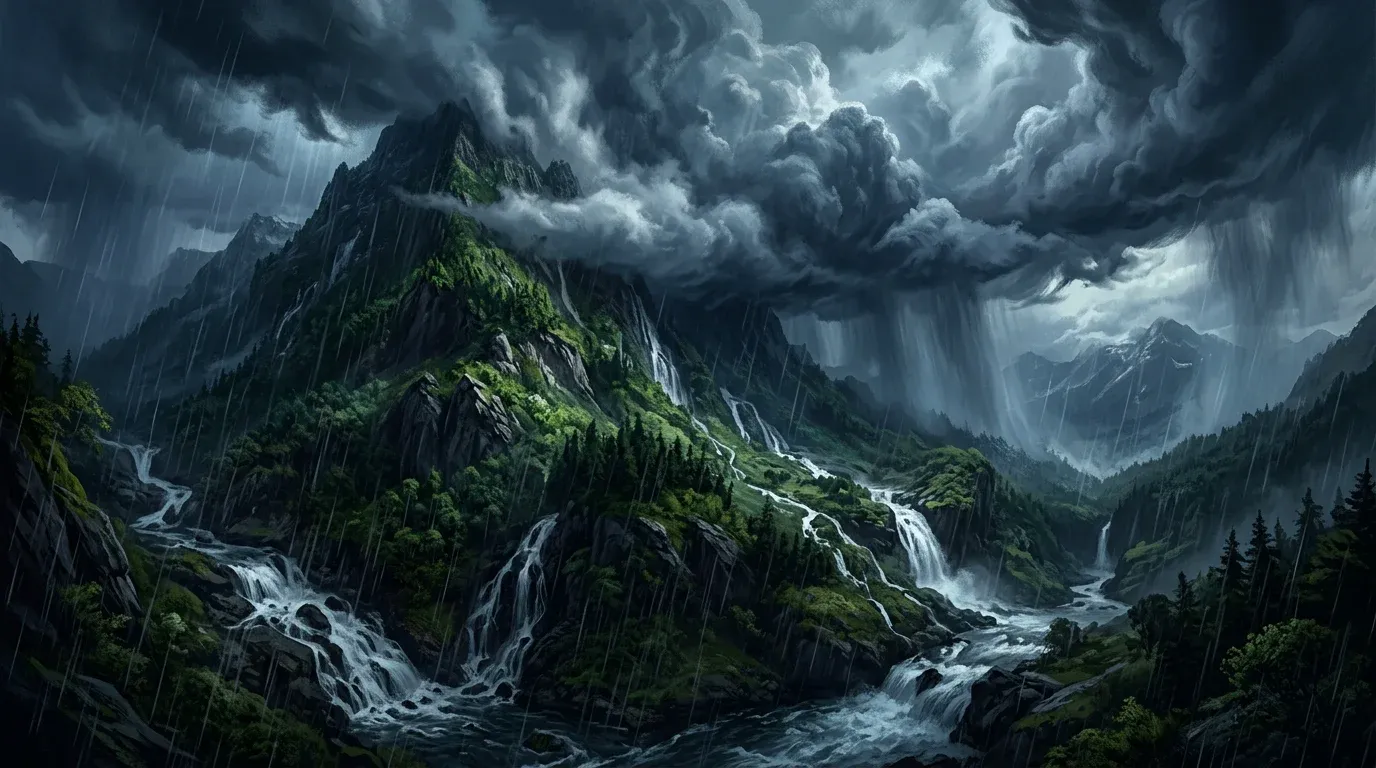
Precipitation is wildly uneven across the globe. The village of Mawsynram in northeastern India receives an average of around 11,870 mm of rainfall per year — making it one of the wettest places on Earth. The Atacama Desert in Chile, by contrast, receives almost none — some weather stations there have never recorded rainfall. This unevenness is driven by geography (mountains force moist air upward, cooling it and triggering precipitation on the windward side while leaving the leeward side dry — the rain shadow effect), latitude, ocean currents, and prevailing winds.
Seasons also dramatically affect precipitation patterns. The Asian monsoon — driven by the temperature contrast between the heating Asian landmass and the cooler Indian Ocean — delivers the majority of South Asia’s annual rainfall in just a few months. The change in season has its own reasons behind it which is related to the movement and tilt of our planet.
When precipitation falls on land, several things can happen. If the rain is intense or the ground is saturated, it flows across the surface as runoff, eventually collecting into streams and rivers. Rivers carry this water toward the ocean — completing the ocean-to-atmosphere-to-land-to-ocean loop.
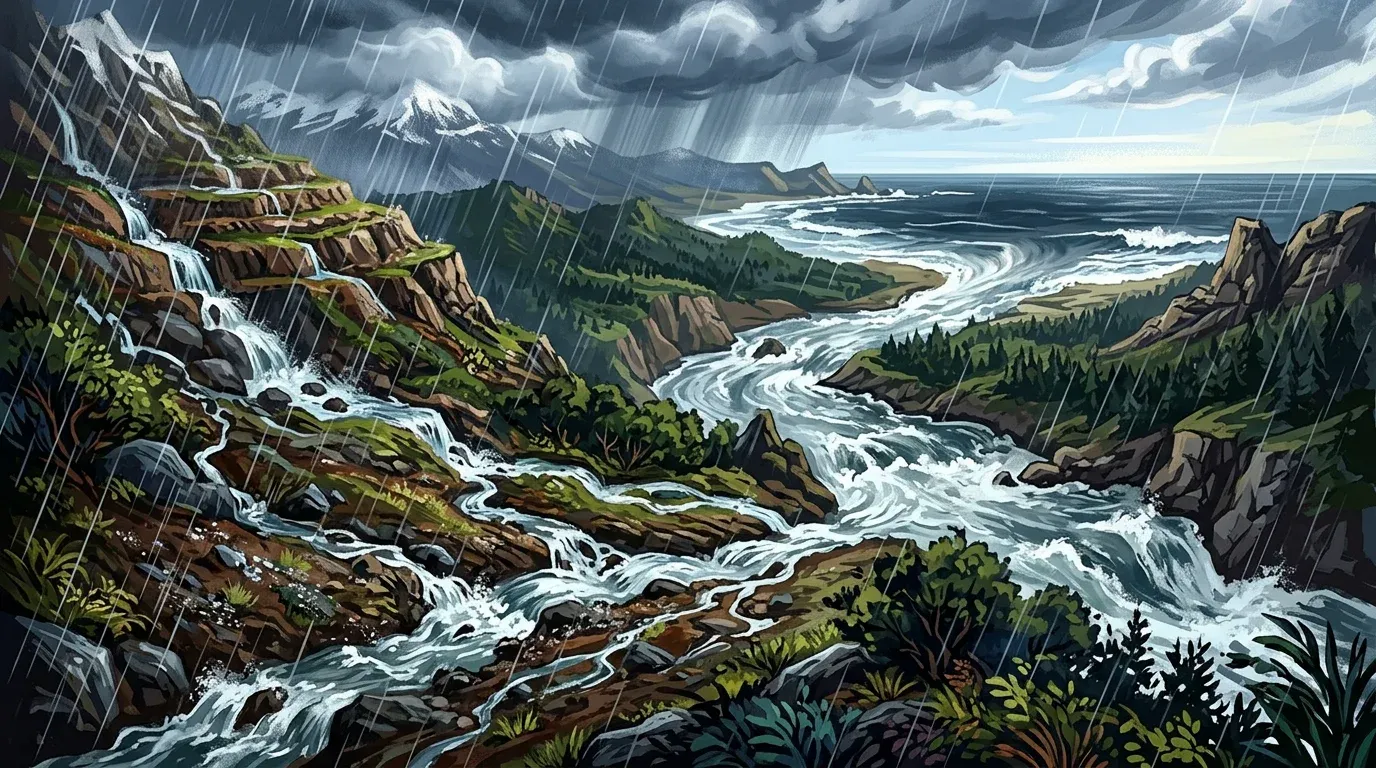
Rivers are not just drainpipes. They are dynamic systems that carve valleys, deposit sediment, build deltas, and sustain ecosystems. The Amazon River alone discharges about 20% of all the fresh water that flows into the world’s oceans. Runoff also carries dissolved minerals, nutrients, and sediments, connecting the chemistry of the land to that of the ocean.
How much precipitation becomes runoff — versus being absorbed by vegetation, evaporated, or infiltrating the soil — depends on land cover, soil type, topography, and intensity of rainfall. Urbanisation dramatically increases runoff: concrete and asphalt are impermeable, so rain that would have soaked into a forest floor instead rushes rapidly into storm drains, increasing flood risk and reducing groundwater recharge.
Water that does not run off soaks into the ground — a process called infiltration. It percolates downward through soil and rock until it reaches the water table, the upper boundary of the saturated zone, and joins groundwater stored in porous rock formations called aquifers.
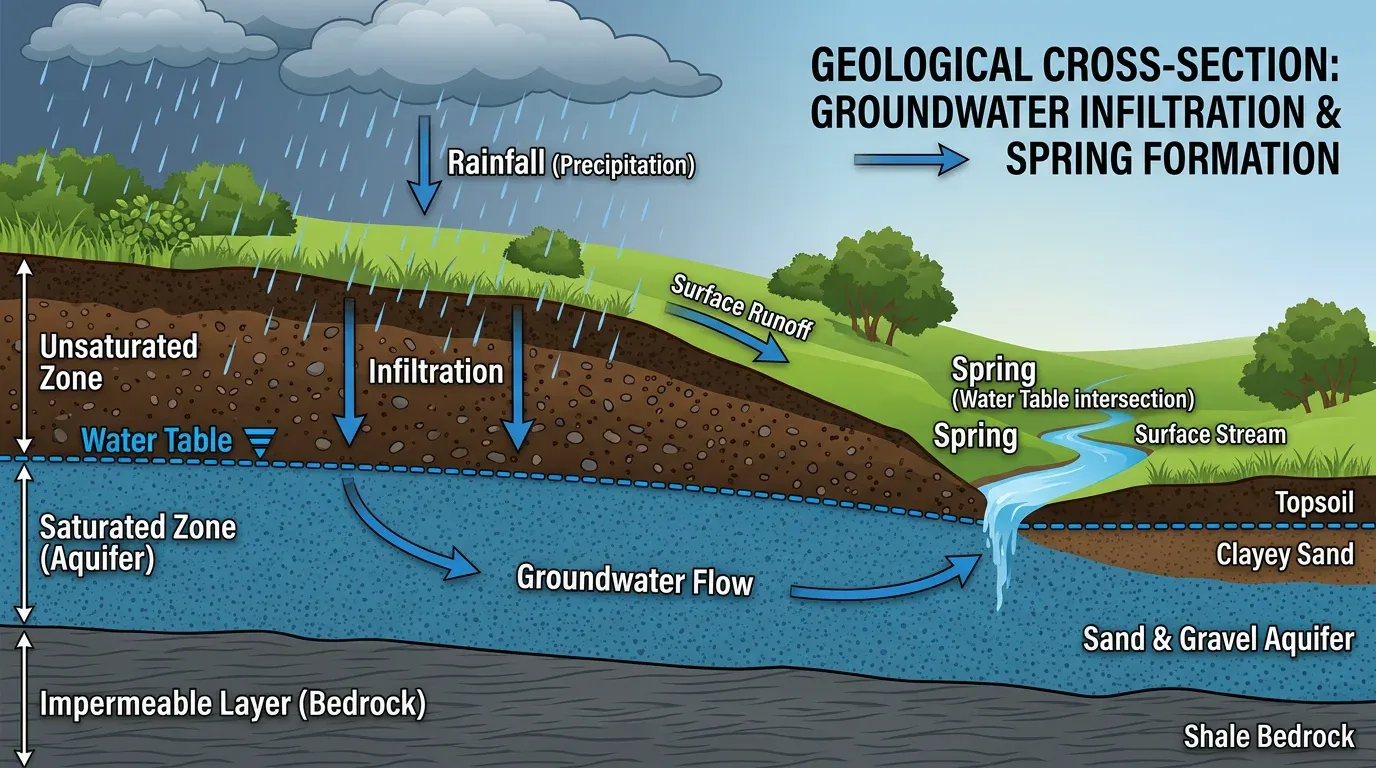
Groundwater is one of humanity’s most important freshwater resources. About 2 billion people rely on groundwater for their primary drinking water supply. Aquifers can hold water for thousands of years — some contain water that fell as rain during the last Ice Age. The Ogallala Aquifer beneath the Great Plains of the United States irrigates roughly a third of all US groundwater-irrigated cropland, but is being drawn down far faster than rainfall can recharge it.
Springs occur where the water table intersects the surface, releasing groundwater as a natural flow. In many arid regions, springs and groundwater seepage sustain rivers through dry seasons. Groundwater eventually flows slowly toward rivers, lakes, wetlands, or the ocean, returning to the surface portion of the cycle.
A significant portion of the world’s precipitation falls as snow and accumulates as snowpack in mountains and polar regions. Snowpack acts as a natural reservoir, storing winter precipitation and releasing it slowly as meltwater in spring and summer — precisely when rivers and agricultural regions in many parts of the world most need water.
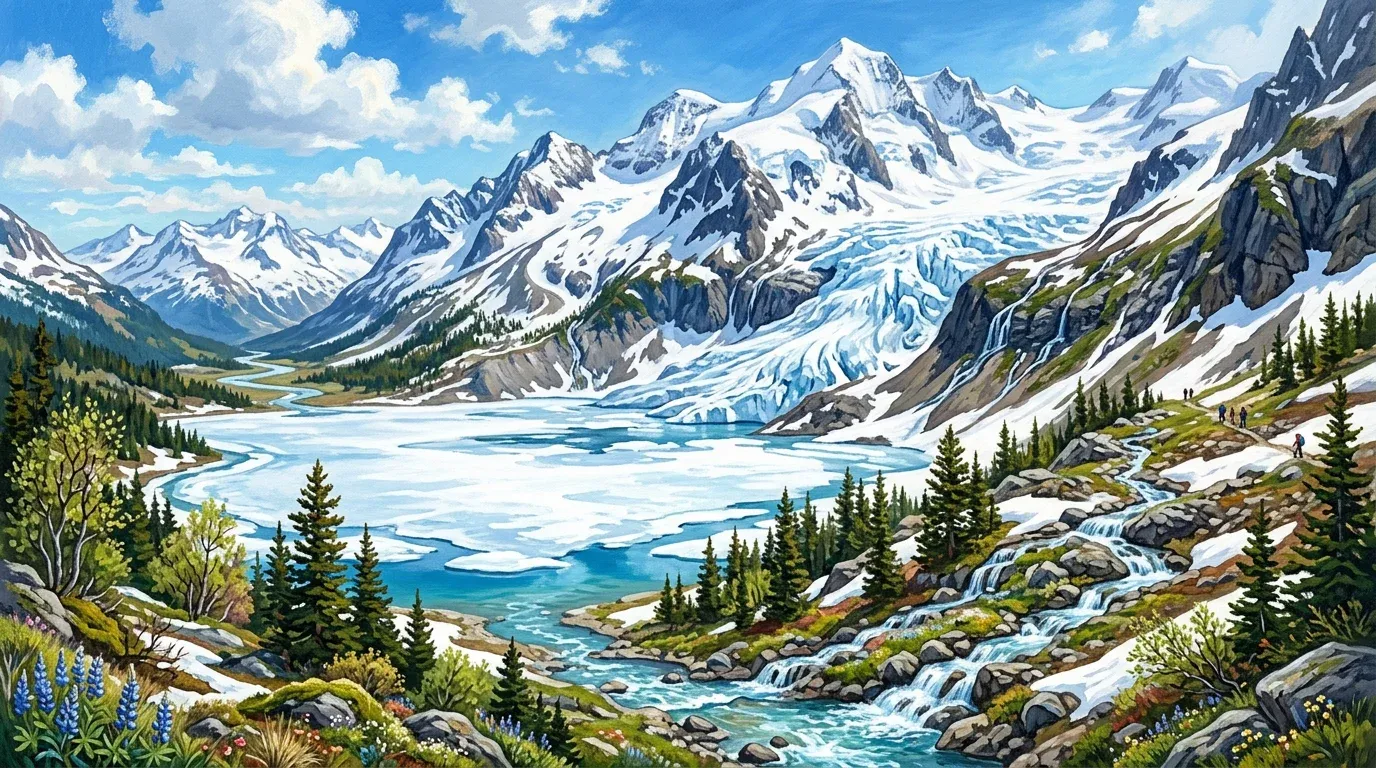
In California, mountain snowpack in the Sierra Nevada historically provided about a third of the state’s water supply. In the Hindu Kush-Himalayan region, glaciers and snowpack feed the rivers that supply fresh water to some 240 million people in the mountains and roughly 1.9 billion in the downstream river basins — the Ganges, Indus, Yangtze, Yellow River, Mekong, and others.
Glaciers represent water locked up for much longer timescales — centuries to millennia. As climate change accelerates glacier retreat worldwide, the short-term effect may be increased meltwater flow, but the long-term consequence is the loss of these frozen reservoirs and reduced summer river flows.
Forests are not merely passive recipients of rainfall. They are active architects of the water cycle at local, regional, and even continental scales.
Tree canopies intercept rainfall, slowing its impact on the soil and reducing runoff and erosion. Deep tree roots create channels that allow water to infiltrate deeper into the soil. Fallen leaves and organic matter on the forest floor act as a sponge, absorbing water and releasing it slowly. And through transpiration, forests pump massive quantities of water vapour back into the atmosphere.
Deforestation disrupts all of these functions. When forest is cleared, rainfall that would have been absorbed and transpired instead runs off rapidly. Rivers flood more intensely after rain and run low between rains. Regional humidity and rainfall often decrease. Studies of deforested regions in the Amazon have shown reduced rainfall even hundreds of kilometres from the cleared land, because the moisture that would have been recycled back into the atmosphere through transpiration no longer makes the journey.
Forests also influence cloud formation and rainfall through a mechanism called biotic pump theory, which proposes that evapotranspiration from forests creates a pressure gradient that draws moist ocean air inland, sustaining continental rainfall far from the coast. It is clear that forests and rainfall are deeply interlinked and interdependent.
Human activity has altered the water cycle in profound ways at every stage.
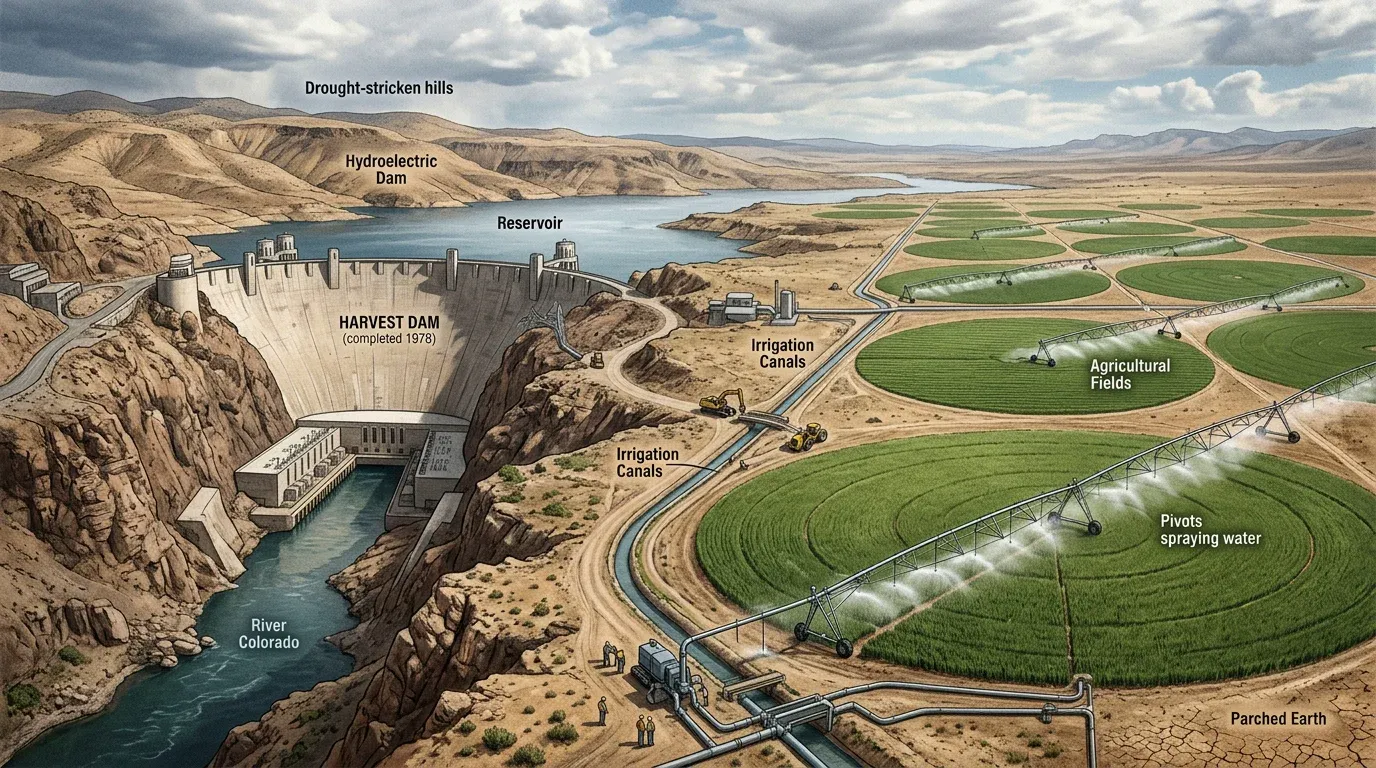
Land use change — deforestation, agriculture, and urbanisation — changes evapotranspiration rates, infiltration, and runoff patterns. Globally, agriculture accounts for about 70% of all freshwater withdrawals, much of it for irrigation, which returns the water to the atmosphere through evapotranspiration rather than the river systems from which it came.
Groundwater overextraction is drawing down aquifers far faster than natural recharge. The consequences — land subsidence, salinisation of coastal aquifers, and eventual depletion of a resource that took millennia to accumulate — are already being felt in parts of India, China, the Middle East, and the American West.
Climate change is intensifying the entire water cycle. A warmer atmosphere holds more water vapour (about 7% more per degree Celsius, following the Clausius-Clapeyron equation). This means more evaporation, more moisture in the air, and when it rains, more intense rainfall. Paradoxically, warming also increases evaporation from soils and reservoirs, exacerbating drought in already dry regions. The pattern emerging from climate projections is “wet gets wetter, dry gets drier” — with more extreme swings between the two.
Dams and reservoirs rearrange the flow of water in time and space, providing storage and flood control but altering downstream river hydrology and ecosystems, blocking sediment transport, and increasing evaporative water loss from large reservoir surfaces.
Residence times vary enormously. Water vapour in the atmosphere lasts an average of about 9 days before falling as precipitation. Water in rivers may spend weeks to years. Groundwater in deep aquifers may persist for thousands of years. Water locked in polar ice caps can remain for hundreds of thousands of years.
Essentially yes. Water molecules are not significantly created or destroyed at Earth's surface on human timescales. The same quantity of water has been cycling through the Earth system for billions of years, though small amounts are lost to space and gained from volcanic outgassing and asteroid impacts over geological time.
Evaporation is the direct conversion of liquid water to vapour from any water surface — ocean, lake, river, or wet soil. Transpiration is the process by which plants release water vapour through their leaves as part of their biological processes. Together they are called evapotranspiration.
This is the rain shadow effect. As moist air is forced upward over a mountain, it cools and the water vapour condenses into clouds and precipitation — drenching the windward side. By the time the air descends the leeward side, it has lost most of its moisture and is often warm and dry, creating arid or semi-arid conditions.
A warmer atmosphere holds more water vapour, intensifying evaporation and leading to heavier rainfall events. But increased evaporation from soils also worsens droughts. The overall pattern is an amplification of the cycle: wet regions tend to get more precipitation, while already dry regions face more severe droughts.
Earth’s water cycle is an unbroken planetary circuit that has operated for billions of years, transferring moisture between the oceans, atmosphere, land, and biosphere. Every stage relies on the others: rain falling on a mountain forest infiltrates the soil, feeds aquifers, transpires back into clouds, and eventually falls again as precipitation thousands of kilometres away.
All the living beings including the human civilization from the beginning, entirely relied on this continuous process for drinking water, agriculture and full filling all kinds of needs related to water. However, as technology developed and human population and greed increased, they aggresively changed the landform and extracted groudwater heavily. These actions affects the water cycle faster than natural systems can adapt, and the result of every such kind of action is nature’s wrath.
Applaud the article to let us know. You can clap multiple times!