Dark Matter and Dark Energy Explained
What is dark matter? What is dark energy? Discover the evidence for the universe's invisible components and why they matter to modern cosmology.
What is dark matter? What is dark energy? Discover the evidence for the universe's invisible components and why they matter to modern cosmology.
Modern cosmology has taught us a surprising fact: all the stars, gas, dust, planets, black holes, and everything else we can detect with our instruments make up only about 5% of the universe. The remaining 95% consists of things we cannot see, have never directly detected, and do not yet fully understand.
We call them dark matter and dark energy. The names are placeholders as much as descriptions — “dark” meaning invisible to our instruments, not dark in the poetic sense of sinister or absent. Both are inferred from their effects on things we can see, and those effects are so clear and consistent that astronomers treat their existence as established fact. What remains unknown is what they actually are.
Let’s take a deeper dive to understand about dark matter and dark energy in more detail.
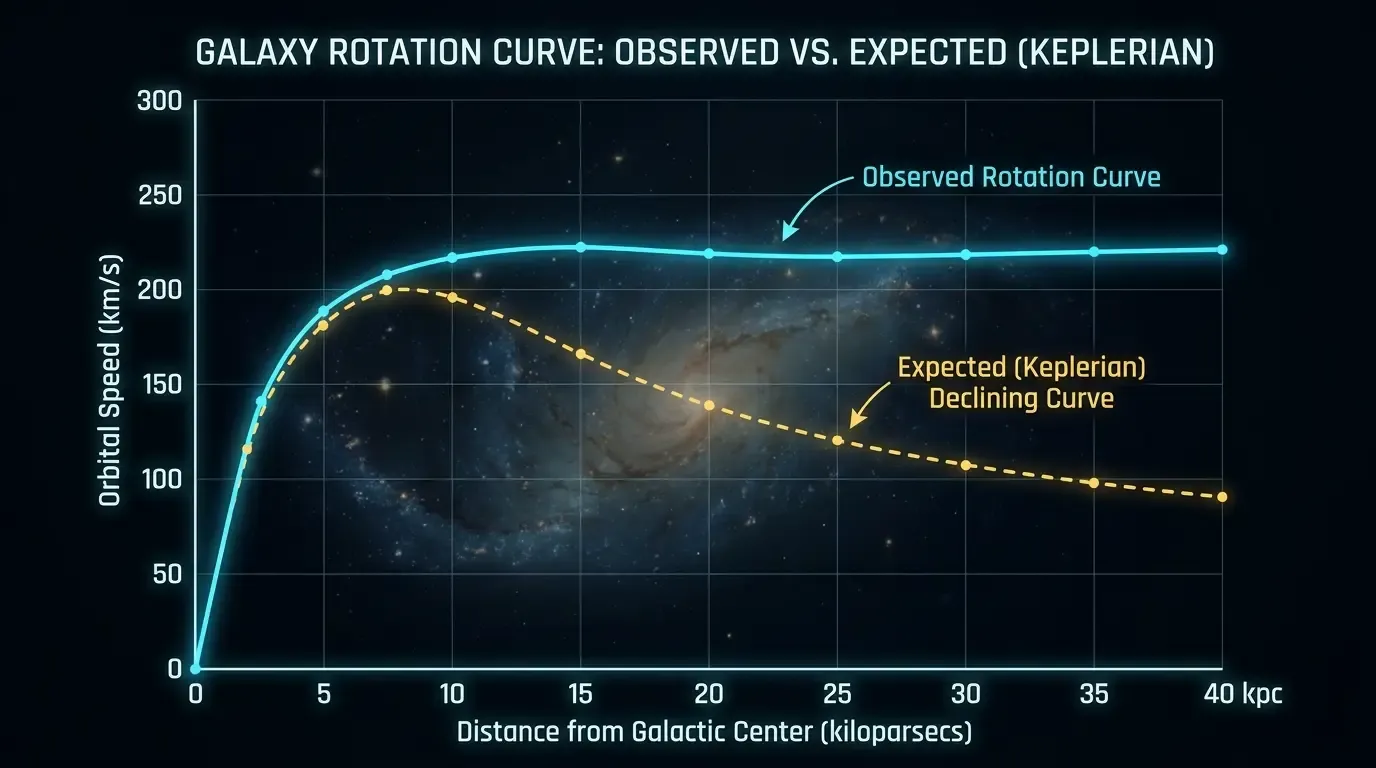
The first serious hint that something was missing came not from the distant universe but from studying our neighbors. In the 1960s and 70s, astronomer Vera Rubin — working with Kent Ford — measured how fast stars and gas orbit the centers of spiral galaxies. Newtonian mechanics makes a clear prediction: the farther a star is from the galactic center, where most of the visible mass is concentrated, the slower it should orbit. Planets in our solar system follow this pattern — Mercury races around the Sun while Neptune ambles.
Galaxies do not. Rubin found that stars near the edges of galaxies orbit just as fast as stars near the center — sometimes faster. The rotation curves are flat where they should slope downward. This is only possible if there is enormous amounts of mass distributed far beyond the visible disk of the galaxy — mass that doesn’t emit, absorb, or reflect light.
Rubin’s findings were initially met with skepticism. By the late 1970s, the evidence from dozens of galaxies was irrefutable. Something — now called dark matter — makes up the bulk of galactic mass. For a typical galaxy, dark matter outweighs all the visible stars and gas by a factor of roughly five to ten.
Perhaps the most visually compelling evidence for dark matter comes from a collision between two galaxy clusters, observed about 3.8 billion light-years away, called the Bullet Cluster.
When two galaxy clusters collide, the individual galaxies largely pass through each other like ghosts — they’re mostly empty space. The hot gas clouds that fill clusters, however, interact and slow down, piling up in the middle. This is precisely what X-ray observations show: the hot gas (glowing in X-ray light) is lagged behind.
But gravitational lensing — the bending of light from even more distant objects behind the cluster — reveals where the mass is. And the mass is not where the gas is. The mass has moved ahead with the galaxies, passing through the collision zone unimpeded. This is exactly what dark matter would do: it interacts only gravitationally, not electromagnetically. It passed through without slowing down.
The Bullet Cluster is so direct a demonstration that many physicists consider it the single most convincing piece of evidence for dark matter. Alternative gravity theories, which attempt to explain galactic rotation curves without dark matter, struggle greatly to explain it.
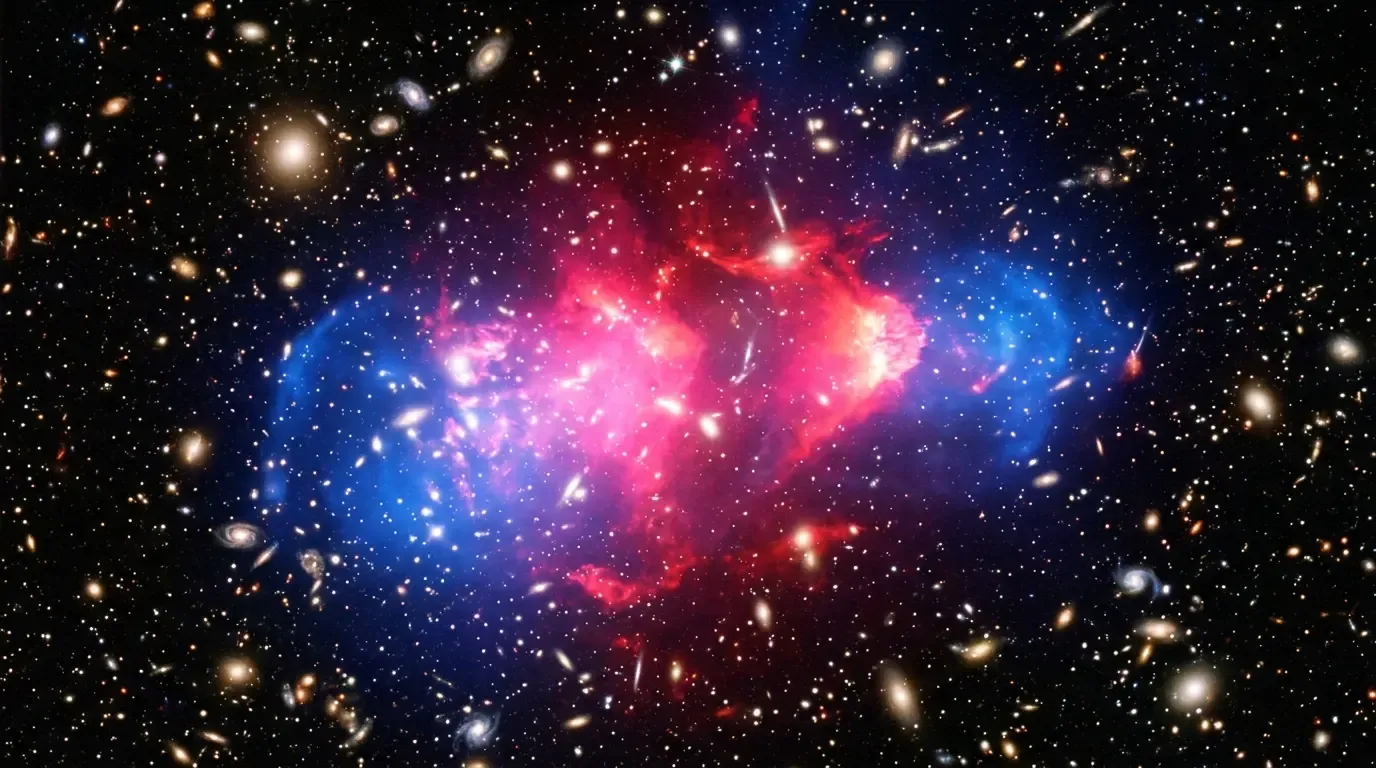
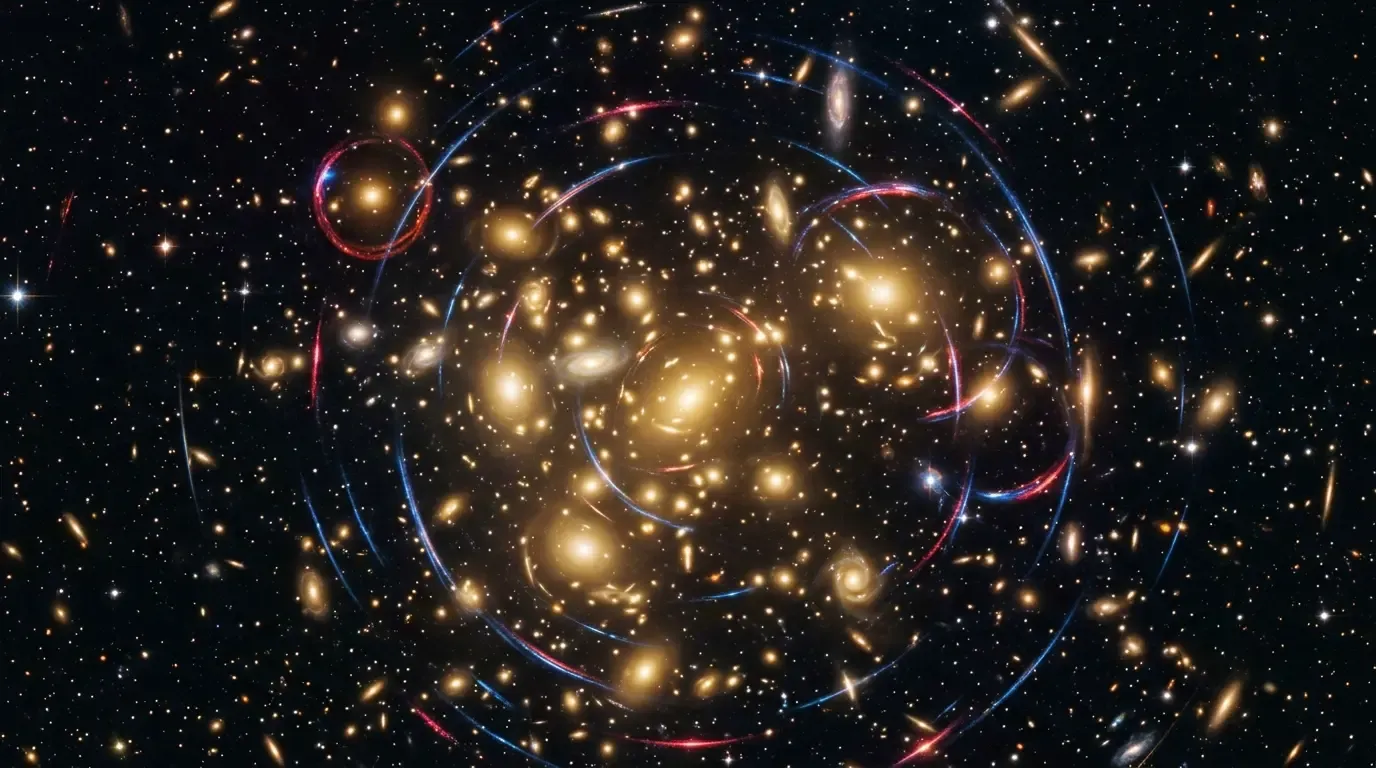
Einstein’s theory of gravity predicts that massive objects curve spacetime, bending the paths of light rays passing near them. Astronomers use this effect — gravitational lensing — to map the distribution of mass in galaxy clusters, regardless of whether that mass emits light.
These lensing maps consistently show far more mass than can be accounted for by visible stars and gas. The “missing” mass is spread in extended halos around and between galaxies. Its distribution matches the large-scale structure of the universe predicted by simulations that include dark matter.
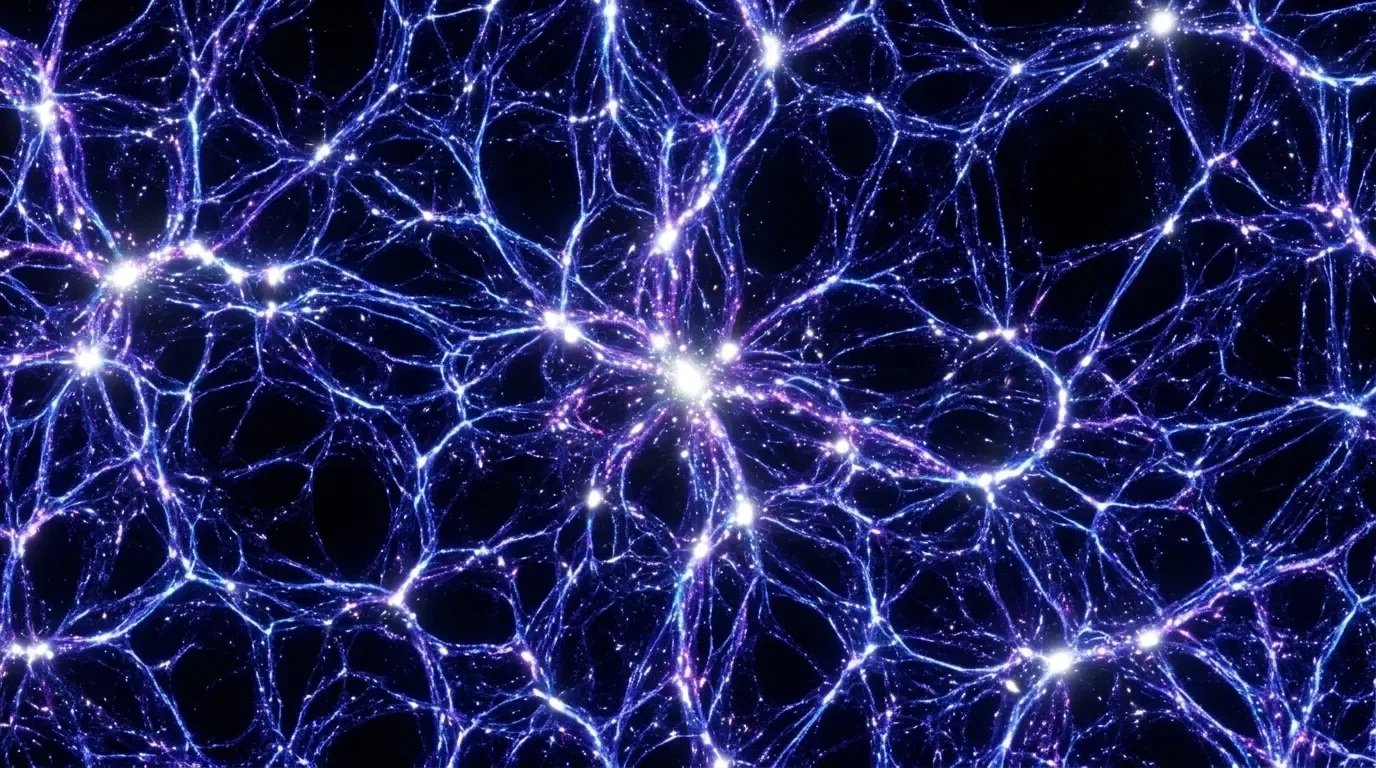
Computer simulations of the universe’s history can start with the tiny fluctuations observed in the cosmic microwave background from The Big Bang and run the gravitational clock forward. With only ordinary matter, these simulations produce a universe that looks nothing like what we observe. Add dark matter — and the cosmic web of filaments, sheets, and voids emerges naturally, matching galaxy surveys in striking detail.
Dark matter is like a web of network or scaffold that is scattered throughout the universe. All the super massive structures like galaxies, stars and planets couldn’t have formed and held in place without it.
Despite decades of evidence for dark matter’s existence, we do not know what it is. Several candidates have been proposed and investigated:
For years, the leading candidate was the WIMP — a hypothetical particle with a mass somewhere between 10 and a few thousand times the proton mass, interacting via gravity and the weak nuclear force but not electromagnetism. WIMPs arise naturally in extensions to the Standard Model of particle physics, especially supersymmetry.
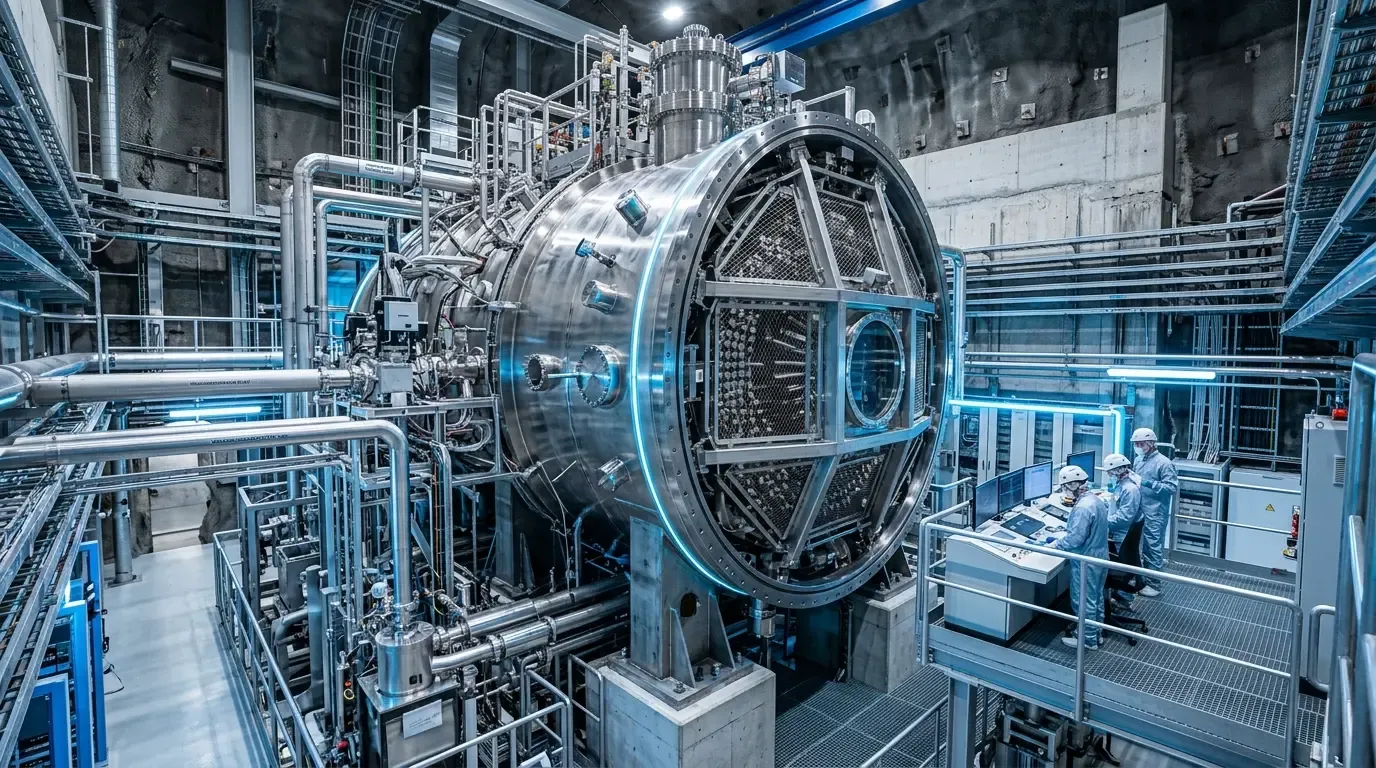
Underground experiments like LUX-ZEPLIN, XENON1T, and PandaX have searched for WIMPs by looking for their rare collisions with atomic nuclei in ultra-sensitive detectors. Despite reaching extraordinary sensitivity, no confirmed WIMP signal has been found. This doesn’t rule WIMPs out, but it has significantly narrowed the parameter space.
Axions are ultra-light hypothetical particles originally proposed to solve a problem in quantum chromodynamics (the theory of the strong nuclear force). They would be vastly lighter than electrons and would interact extremely weakly with ordinary matter. Several experiments — including ADMX — are searching for them using strong magnetic fields that could convert axions into detectable photons.
Some theorists have proposed that a fraction of dark matter could be black holes formed in the early universe — before any stars existed. The LIGO gravitational wave detections of unexpectedly massive black hole mergers briefly renewed interest in this idea. Current constraints from gravitational microlensing surveys rule out primordial black holes as the entire dark matter component, but a small fraction remains possible.
Standard neutrinos interact via the weak force. Sterile neutrinos — if they exist — would interact only gravitationally. They could be produced in the early universe and contribute to dark matter. X-ray observations of galaxy clusters have occasionally shown an unexplained emission line near 3.5 keV that some researchers interpret as a sterile neutrino signal, though the interpretation remains contested.
[!NOTE] Dark matter is not anti-matter, not black holes (in general), and not simply a failure of our understanding of gravity. The Bullet Cluster and other observations make modified gravity theories very difficult to sustain without invoking something beyond ordinary physics.
In 1998, two independent teams of astronomers were measuring the distances and recession speeds of Type Ia supernovae in distant galaxies. One team was led by Saul Perlmutter. The other team was led by Brian Schmidt and Adam Riess. Type Ia supernovae are excellent cosmic distance markers because they all achieve approximately the same peak brightness. This allows astronomers to calculate how far away they are.
The expectation was that gravity would be slowing the expansion of the universe down over time. The teams expected to find that distant supernovae (representing the universe as it was billions of years ago) were receding faster than nearby ones — confirming deceleration.
They found the opposite. Distant supernovae were dimmer than expected, meaning they were farther away than they should be if the expansion were decelerating. The expansion of the universe is not slowing down. It is speeding up.
This was so shocking that it was met with intense scrutiny. Systematic errors, dust extinction, evolution of supernovae — every alternative was examined. The conclusion survived. Perlmutter, Schmidt, and Riess shared the Nobel Prize in Physics in 2011 for this discovery.
The accelerating universe expansion implies that some form of energy is embedded in space itself — an outward pressure that grows in importance as the universe expands and ordinary matter dilutes. This is dark energy.
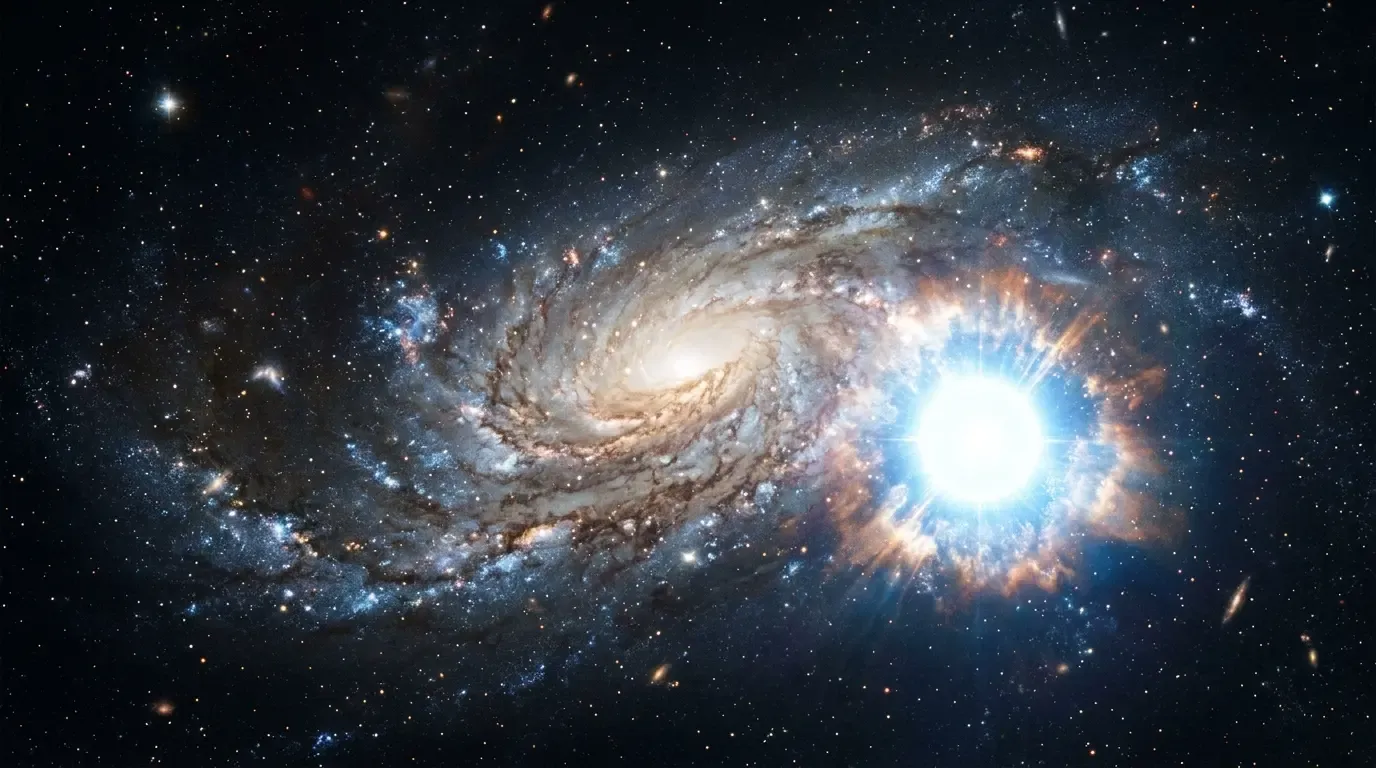
The simplest mathematical description of dark energy is Einstein’s cosmological constant, Λ (lambda). He added this term to his field equations of general relativity in 1917 to produce a static universe. Einstein later called it his “greatest blunder” when Hubble showed the universe was expanding. Now, in a remarkable twist, the cosmological constant is back. This time, it serves as a description of dark energy rather than stasis.
Quantum field theory suggests that even “empty” space should have energy — the zero-point energy of quantum fields. The cosmological constant could represent this vacuum energy. The problem is that when physicists calculate the expected magnitude of vacuum energy, the result is about 120 orders of magnitude larger than the observed value. This is one of the most dramatic mismatches in all of physics, sometimes called “the worst prediction in the history of science.”
Whether dark energy is truly a cosmological constant, or whether it varies over time (a dynamical field called quintessence), is a question that next-generation surveys like the Dark Energy Spectroscopic Instrument (DESI) and the Euclid space telescope are designed to answer.
Dark energy currently makes up about 68% of the total energy content of the universe. Ordinary matter (all the stars, gas, and dust) accounts for about 5%. Dark matter makes up the remaining ~27%.
Because dark energy acts as a repulsive pressure embedded in space itself, more space means more dark energy, which means faster expansion, which creates even more space. This runaway process means the universe’s expansion will continue to accelerate indefinitely — at least under current models.
In the very far future, this has strange implications. Galaxies beyond our Local Group will recede faster than light can cross the expanding gap. This is not because they travel faster than light, but because the space between us stretches faster than light can traverse it. Over trillions of years, distant galaxies will redshift beyond any detection. Observers in the far future universe might see only a static island of local galaxies surrounded by apparent void. They would have no way to detect or infer the expansion that formed everything.
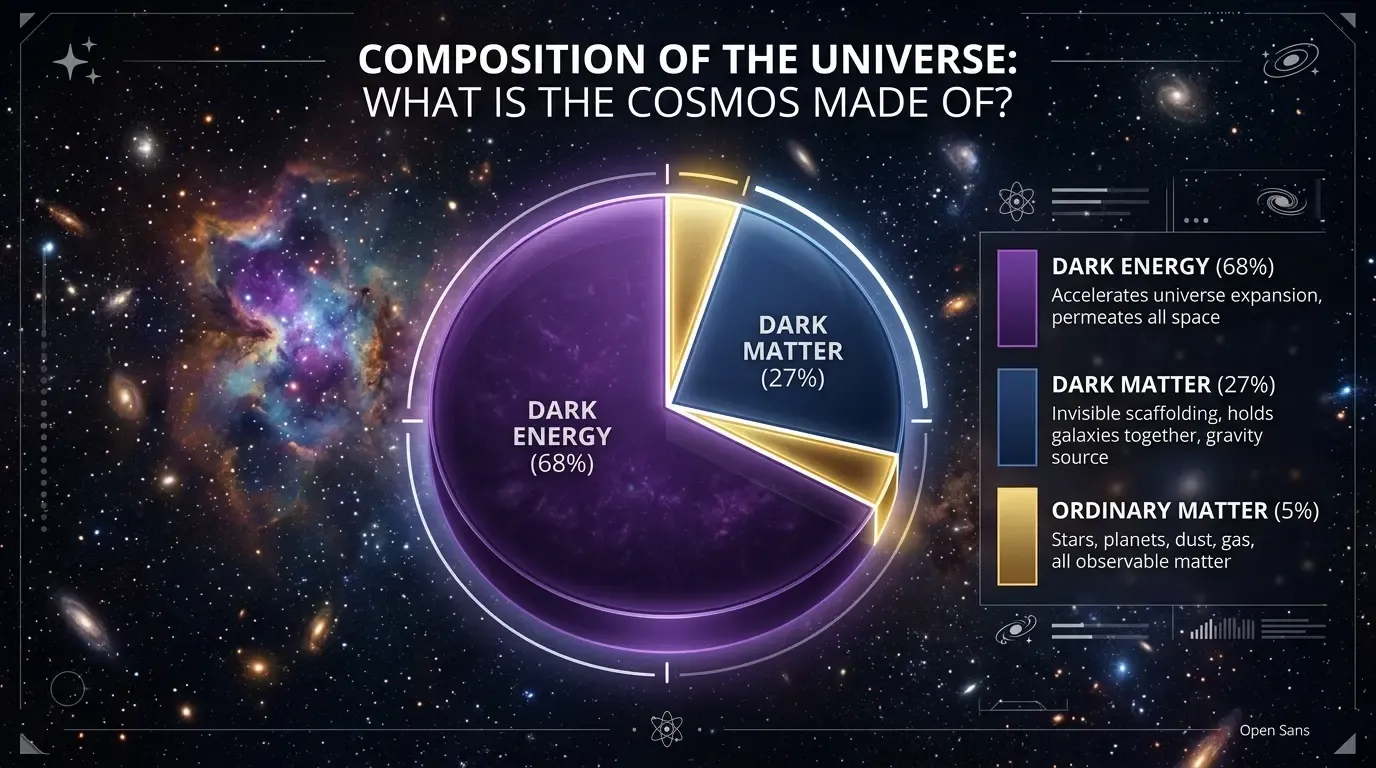
These two “dark” components are frequently confused but are fundamentally distinct:
| Property | Dark Matter | Dark Energy |
|---|---|---|
| Gravitational effect | Attractive — holds structures together | Repulsive — drives expansion apart |
| Distribution | Clumped in halos around galaxies | Uniformly distributed throughout space |
| Origin | Unknown particle(s) | Possibly vacuum energy or a field |
| Role in structure | Forms cosmic scaffolding | Resists further structure formation |
| Amount | ~27% of universe | ~68% of universe |
| Changes with expansion | Dilutes as universe expands | Constant (or near-constant) per volume |
The current structure of the universe is said to be held together by dark matter, and dark energy is tearing it apart, slowly, in the cosmic timeline.
No. Astronomers have accounted for all forms of ordinary (baryonic) matter, including faint stars, gas clouds, and stellar remnants. The mass deficit is far too large to be filled by undiscovered ordinary objects. Big Bang nucleosynthesis also constrains how much baryonic matter there can be, and dark matter far exceeds that limit.
Not yet. Despite increasingly sensitive experiments like LUX-ZEPLIN and XENON1T, no confirmed direct detection of a dark matter particle has been made. The search continues with new experiments and new candidate particles.
The cosmological constant is the simplest mathematical description of dark energy, and it fits current observations well. But it remains unclear whether dark energy is truly constant or whether it is a dynamic field (quintessence) that changes over time. Future surveys aim to distinguish between these possibilities.
Some theoretical models propose a unified 'dark fluid,' but there is currently no compelling evidence for this. Dark matter and dark energy behave very differently — one clusters gravitationally, the other permeates space uniformly — making a single explanation difficult.
If dark energy is a cosmological constant, it will cause continued accelerating expansion — eventually isolating galaxy clusters from each other — but not tear apart galaxies or atoms. A more dramatic scenario, called the Big Rip, would occur if dark energy strengthens over time, but current data does not favor this outcome.
Applaud the article to let us know. You can clap multiple times!