The Big Bang Theory: How the Universe Began
Explore the Big Bang theory — the evidence, the timeline, the physics of inflation, and common misconceptions about how our universe began.
Explore the Big Bang theory — the evidence, the timeline, the physics of inflation, and common misconceptions about how our universe began.
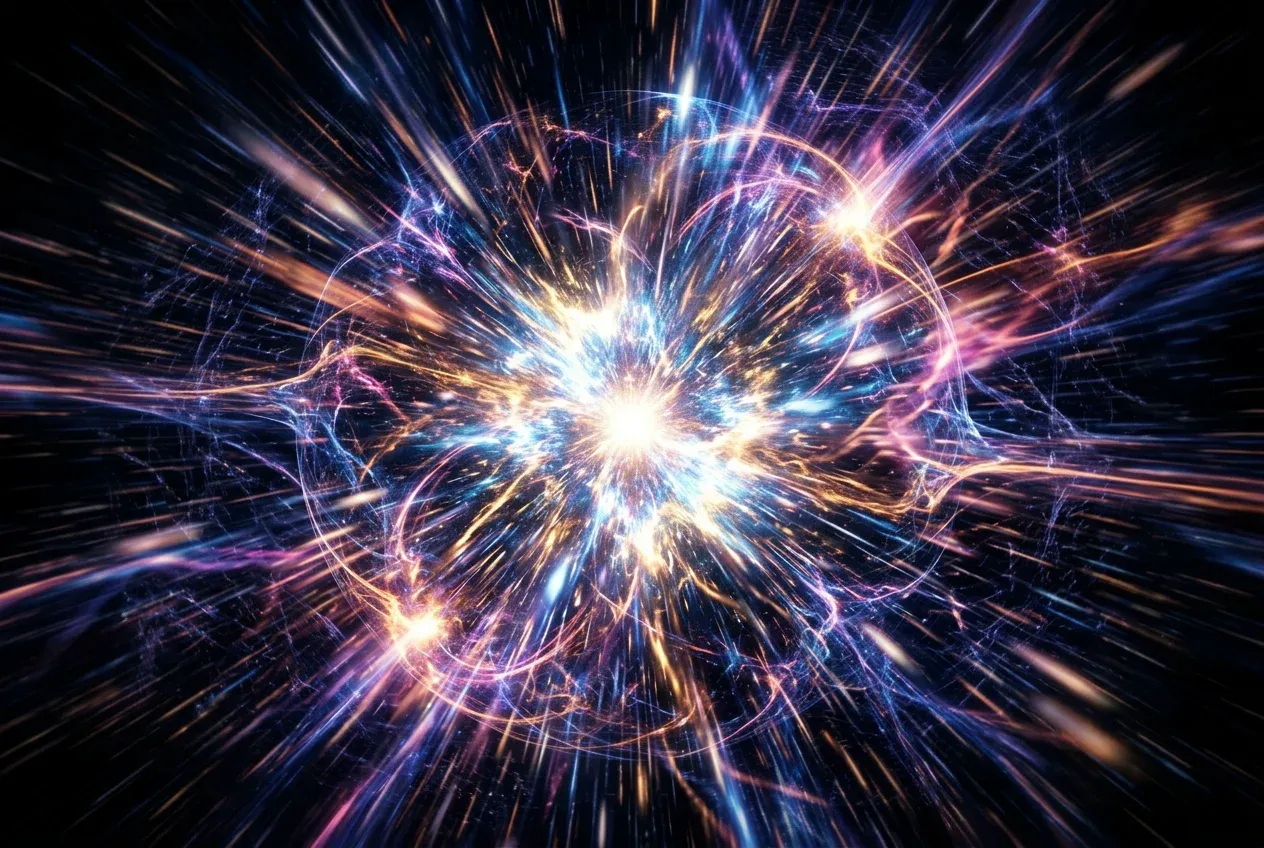
It is said that just around 13.8 billion years ago, there was nothing in this universe. Every object that we see today, from our every tools like table and chairs to the collosal stars and galaxies out there - everything was compress into an unimaginable tiny point of compression.
Something happened in the very first few microseconds of the universe, that caused the big bang explosion. Right away, everything started to move away, at an astonishing speed. At first, energy was everywhere, there was no matter.
Soon, due to gravity, the resultant compression and heat produced the very first atoms in the early Universe. The universe continued to expand since then and the chain of events resulted in the formation of what we see in the universe today. Who knows when we will be able to understand the real truth about this Universe.
That story is the Big Bang theory. It is the most rigorously tested and widely accepted explanation for the universe origin and the early evolution of our cosmos. But despite the name, it was not an explosion in the conventional sense — there was no bomb, no pre-existing void for debris to fly through, no single point in space where it happened. Understanding what the Big Bang really means requires rethinking some of our most basic intuitions about space, time, and the nature of existence itself.
The term “Big Bang” was coined somewhat sarcastically in 1949 by British astronomer Fred Hoyle, who was actually a proponent of a competing model called the Steady State theory. He used it on a BBC radio program — and the name stuck, even after his preferred theory was abandoned.
The Big Bang theory does not claim to describe the creation of the universe from absolute nothing, nor does it claim to know what caused the Bang. What it does say is this: the universe had an early state of extreme temperature and density, and since that time it has been expanding and cooling. As it cooled, matter formed, gravity pulled it into structures, and the universe evolved into what we observe today.
This idea follows naturally from one of the most consequential scientific discoveries of the twentieth century: the universe is expanding.
In the 1920s, American astronomer Edwin Hubble measured the distances to several fuzzy objects in the sky that had long puzzled astronomers. He confirmed they were not clouds of gas within the Milky Way, but entire separate galaxies — island universes of hundreds of billions of stars, vastly farther away than anyone had imagined.
More strikingly, Hubble noticed that the light from almost all of these galaxies was shifted toward the red end of the spectrum — redshifted. This Doppler-like effect indicated the galaxies were moving away from us. And the farther a galaxy was, the faster it was receding.
This relationship — now called Hubble’s Law — has a profound implication. If galaxies are moving apart from each other right now, then in the past they must have been closer together. Run the clock backward far enough, and all of matter and energy converges on an extraordinarily hot, dense starting point.
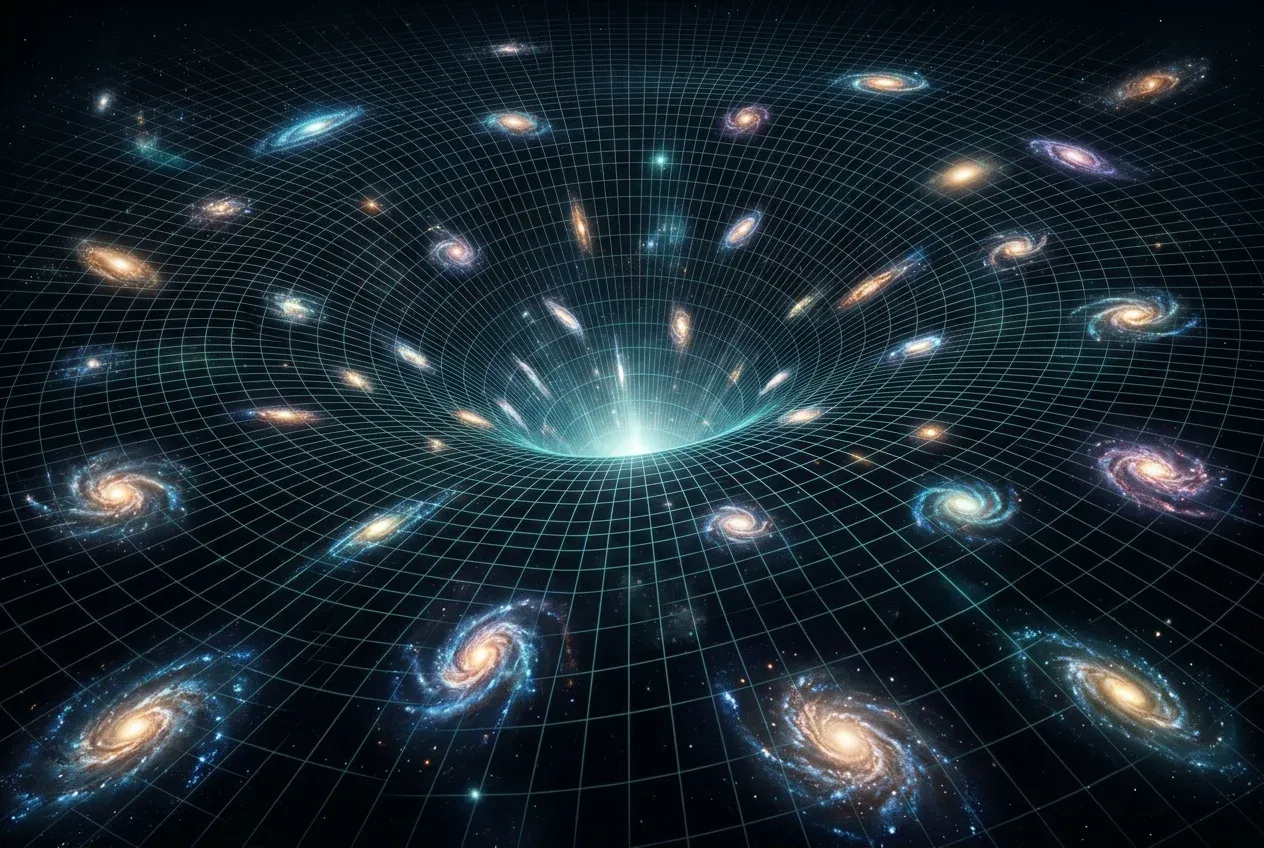
It’s important to be precise about what is expanding: not the galaxies themselves, and not the matter within them, but the fabric of space between them. Imagine dots drawn on a rubber balloon — as the balloon inflates, the dots move apart not because they are being propelled outward, but because the surface they sit on is stretching.
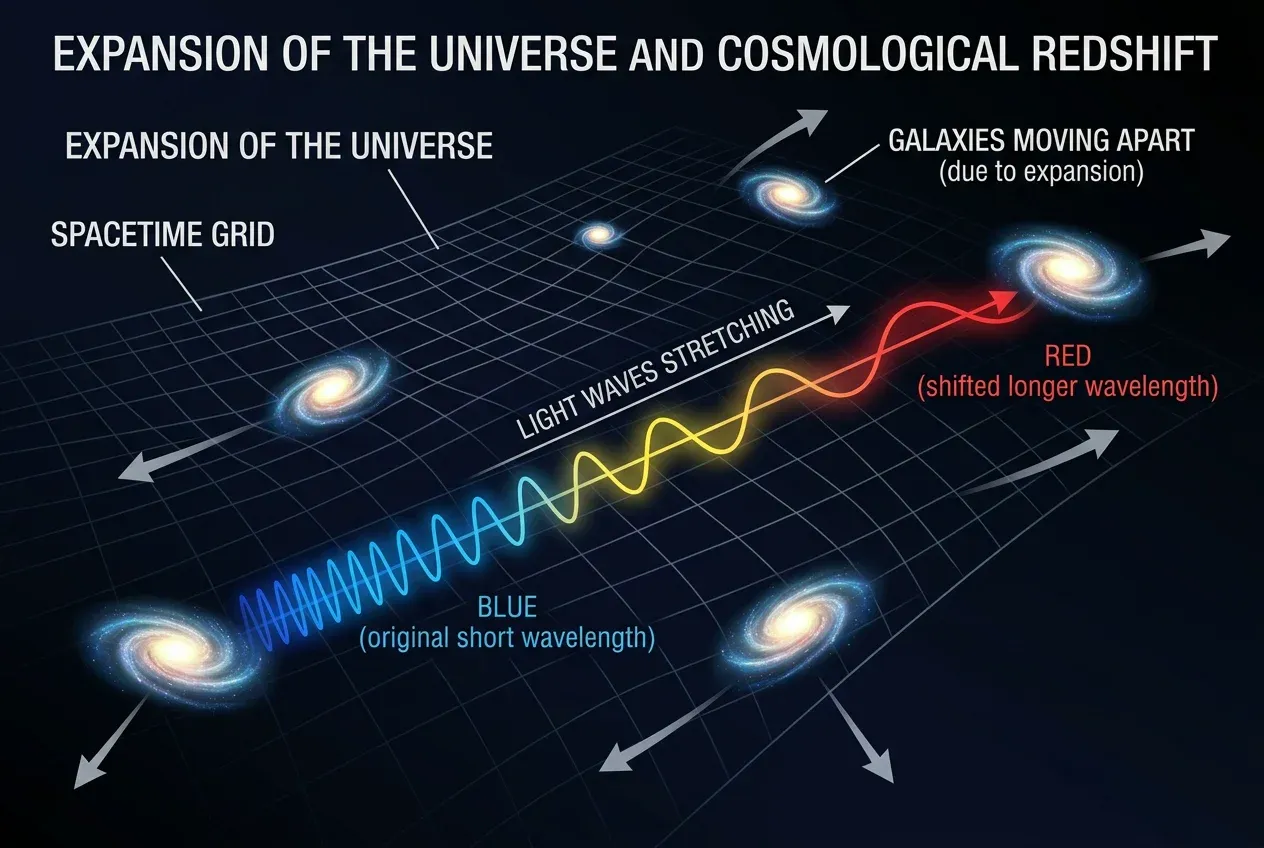
The Big Bang theory rests on three major independent lines of observational evidence. Together, they are remarkably difficult to explain by any alternative.
In 1964, radio engineers Arno Penzias and Robert Wilson at Bell Labs in New Jersey were testing a sensitive antenna intended for satellite communications. No matter which direction they pointed it, they detected a faint, persistent hiss of microwave radiation. This radiation had a temperature of about 2.7 degrees above absolute zero.
They checked every possible source of interference — even a pair of nesting pigeons and their droppings inside the antenna. Finally, they concluded the signal was real, uniform across the sky, and inexplicable by any known local source.
What they had accidentally discovered was the Cosmic Microwave Background (CMB): the afterglow of the Big Bang itself.
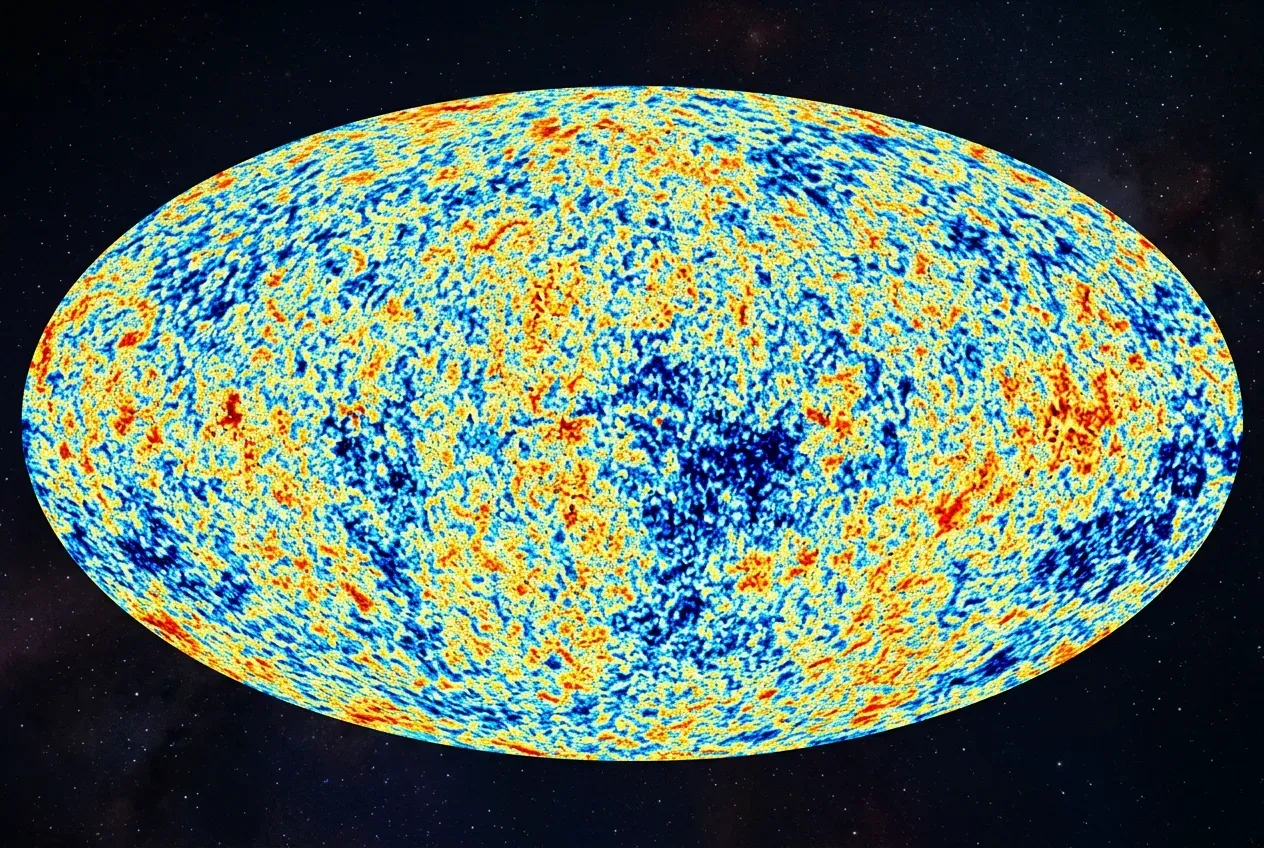
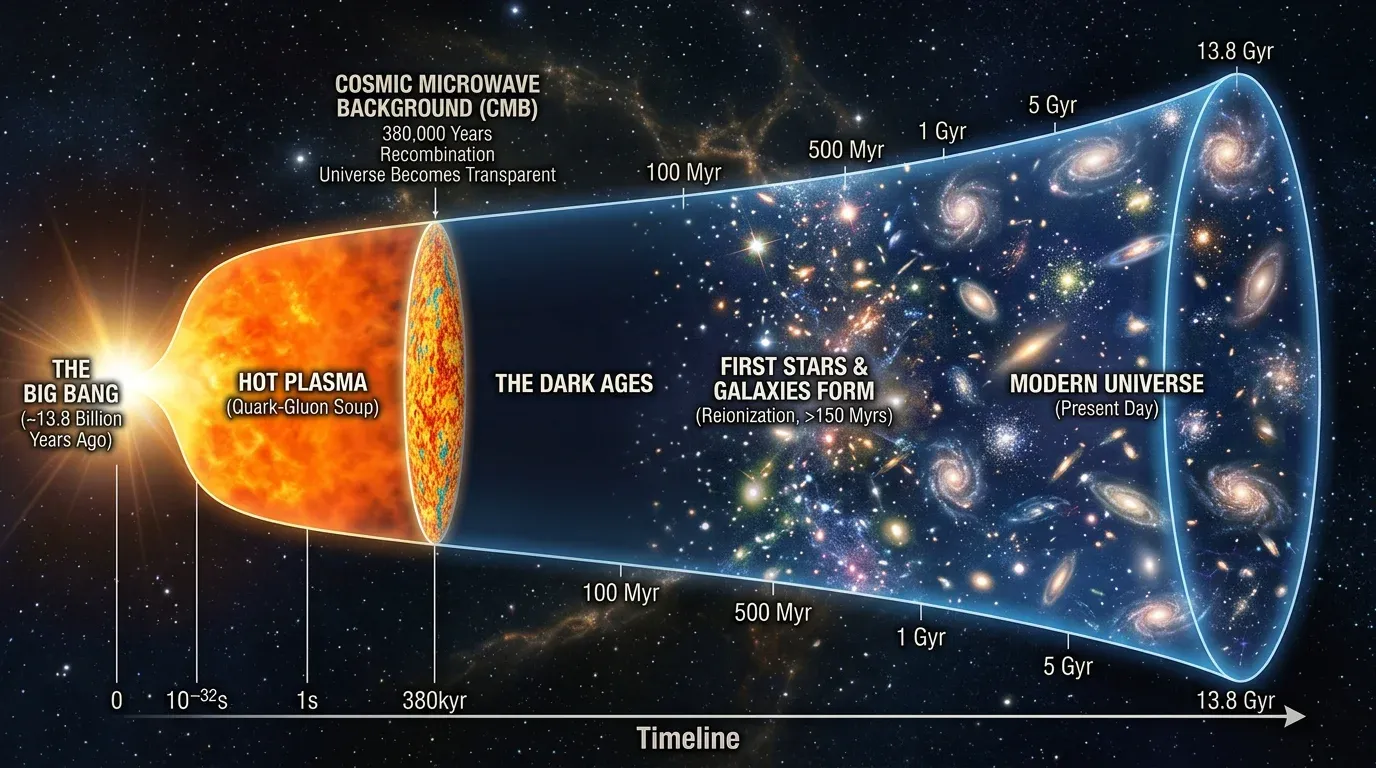
Here’s the physics. When the universe was very young — around 380,000 years old — it was hot enough that electrons and protons could not combine to form neutral hydrogen atoms. The universe was a plasma, opaque to light, photons constantly bouncing off free electrons. Then, as the universe cooled below about 3,000 Kelvin, electrons and protons combined in an event cosmologists call recombination. The universe became transparent for the first time, and light flooded freely through space.
That ancient light has been traveling ever since. The expansion of the universe has stretched its wavelengths from visible and infrared into the microwave range. Today it reaches us from every direction, a faint but precisely measurable cosmic fossil. Penzias and Wilson won the Nobel Prize in Physics in 1978 for its discovery.
Subsequent space missions — NASA’s COBE satellite in the early 1990s, WMAP in the 2000s, and ESA’s Planck satellite in the 2010s — mapped the CMB in exquisite detail. It is not perfectly uniform; it has tiny temperature fluctuations at the level of one part in 100,000. These fluctuations match precisely the predictions of Big Bang cosmology and even encode information about the density, age, and geometry of the universe.
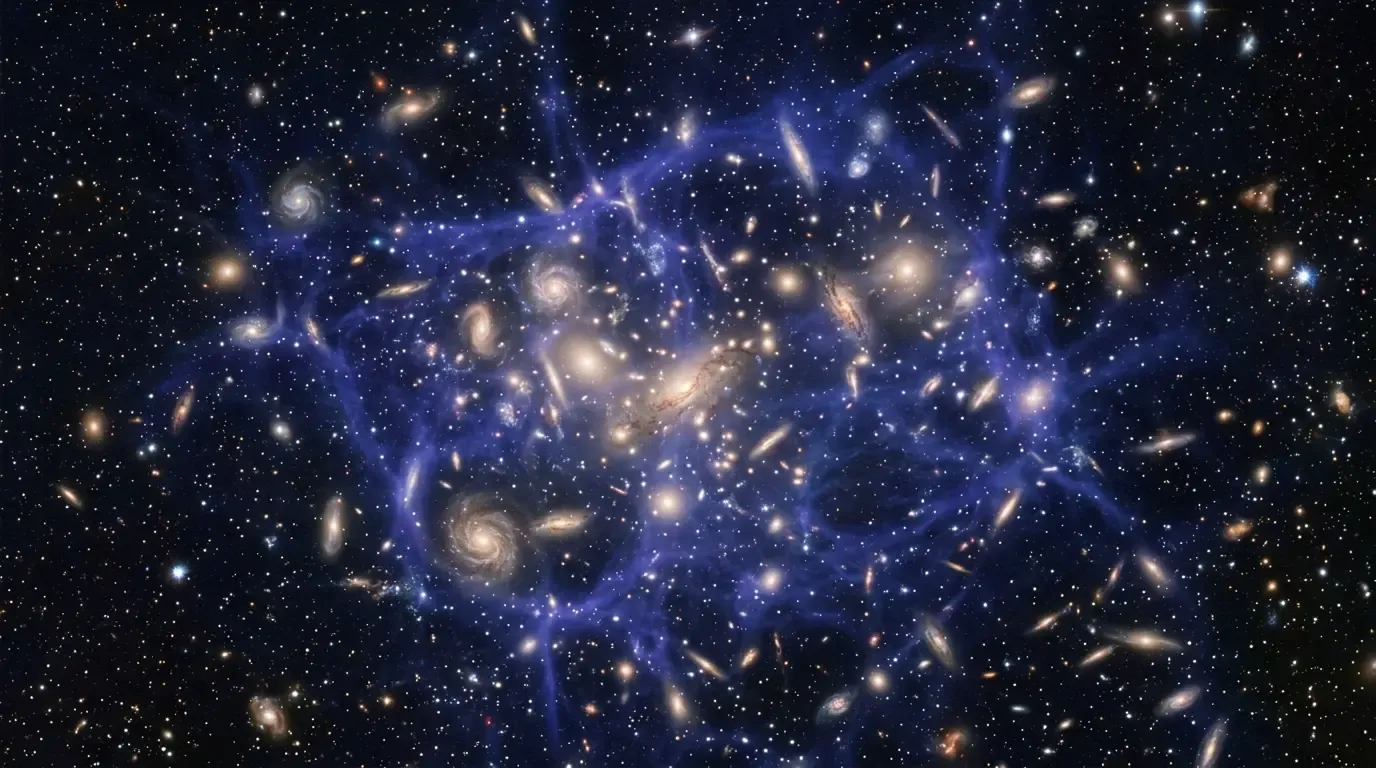
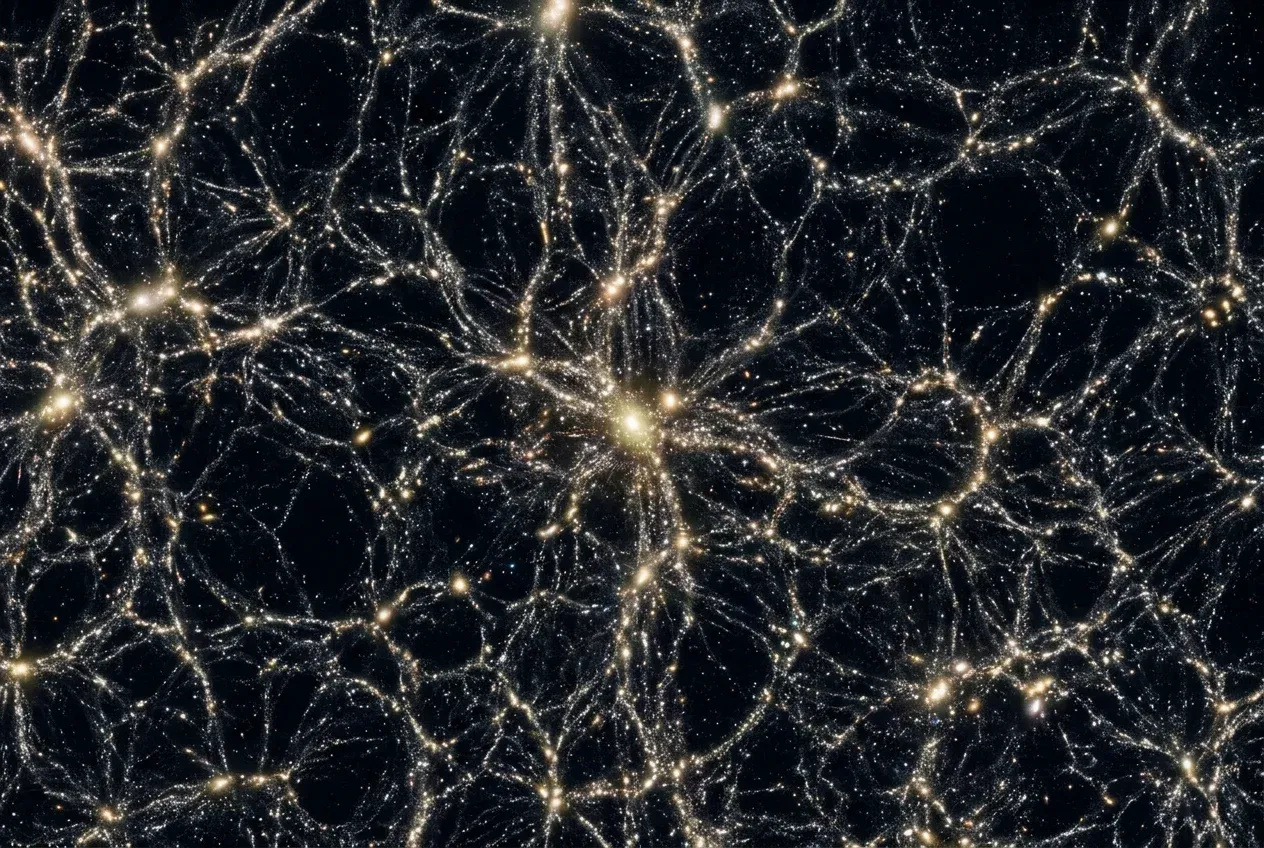
Beyond Hubble’s original observations, decades of galaxy surveys have mapped the universe’s large-scale structure — vast sheets and filaments of galaxies surrounding enormous voids. This web-like architecture matches computer simulations of how matter would clump together under gravity starting from the tiny CMB fluctuations. No other cosmological model naturally produces this structure.
Meanwhile, the relationship between galaxy recession speed and distance (Hubble’s Law) has been refined and confirmed using multiple independent distance-measurement techniques, from Cepheid variable stars to Type Ia supernovae. These measurements consistently point back to an origin roughly 13.8 billion years ago.
The third pillar concerns the abundances of the lightest chemical elements — hydrogen, helium, and trace amounts of lithium and deuterium — found throughout the universe.
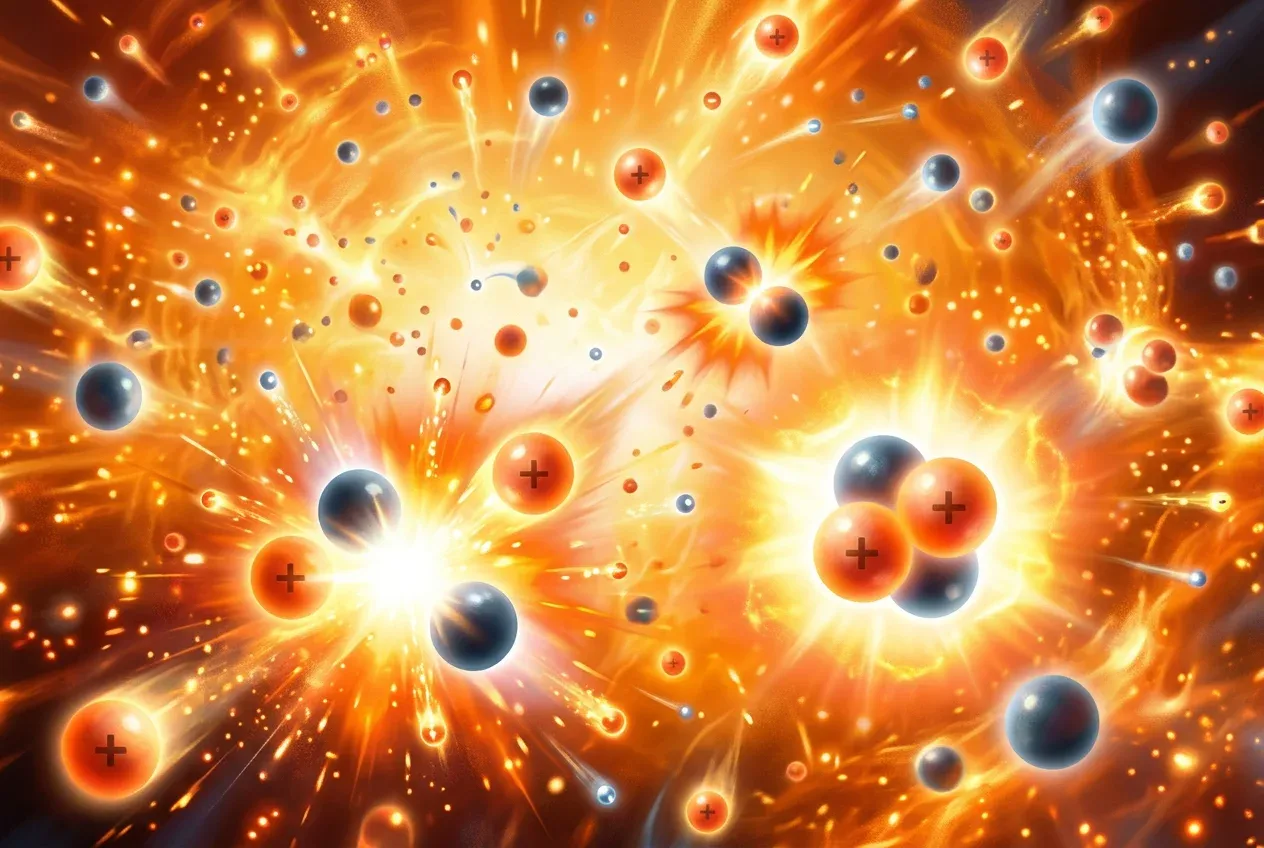
The Big Bang theory makes precise, testable predictions. In the first three minutes after the Bang, the universe was a nuclear furnace: hot enough and dense enough for protons and neutrons to fuse. But it was also expanding and cooling rapidly, so the window for fusion was brief. Theory predicts this process — Big Bang nucleosynthesis — should have produced a universe about 75% hydrogen and 25% helium by mass, with tiny amounts of other light elements.
Astronomers measure the primordial abundance of these elements in the oldest, least-processed objects in the universe — ancient gas clouds and the oldest stars. The observed ratios match the Big Bang predictions with remarkable precision. This is a completely independent line of evidence from the CMB or galaxy observations, and the agreement is not a coincidence.
The Big Bang model, combined with our understanding of particle physics, lets us reconstruct the history of the universe with confidence almost all the way back to the very beginning. Here is a condensed tour.
Cosmologists believe the universe began in a state of extreme density and temperature. Before 10⁻⁴³ seconds — the Planck time — our current laws of physics break down. General relativity and quantum mechanics, our two best theories, are mutually incompatible at this scale. We genuinely do not yet know what happened in this moment.
The leading hypothesis for what happened next is cosmic inflation (often referred to as inflation theory). Physicist Alan Guth first proposed this idea in 1980. Inflation theory proposes that the universe underwent an extraordinarily rapid exponential expansion, growing by a factor of at least 10²⁶ in a tiny fraction of a second — far faster than the speed of light.
This does not violate relativity; the speed-of-light limit applies to objects moving through space, not to the expansion of space itself.
Inflation solves several puzzles that otherwise plague Big Bang cosmology:
Inflation also provides the origin of the CMB’s temperature fluctuations: tiny quantum fluctuations in the inflationary field were stretched to cosmic scales and became the seeds of all large-scale structure.
[!NOTE] Inflation is the leading hypothesis but remains unconfirmed. Detecting the gravitational wave signature it should have left in the CMB — called B-mode polarization — is one of the major goals of current and next-generation CMB experiments.
As the universe cooled, the fundamental forces separated one by one from a unified state. The electromagnetic and weak nuclear forces separated, particles called quarks appeared, and the universe was filled with a quark-gluon plasma. By about one microsecond, quarks bound together into protons and neutrons.
Crucially, there was a slight asymmetry between matter and antimatter — about one extra matter particle for every billion antimatter particles. When matter met antimatter, both annihilated. That slight excess of matter is literally everything we see today: every star, every galaxy, every planet, and every person.
Protons and neutrons were now forming. In the blazing heat, they fused to produce deuterium, helium-3, helium-4, and lithium. As described above, this produced the primordial elemental abundances that match observations.
The universe cooled enough for electrons to combine with nuclei, forming the first neutral atoms. The universe became transparent, and the CMB was released.
After recombination, the universe entered a period called the Cosmic Dark Ages — no stars yet, just vast clouds of hydrogen and helium gas slowly collapsing under gravity. Around 200 million years after the Bang, the first stars ignited. These were massive, hot, and short-lived — nothing like the stars in our own neighborhood. They forged the first heavy elements in their cores and scattered them into space when they died.
This is perhaps the most pervasive misunderstanding. The Big Bang did not happen at a particular location in an otherwise existing space. Space itself began with the Big Bang. There is no center and no edge to the universe in the conventional sense. Every point in space was equally “the Bang."
There was no pre-existing empty space for the universe to expand into. Space is not a container; it is a property of the universe itself. What expanded was space, carrying matter along with it.
The universe may be much larger — perhaps infinitely larger — than the observable universe, which is the sphere defined by the distance light has had time to travel since the CMB was released. We cannot see beyond it, not because space ends there, but because light from farther away hasn’t reached us yet.
The theory describes the evolution of the universe from an early hot dense state. It does not claim to explain why there is something rather than nothing, or what preceded the Bang. Those questions remain open.
The extreme density of the early universe is sometimes compared to black holes, and the comparison is instructive. A black hole is a region where matter is compressed so tightly that spacetime curves in on itself. The early universe was similarly extreme in some respects — but crucially, it was expanding rather than contracting.
As for the far future: the rate of expansion is not slowing down. Observations of distant supernovae in 1998 showed it is actually accelerating, driven by a mysterious component called dark energy. If this continues indefinitely, the universe will eventually grow so large and cold that stars burn out, black holes evaporate, and the cosmos approaches a state of maximum entropy — a theoretical endpoint called the Heat Death.
We don't know. The Big Bang theory describes what happened after the universe was in an extremely hot, dense state, but the question of what caused or preceded it remains unanswered. Some physicists propose ideas like quantum fluctuations, cyclic cosmologies, or string theory landscapes, but none is confirmed.
Not exactly. The theory describes the transformation of energy into matter as the universe cooled, following Einstein's E=mc². Whether the initial energy itself came from 'nothing' is a philosophical and physics question beyond the current reach of the theory.
There is no center. Because space itself expanded, every point in the universe is equally a 'center.' An observer in any galaxy would see all other galaxies receding from them — the expansion looks the same from anywhere.
Multiple independent measurements converge on this figure: the CMB temperature and its fluctuation patterns (from Planck satellite data), the observed expansion rate (Hubble constant), the ages of the oldest stars, and Big Bang nucleosynthesis models. The precision is within about 1%.
Some theoretical models — like the cyclic universe proposed by Penrose or by Steinhardt and Turok — suggest the Big Bang was one of many cycles. Others argue the concept of 'before' the Big Bang may be meaningless if time itself began at that moment. This remains speculative and unresolved.
The Big Bang theory is one of science’s greatest achievements — a coherent, evidence-rich account of how the universe evolved from an unimaginably hot, dense state 13.8 billion years ago into the vast, structured cosmos we observe today. Its three pillars — cosmic redshift, the Cosmic Microwave Background, and primordial nucleosynthesis — form a convergent web of evidence that no alternative theory has come close to matching.
Yet the theory is not complete. The nature of the very first instant, the mechanism of inflation, the origin of the matter-antimatter asymmetry, and the ultimate fate of the universe remain active areas of research. The Big Bang tells us what happened; it does not yet tell us why. And for the most philosophically loaded question of all — why is there something rather than nothing? — science is still reaching.
Applaud the article to let us know. You can clap multiple times!