The James Webb Space Telescope's Greatest Discoveries
Explore the James Webb Space Telescope's greatest discoveries — from ancient galaxies to exoplanet atmospheres — and how it's reshaping our understanding of the universe.
Scroll to read
On Christmas Day 2021, a rocket carrying the most ambitious scientific instrument ever built lifted off from a jungle launchpad in French Guiana. There were no passengers, no cargo of satellites — only a folded, gold-coated mirror the size of a tennis court and the collective scientific ambition of several decades of work. The James Webb Space Telescope (JWST) had finally launched, and the world held its breath.
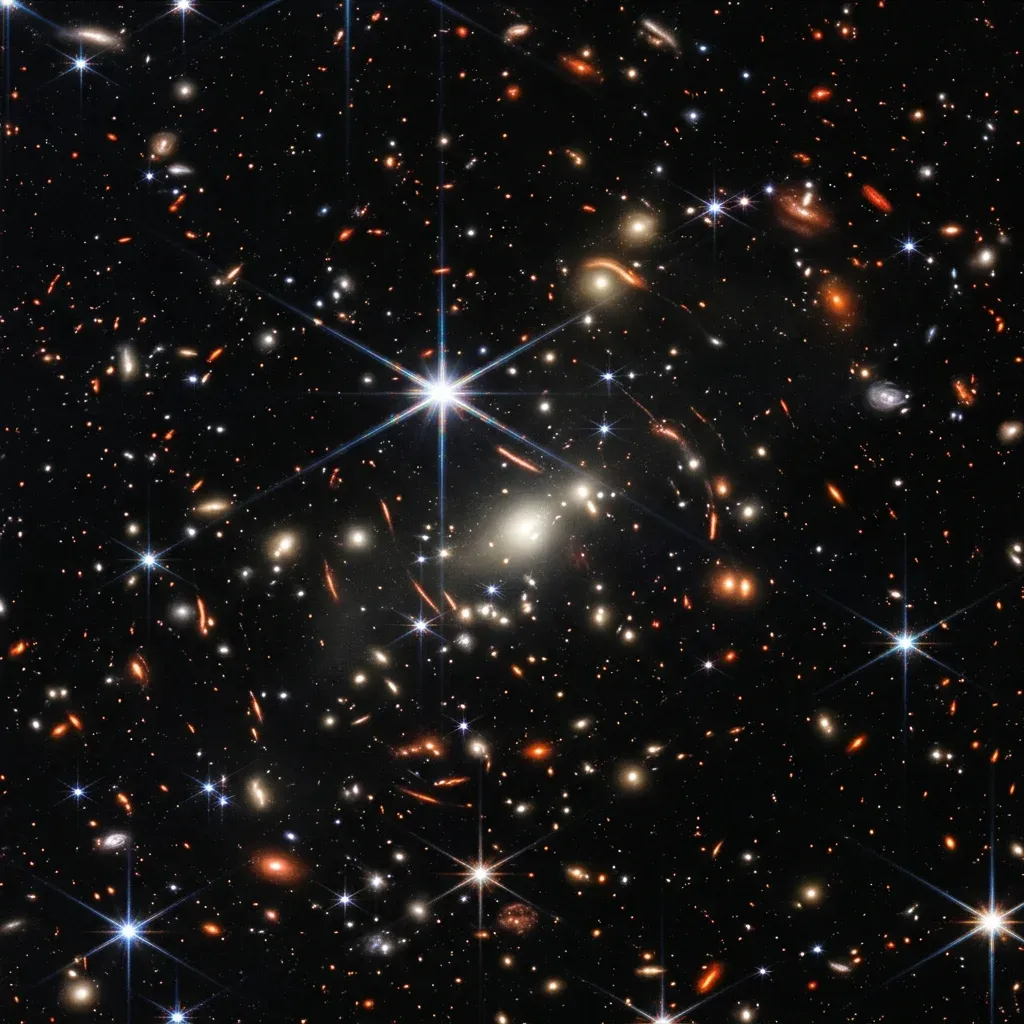
Eighteen months of calibration later, on July 12, 2022, NASA released the first full-color images. Scientists cried. Social media erupted. A cluster of galaxies called SMACS 0723 appeared not as a smudge but as a tapestry — thousands of ancient galaxies stretching across a patch of sky smaller than a grain of sand held at arm’s length. Some of those lights had been traveling toward us for more than 13 billion years.
We are going to talk about the most stunning JWST discoveries, why those findings matter, and why this telescope — more than any telescope before it — is genuinely rewriting the textbooks.
Key Takeaways
JWST observes in the infrared, allowing it to see through dust and detect light from the most distant — and therefore oldest — galaxies in the observable universe.
Its first images revealed unexpectedly large and bright galaxies in the early universe, creating genuine tension with existing cosmological models.
Webb has conducted the most detailed chemical analyses of exoplanet atmospheres ever achieved, detecting molecules including carbon dioxide, water, methane, and possibly dimethyl sulfide on K2-18 b.
Images of the Carina Nebula, Stephan’s Quintet, and Jupiter demonstrated Webb’s ability to reveal previously hidden details across a wide range of targets.
With an operational lifespan likely exceeding 20 years, JWST will define observational astronomy for the next generation.
What Makes JWST Different from Hubble
Before diving into discoveries, it is worth understanding what actually changed. The Hubble Space Telescope, launched in 1990, revolutionized astronomy by operating primarily in visible and ultraviolet light. It gave us stunning portraits of nebulae, measured the expansion rate of the universe, and helped confirm the existence of dark energy. Hubble is extraordinary, and it is still operating today.
But Hubble has a fundamental limitation when it comes to peering at the very early universe: light from the most distant objects is redshifted. As the universe expands, the wavelength of light stretching across that expanding space gets stretched too. By the time ancient starlight reaches us after a 13-billion-year journey, it has shifted entirely out of the visible spectrum and into the infrared. Hubble simply was not designed to see it.
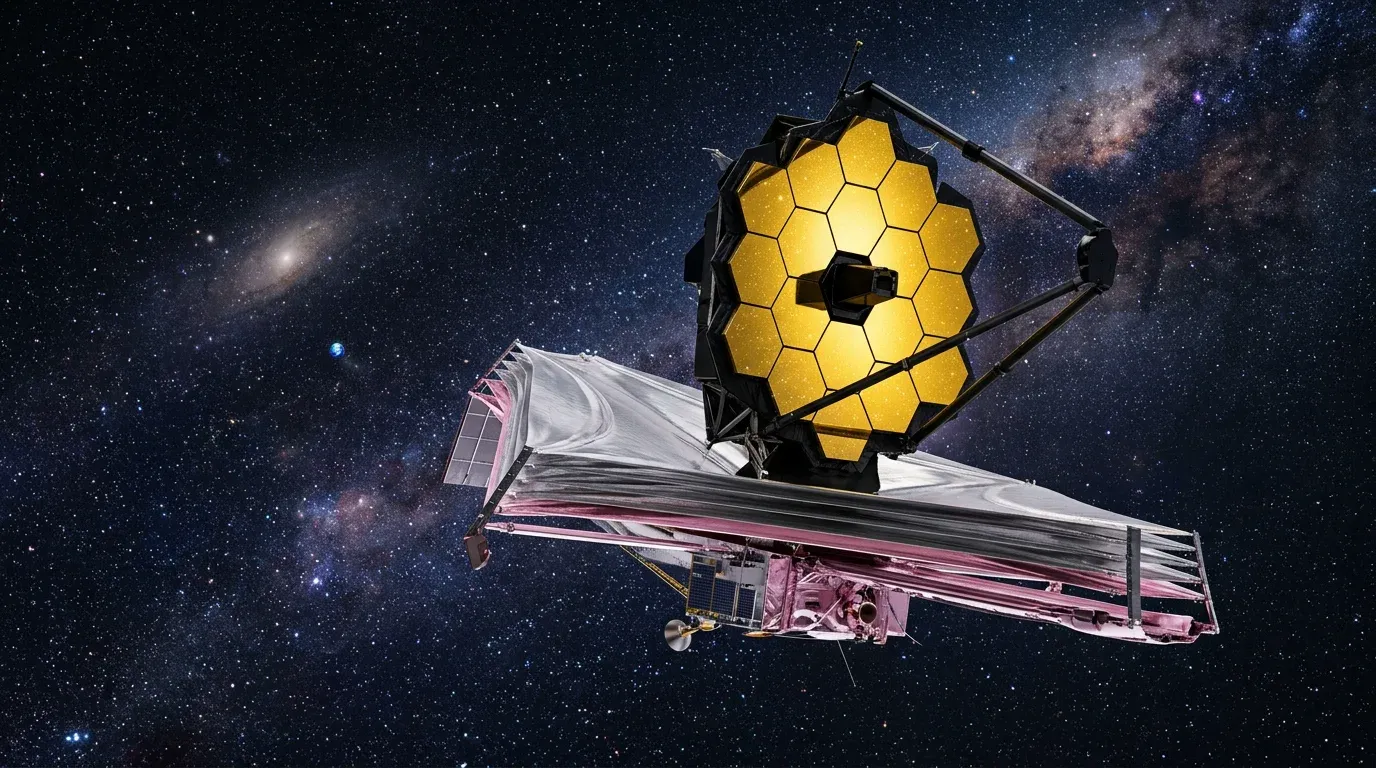
JWST was. Its 6.5-meter primary mirror — nearly three times the diameter of Hubble’s — is segmented into 18 hexagonal beryllium panels coated in a thin layer of gold, an excellent reflector of infrared light. The telescope is shielded from the Sun, Earth, and Moon by a five-layer sunshield the size of a tennis court, keeping its instruments at a frigid minus 233 degrees Celsius (about 40 degrees above absolute zero). Infrared astronomy demands this extreme cold because any warmth from the telescope itself would drown out the faint heat signatures from distant objects.
JWST's 6.5-meter primary mirror consists of 18 gold-coated beryllium segments designed specifically to capture faint infrared light.
JWST operates from Lagrange Point 2 (L2), a gravitational sweet spot about 1.5 million kilometers from Earth, where it orbits the Sun in lock-step with our planet. Unlike Hubble — which astronauts visited for repairs five times — JWST is far beyond any human reach. It had to work perfectly from the start.
The Instruments Aboard
Four scientific instruments share the focal plane: NIRCam (near-infrared camera), NIRSpec (near-infrared spectrograph), MIRI (mid-infrared instrument), and FGS/NIRISS (fine guidance sensor and near-infrared imager). Together they cover wavelengths from 0.6 to 28 micrometers, giving astronomers the ability not just to image objects in unprecedented detail, but to break their light apart into spectra — chemical fingerprints that reveal what those objects are made of.
That spectroscopic ability is, in many ways, JWST’s most powerful feature. Images dazzle. Spectra discover.
[!NOTE]
JWST’s primary mirror has a collecting area of 25.4 square meters — about six times greater than Hubble’s 4.5 square meters. More collecting area means more light gathered, which translates directly into sensitivity to fainter, more distant objects.
The Cosmic Cliffs and the Art of the Universe
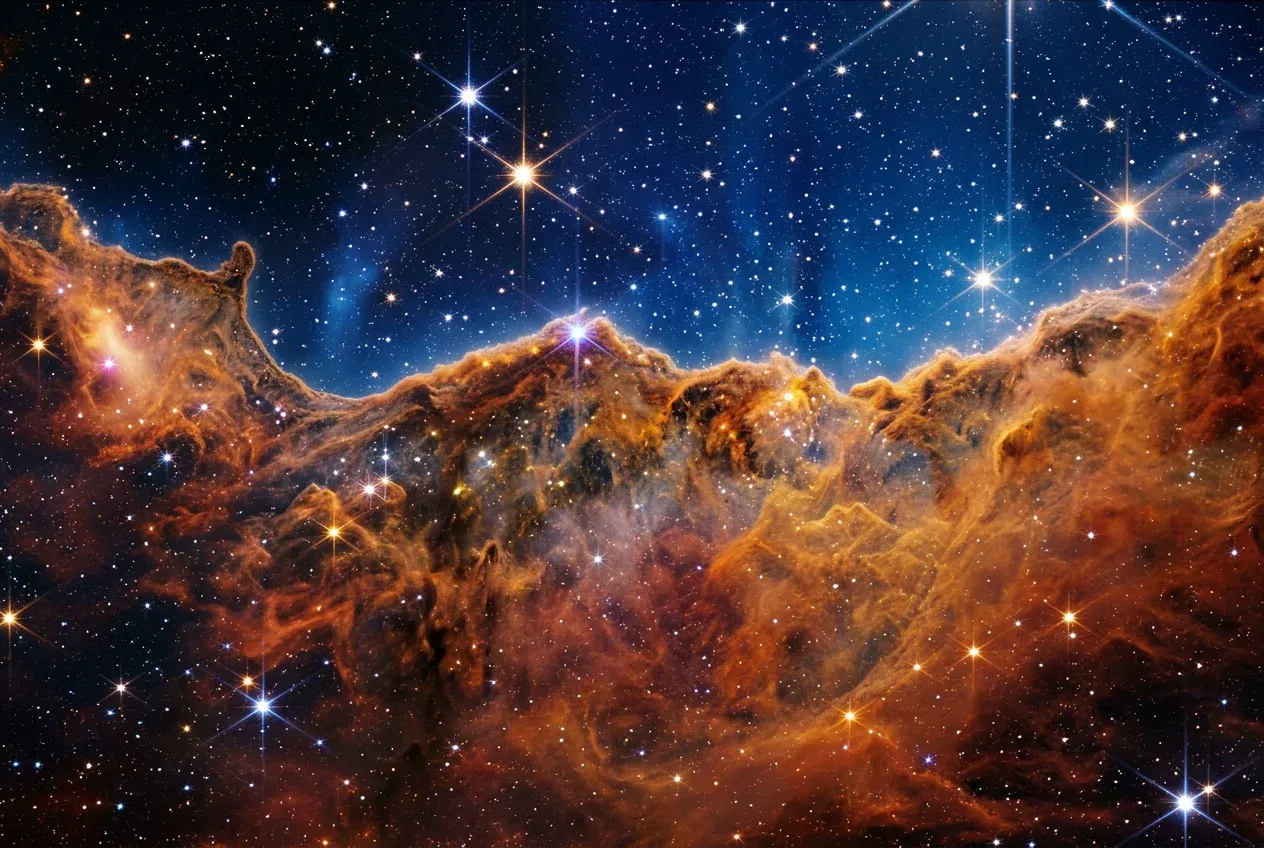
One of the first images released on July 12, 2022 — and perhaps the most visually arresting — shows what NASA called the “Cosmic Cliffs”: a towering landscape of gas and dust at the edge of a star-forming region in the Carina Nebula, about 7,600 light-years away. Previous images of Carina had been taken by Hubble. They were beautiful. Webb’s version was something else entirely.
Where Hubble showed a dense fog of gas, Webb’s infrared eyes pierced straight through to reveal previously hidden protostars — newborn stars still embedded in their cocoons of dust — erupting jets of material into surrounding space. Hundreds of never-before-seen young stellar objects appeared in the image. Astronomers studying star formation had to re-examine long-held assumptions almost immediately.
The Cosmic Cliffs of the Carina Nebula as seen by JWST's NIRCam. The orange landscape is actually the edge of a giant gaseous cavity roughly 7,600 light-years away.
The Stephan’s Quintet image released the same day showed five galaxies in a close gravitational dance — four of them interacting — with Webb capturing the shock waves from galactic collisions in exquisite detail. The mosaic contains over 150 million pixels, constructed from nearly 1,000 separate image files.
These early releases were not merely pretty pictures. They were proof of concept: the telescope worked, and it worked better than anyone had dared hope.
Peering at the Edge of Time: Early Galaxies
The biggest cosmological surprise JWST delivered came within weeks of science operations beginning. Astronomers using Webb’s deep field images began identifying galaxy candidates at redshifts far higher than expected — meaning objects from a time when the universe was only 300 to 400 million years old, roughly 3% of its current age.
By observing in the infrared, JWST can see ancient galaxies whose light has been stretched into redder wavelengths by the expansion of the universe.
The shock was not that old galaxies existed. The shock was how large and bright these early galaxies appeared to be.
Standard cosmological models had successfully predicted the cosmic microwave background, the distribution of galaxy clusters, and the formation timescales of structure in the universe. However, these models suggested that galaxies this massive simply should not exist this early. They had not had enough time to accumulate so many stars.
Several candidate galaxies detected by Webb in 2022 and 2023 appeared to contain stellar masses comparable to the Milky Way but existed when the universe was less than a billion years old. Follow-up spectroscopy confirmed many of these redshifts. The tension with the standard Lambda-CDM model of cosmology is real and, as of mid-2026, not fully resolved.
This does not mean the Big Bang model is wrong. It may mean that early star formation was more efficient than models predict, or that some of these objects harbor unusual stellar populations, or that active galactic nuclei contributed to their brightness. What it means, definitively, is that we are learning something genuinely new.
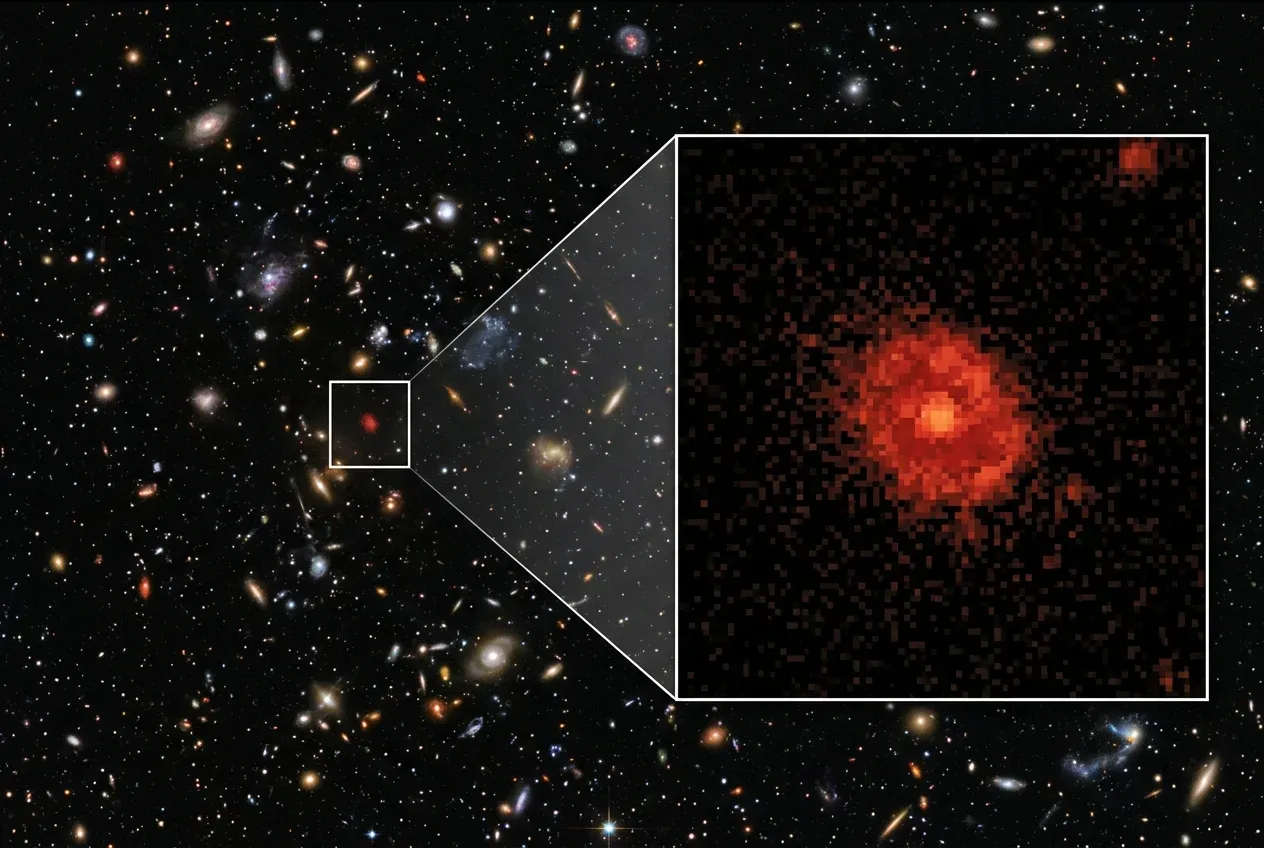
The JWST Advanced Deep Extragalactic Survey (JADES) represents one of the most ambitious observing programs in Webb’s early mission. By staring at a small patch of sky — overlapping with the original Hubble Ultra Deep Field — for hundreds of hours, JADES has identified thousands of galaxies in the early universe. One object, JADES-GS-z14-0, confirmed in 2024, is among the most distant galaxies ever spectroscopically confirmed, observed at a time when the universe was only about 290 million years old.
Surveys like JADES have identified galaxies existing just a few hundred million years after the Big Bang, challenging our models of early cosmic history.
What makes this detection stunning is that the galaxy is bright enough that it should not exist — at least not according to pre-Webb models. It contains oxygen, a relatively heavy element, indicating that stars had already gone through entire generations of birth and death within those 290 million years. Stars must have formed fast, lived short lives, and died violently very early in cosmic history.
Reading the Air of Other Worlds: Exoplanet Atmospheres
Beyond cosmology, Webb has quietly accomplished something that no telescope in history has done at the same level of detail: it has read the chemical composition of the atmosphere of worlds orbiting other stars.
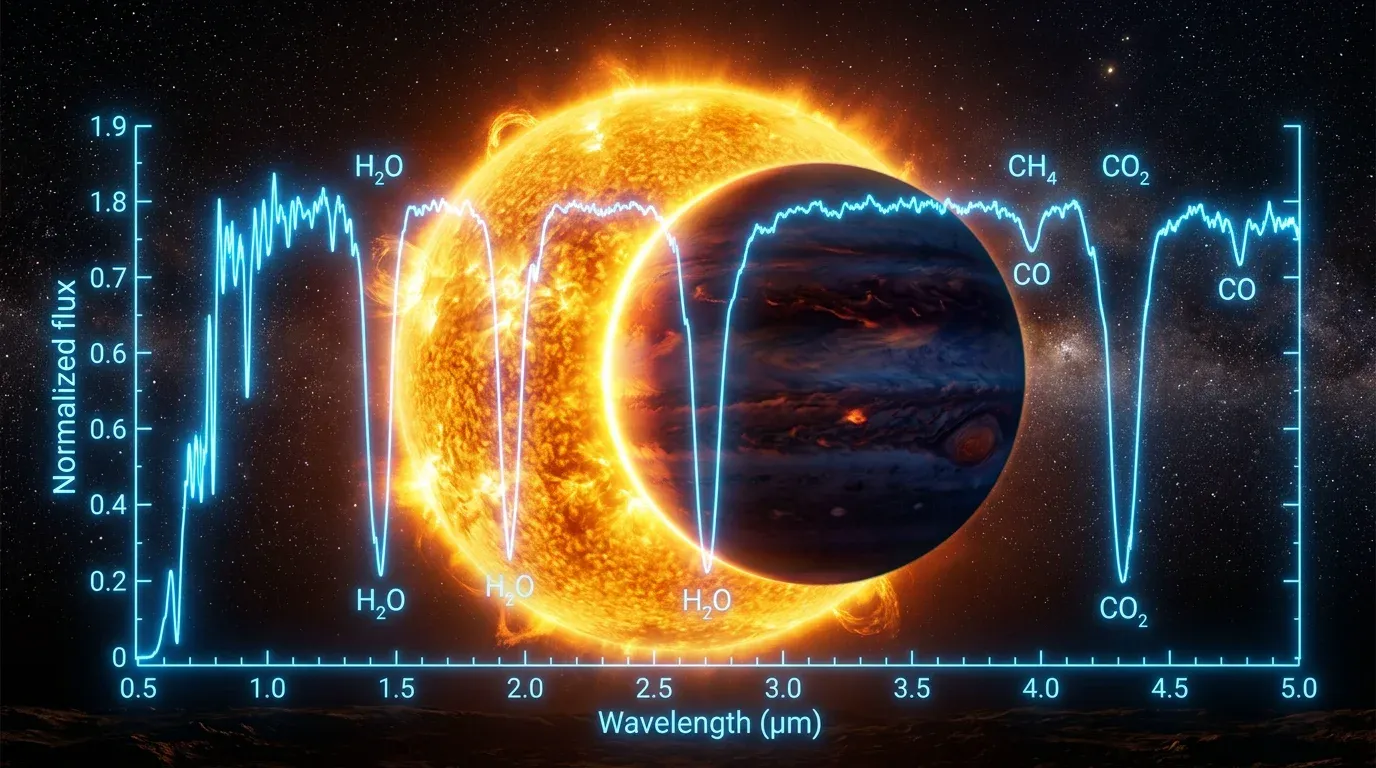
The technique is called transmission spectroscopy. When an exoplanet passes in front of its star, a tiny fraction of the starlight filters through the planet’s atmosphere. Different molecules absorb different wavelengths, leaving gaps — absorption lines — in the spectrum. By analyzing those gaps, astronomers can identify which molecules are present.
JWST’s sensitivity in the infrared makes it far superior to any previous telescope for this purpose, because most atmospheric molecules — water vapor, carbon dioxide, methane, ammonia — leave signatures in the infrared.
WASP-39 b: A Chemistry Textbook in One Spectrum
In November 2022, the Webb team published a landmark set of papers on WASP-39 b, a hot Saturn-like planet about 700 light-years away. The spectrum was unlike anything previously achieved. In a single sweep, Webb detected water vapor, carbon dioxide, sulfur dioxide, carbon monoxide, and sodium. The detection of sulfur dioxide was particularly significant — it is produced by photochemical reactions driven by starlight, the first time such a process had ever been directly observed in an exoplanet atmosphere.
As an exoplanet passes in front of its star, its atmosphere filters the starlight. JWST's spectrographs read this filtered light to identify molecules like water and carbon dioxide.
To be clear: WASP-39 b is a scorching gas giant with temperatures around 900 degrees Celsius, orbiting so close to its star that its year lasts just four Earth days. It is not habitable. But the fact that Webb can read this level of atmospheric chemistry at 700 light-years opens a tantalizing door for cooler, rocky planets in habitable zones.
K2-18 b: A Possible Ocean World
In September 2023, a team led by researchers at the University of Cambridge announced Webb detections of carbon dioxide and methane in the atmosphere of K2-18 b — an 8.6-Earth-mass planet in the habitable zone of a red dwarf star 120 light-years away. More provocatively, the data was consistent with the presence of dimethyl sulfide (DMS), a molecule that on Earth is produced almost exclusively by marine phytoplankton.
JWST data suggests K2-18 b might be a "Hycean" world—a planet with a hydrogen-rich atmosphere and a global liquid water ocean.
The researchers were careful: the DMS detection is tentative, requires confirmation with more observations, and could have abiotic explanations. The planet may be a “Hycean world” — a hypothetical class of ocean-covered planets with hydrogen-rich atmospheres — or it may not.
But the very fact that we can ask the question with real spectroscopic data is new. Before Webb, this conversation was theoretical. Now it involves actual evidence, however preliminary.
The Solar System, Up Close
Webb has not only looked outward. Closer to home, it has produced remarkable results within our own solar system.
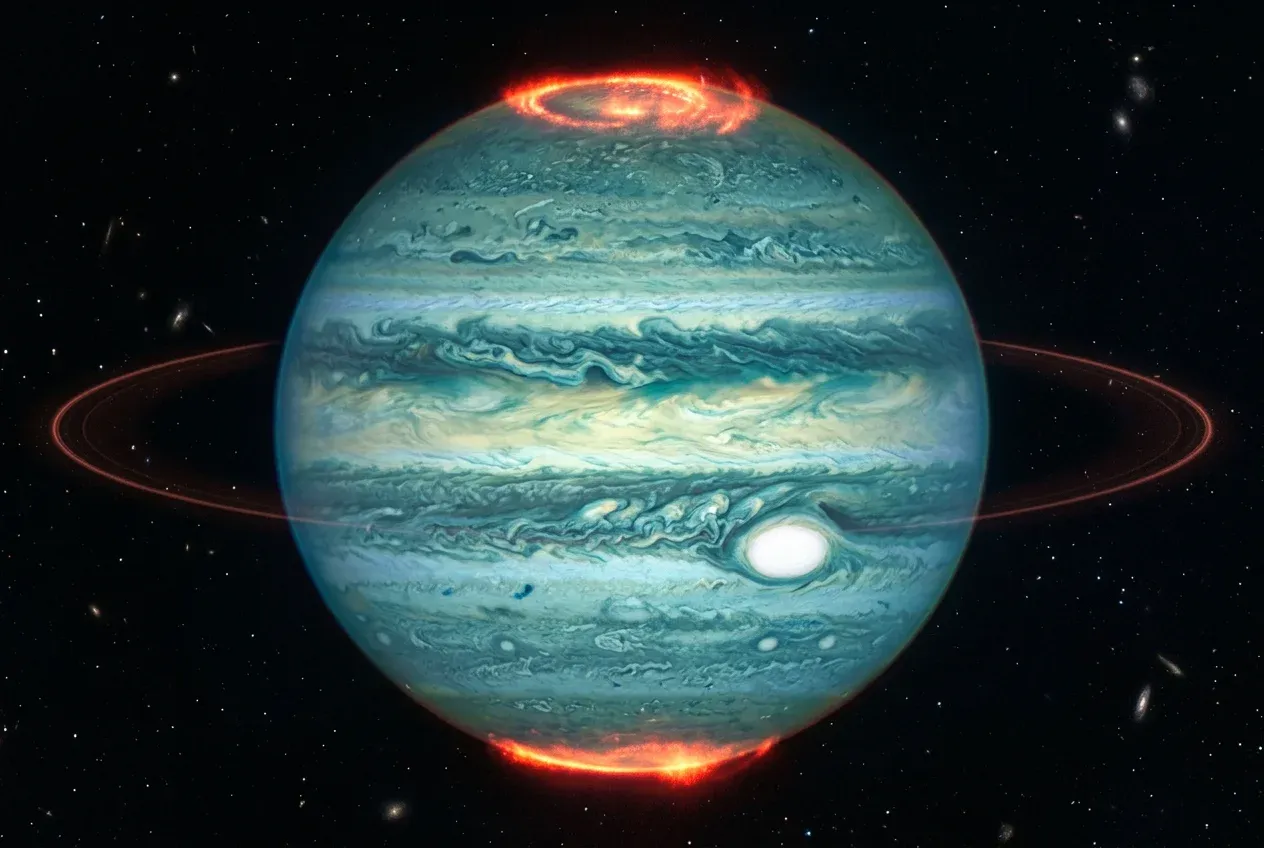
Images of Jupiter in 2022 revealed the planet’s auroras in unprecedented infrared detail, along with previously unseen features in its cloud bands and the faint outline of Jupiter’s ring system. Neptune’s rings appeared sharper than they had since the Voyager 2 flyby in 1989. Observations of Mars provided atmospheric spectra. Webb even captured Titan, Saturn’s largest moon, revealing storm clouds — possibly the first time active weather has been observed in Titan’s atmosphere from Earth orbit.
Jupiter as seen by JWST's NIRCam. The bright auroras at both poles, ring system, and moons Amalthea and Thebe are all visible in this composite.
A Continuing Partnership: Webb and Hubble
As established earlier, it would be a mistake to frame JWST as simply a better Hubble. They are fundamentally different instruments designed to answer different questions.
Hubble still leads in ultraviolet observations and in the visible light range where human eyes operate. Hubble’s images — the Pillars of Creation, the Hubble Deep Field, the Eagle Nebula — remain iconic and scientifically irreplaceable. Webb cannot replicate them because it does not observe at those wavelengths.
What Webb does that Hubble cannot is see through dust, detect the signatures of the very first stars and galaxies, and characterize exoplanet atmospheres in chemical detail. The two telescopes are, ideally, complementary — and astronomers routinely propose joint Hubble-Webb observing campaigns for exactly that reason.
One practical difference: Hubble was serviced in orbit by Space Shuttle crews, extending its life repeatedly. Webb has no such option. Its lifespan depends on the fuel used for orbital maintenance and attitude corrections. The initial estimates suggested 10 years of operations; an unusually precise launch meant far less fuel was consumed than budgeted, and NASA has since updated operational estimates to 20 years or more.
What Comes Next
Webb’s mission is still early. Its science operations began in earnest in mid-2022, and the telescope is expected to operate well into the 2040s if hardware permits. The queue of approved science programs covers everything from the magnetic fields of distant quasars to the moons of dwarf planets in the Kuiper Belt.
Among the most anticipated upcoming programs are long-duration observations of TRAPPIST-1, the red dwarf system hosting seven Earth-sized planets, three of which sit in the habitable zone. Early Webb spectra of TRAPPIST-1 b and c have not yet detected substantial atmospheres — but the search is ongoing, and each observation adds critical constraints.
The search for oxygen in an exoplanet atmosphere — the true biosignature — remains out of Webb’s reach for most targets. It would require thousands of hours of observation time on nearby rocky planets. But the roadmap to doing exactly that has been laid.
Are you curious why we invest so much in missions like JWST? You may want to know more about why we explore space?
How far can the James Webb Space Telescope see?
JWST can detect light from galaxies that existed when the universe was only about 200 to 300 million years old — more than 13 billion years ago. In terms of distance, this corresponds to objects roughly 13.5 billion light-years away, though due to the expansion of the universe, they are now much farther.
Why is JWST better than the Hubble Space Telescope?
JWST is not strictly better — it is optimized for different wavelengths. Webb observes primarily in infrared light, which allows it to see through dust clouds and detect ancient, redshifted light from the early universe. Hubble observes in visible and ultraviolet light and remains valuable for those wavelengths. The two telescopes are complementary.
Has JWST found signs of life on other planets?
Not definitively. Webb detected a tentative signal of dimethyl sulfide — a molecule associated with marine life on Earth — in the atmosphere of K2-18 b, but this requires confirmation and may have non-biological explanations. The search for genuine biosignatures is ongoing.
Where is the James Webb Space Telescope located?
JWST orbits the Sun from Lagrange Point 2 (L2), a gravitationally stable location about 1.5 million kilometers from Earth in the direction away from the Sun. It cannot be serviced by astronauts.
How long will JWST operate?
Originally estimated at a minimum 10-year mission, the precise launch trajectory consumed far less fuel than planned. NASA now expects JWST can operate for 20 years or more, well into the 2040s, assuming hardware remains functional.
Robertson, B. E., et al. (2023). “Identification and properties of intense star-forming galaxies at redshifts above 10.” Nature Astronomy, 7, 611–621. https://doi.org/10.1038/s41550-023-01921-1
Madhusudhan, N., et al. (2023). “Carbon-bearing Molecules in a Possible Hycean Atmosphere.” The Astrophysical Journal Letters, 956(1), L18. https://doi.org/10.3847/2041-8213/acf577
Gardner, J. P., et al. (2023). “The James Webb Space Telescope Mission.” Publications of the Astronomical Society of the Pacific, 135, 025001. https://doi.org/10.1088/1538-3873/ac9430
Did this spark your curiosity?
Applaud the article to let us know. You can clap multiple times!
Enjoyed this exploration?
Share this article with fellow science lovers, researchers, and curious minds.
We use cookies to ensure you get the best, fastest experience on our website and to show you content you actually care about. By clicking "Accept All", you consent to our use of cookies.
Cookie Preferences
Strictly Necessary
These cookies are essential for the website to function properly and cannot be disabled in our systems.
Analytics Cookies
These cookies allow us to count visits and traffic sources so we can measure and improve the performance of our site.
Advertising Cookies
Used by our advertising partners (like Google AdSense) to build a profile of your interests and show you relevant ads.