Lightning: A Natural Phenomenon
Discover the incredible physics behind how lightning forms, why thunder follows, and how to calculate a lightning strike's distance.
Discover the incredible physics behind how lightning forms, why thunder follows, and how to calculate a lightning strike's distance.
Lightning, thunder, and the sheer terror of a raging storm. When the sky cracks open and illuminates the night, it is both one of the most beautiful and most terrifying spectacles in nature. Many people are instinctively afraid of lightning and the deafening sound of thunder that follows. But what exactly is happening up there?
Let’s discuss about how does lightning form and how can we calculate our approximate distance from lightning in a matter of seconds.
To understand lightning, we first have to understand the environment that creates it: the Cumulonimbus cloud, also known as a thunderhead. These massive clouds can tower up to 60,000 feet into the atmosphere, where temperatures drop well below freezing.
Inside these towering clouds, powerful updrafts and downdrafts create a highly turbulent environment. Tiny ice crystals (which are positively charged) are forced upward, while heavier slushy hail or graupel (which are negatively charged) fall toward the bottom of the cloud. This constant friction acts like a giant atmospheric battery, separating charges on a massive scale.
Eventually, the top of the cloud becomes highly positively charged, and the bottom of the cloud becomes fiercely negatively charged.
If the Earth’s surface and the bottom of a thundercloud both have opposite electrical charges that desperately want to connect, why doesn’t lightning just strike continuously like a laser beam? The answer is that air is a fantastic electrical insulator! It takes an unfathomable amount of voltage to finally “break” the air and allow electricity to flow.
Because like charges repel, the massive negative charge at the base of the cloud begins to push away electrons on the Earth’s surface directly below it. This leaves the ground, trees, and buildings with a strong positive charge, setting the stage for a dramatic electrical discharge.
When the electrical potential difference becomes too great for the insulating air to hold back (often exceeding 100 million volts), the cloud finally releases its energy.
A channel of negatively charged, ionized air begins to snake its way down toward the ground in a jagged, branching pattern. This is called a stepped leader. It moves incredibly fast—about 200,000 miles per hour—but it is nearly invisible to the naked eye.
As the stepped leader approaches the ground, the intense electric field causes positively charged channels to reach up from tall objects like trees, skyscrapers, and even people. These upward-reaching channels are called positive streamers.
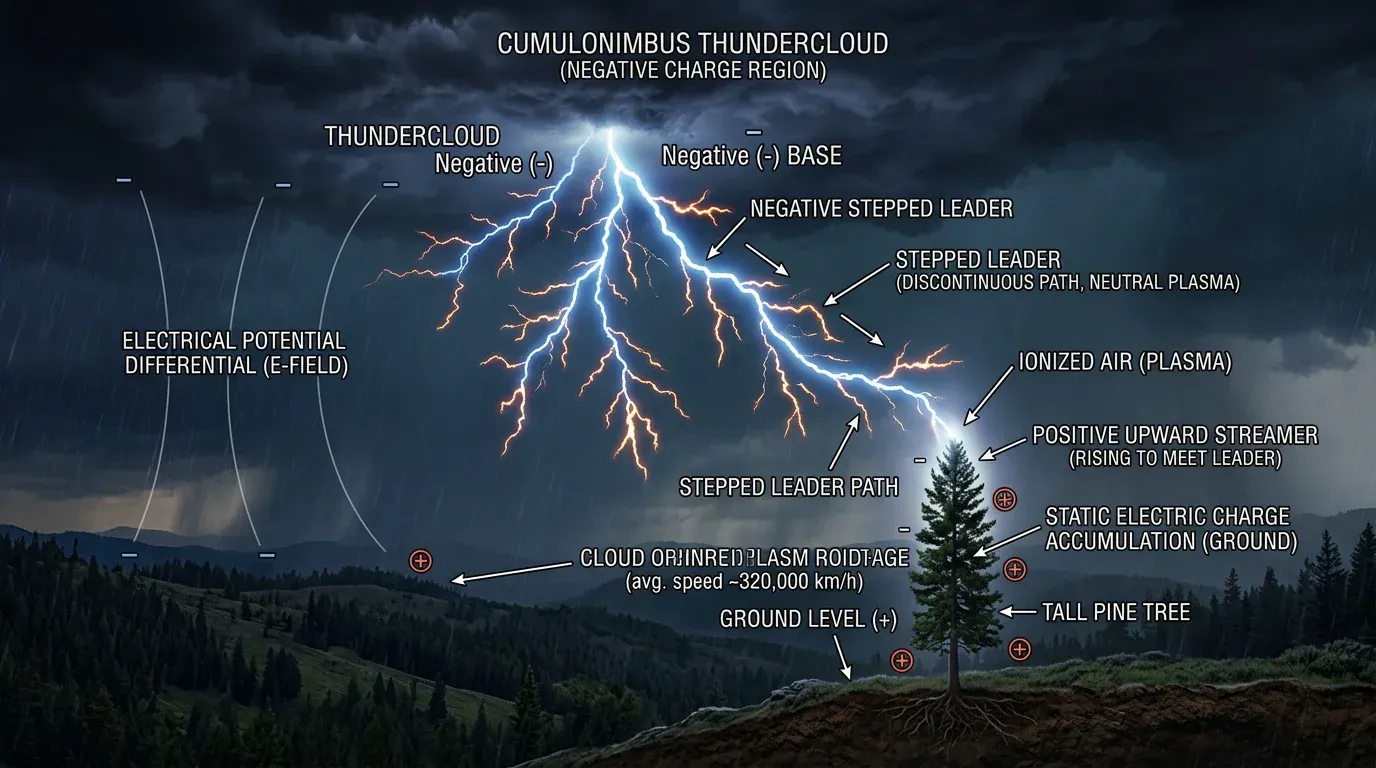
When the stepped leader and a positive streamer finally connect, the circuit is closed. A massive surge of electrical current rushes upward from the ground to the cloud at one-third the speed of light. This is the return stroke, and it is the brilliant flash of light that we actually see.
You cannot have thunder without lightning. They are two halves of the exact same physical event.
When that massive return stroke blasts through the air, it carries a phenomenal amount of energy. In a fraction of a millisecond, the lightning bolt superheats the narrow channel of air around it to approximately 30,000 Kelvin (53,540 degrees Fahrenheit). To put that into perspective, that is roughly five times hotter than the surface of the Sun!
This extreme, instantaneous heating causes the air inside the channel to expand explosively outward. This rapid expansion creates a shockwave that compresses the surrounding air, which then quickly contracts as it cools.
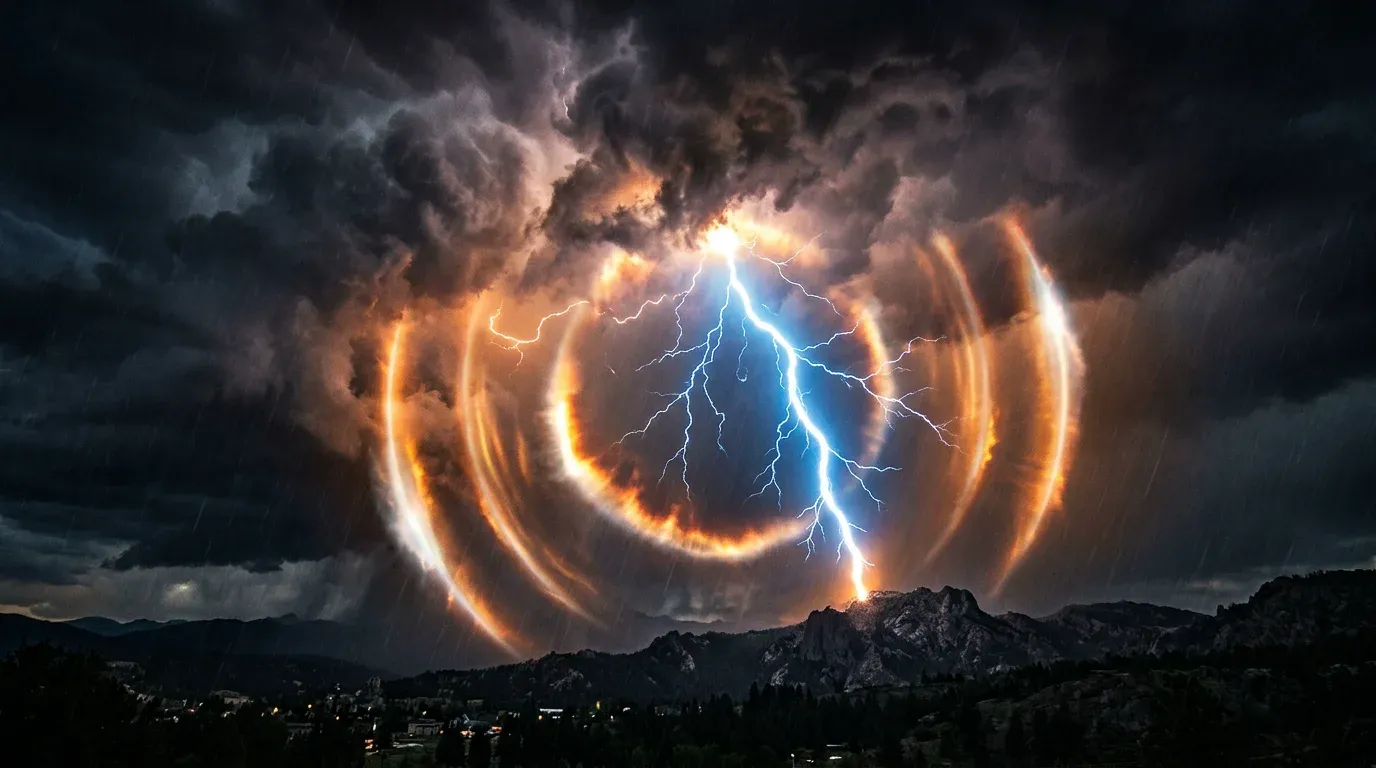
This violent expansion and contraction is a massive acoustic shockwave — a sonic boom that we perceive as thunder. Like all sound, thunder is a mechanical longitudinal wave propagating through the air. The rumbling sound that follows the initial “crack” is caused by the sound waves bouncing and echoing off mountains, buildings, and different layers of the atmosphere.
The mathematical trick used to calculate your distance from a lightning strike by measuring the time delay between the flash and thunder is very similar to how seismologists locate earthquake epicenters! They measure the time difference between the fast-moving P-waves and the slower S-waves.
According to the National Weather Service, approximately 100 lightning bolts strike the Earth’s surface every single second. If you find yourself caught in a storm, it is incredibly useful to know exactly how far away those strikes are so you can gauge whether the storm is moving toward you or away from you.
Because light travels much faster than sound, we can use the time delay between seeing the flash and hearing the thunder to calculate the distance.
To calculate your distance from the strike, follow this simple procedure:
If you prefer to calculate the distance in kilometers, you can use a slightly different ratio (since sound travels about 1 kilometer every 3 seconds):
Example: If you see a flash of lightning and count 10 seconds before hearing the thunder, the lightning strike occurred exactly 2 miles away (). If you measure the next strike and the gap is only 5 seconds, the storm is moving closer to you!
Here is a quick video breakdown of how to perform this calculation in the real world:
While it is fun to calculate the distance of a storm, safety must always come first. If you can hear thunder, you are close enough to be struck by lightning. The National Weather Service uses the motto: “When thunder roars, go indoors!” Never stand in an open field, under a solitary tree, or near bodies of water during a thunderstorm.
Light travels at approximately 300,000 kilometers per second, which is much faster than the speed of sound (about 343 meters per second in air). Therefore, the light reaches our eyes almost instantly, while the sound wave takes several seconds to cross the physical distance to our ears.
Yes, this is a common myth! Lightning frequently strikes the same place twice, especially if it is a tall, isolated object like a skyscraper or a radio tower. For example, the Empire State Building is struck by lightning about 25 times per year.
Only the violent updrafts and downdrafts inside massive Cumulonimbus clouds can create the immense charge separation (potential difference) necessary to overcome the insulating properties of the air. When the weather stabilizes, the charges neutralize.