The Fundamental Forces of Nature
Discover the four fundamental forces of nature - Gravity, Electromagnetism, the Strong Nuclear Force, and the Weak Nuclear Force - that govern the entire universe.
Discover the four fundamental forces of nature - Gravity, Electromagnetism, the Strong Nuclear Force, and the Weak Nuclear Force - that govern the entire universe.
We all are familiar with the physical sensation of force. Daily, we sit, stand, and walk. In every work we do, we apply force to something in order to get a reaction that helps us attain our desired goal.
We push the floor while we walk, we push the ground and chair when we stand up, we pull the door when we open it. There are just so many things to name, because in every moment we are using these fundamental forces of nature, yet we are not aware of their true nature.
Gravity is perhaps the most familiar of the four forces. It is the force that keeps our feet firmly planted on the ground, holds the Earth in its orbit around the Sun, and binds galaxies together into massive cosmic webs.
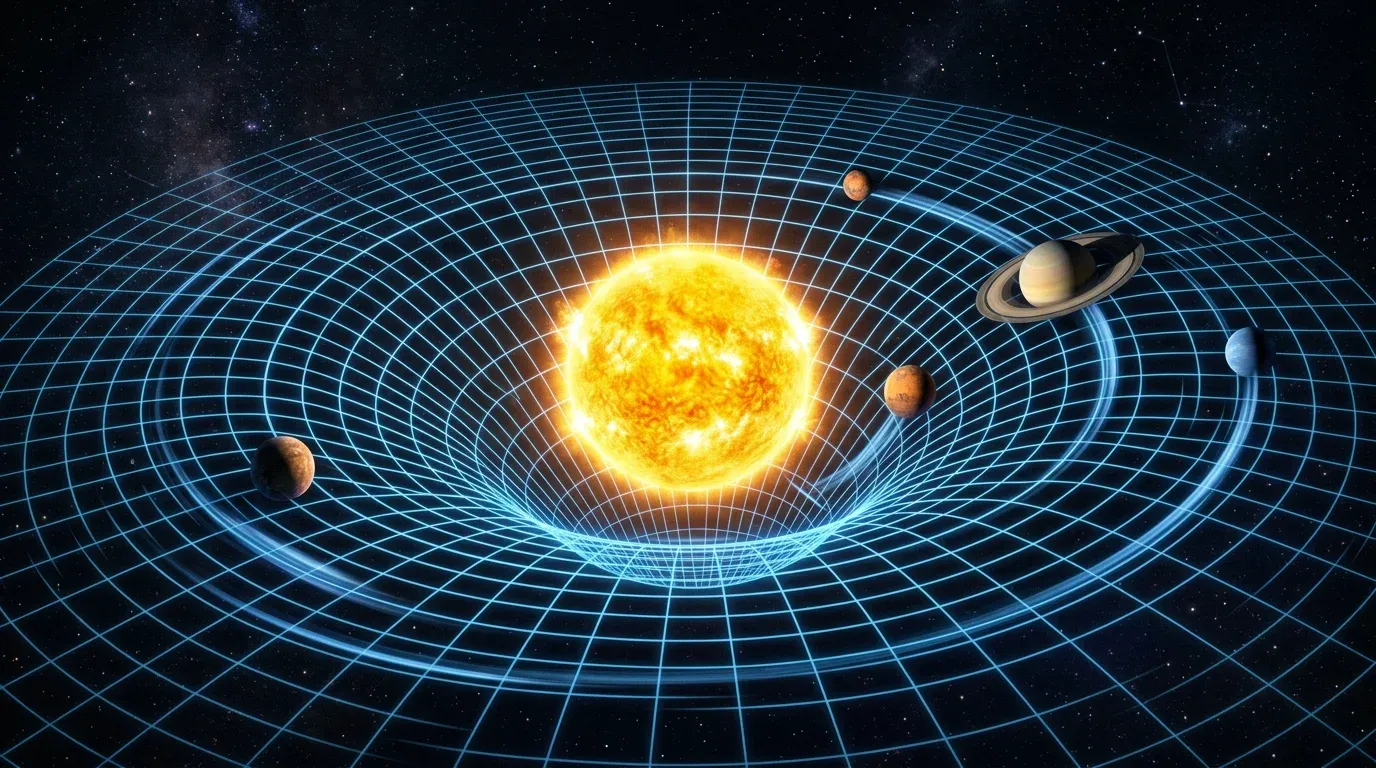
According to Isaac Newton, gravity is an attractive force between any two objects with mass. The more massive an object, and the closer it is, the stronger its gravitational pull.
However, Albert Einstein’s General Theory of Relativity provided a deeper understanding: gravity is actually the curvature of spacetime caused by mass and energy. Massive objects like planets and stars warp the fabric of space around them, and other objects simply follow the curves of this warped space.
The gravitational force is given by the following formula.
F is the gravitational force acting on both of the masses and .
G is the universal constant having the value .
r is the straight distance or displacement distance between the center of masses of the two bodies.
Electromagnetism is the force responsible for almost all the phenomena we experience in daily life (other than gravity). It includes both electricity and magnetism, which physicists realized in the 19th century are two sides of the same coin.
Have you ever wondered why you don’t fall through the floor, even though atoms are mostly empty space? It’s not gravity, it’s electromagnetism! The electrons in your shoes repel the electrons in the floor, creating the sensation of solidity.
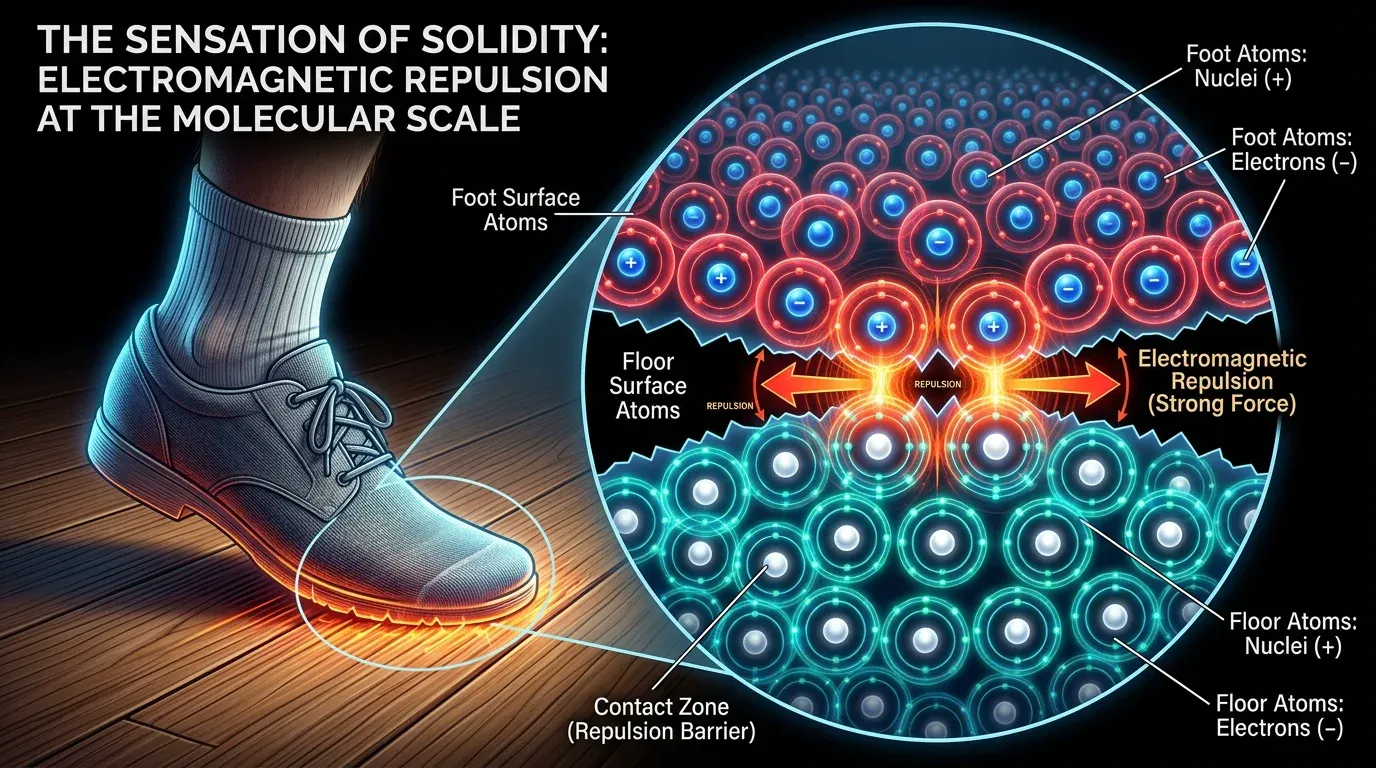
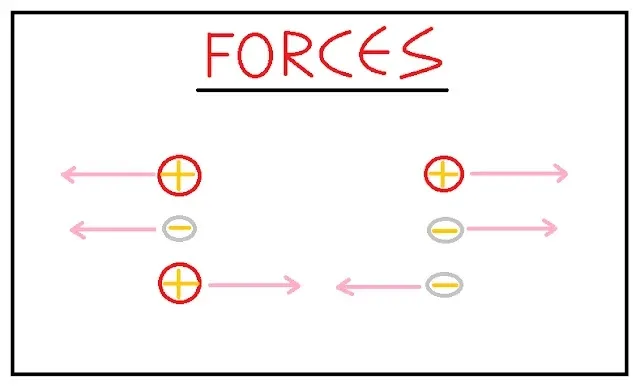
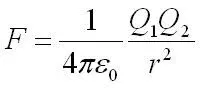
Electromagnetism acts between particles that have an electric charge. Like charges repel each other, while opposite charges attract. These interactions are carried by massless particles called photons (which also make up visible light).
This force holds electrons in orbit around atomic nuclei, allowing atoms to bond together to form molecules. Therefore, electromagnetism is responsible for the structure of all matter, chemical reactions, friction, and even the biological processes occurring in your body right now.
If like charges repel each other due to electromagnetism, why don’t atomic nuclei fly apart? The nucleus is packed with positively charged protons that should fiercely repel each other. The answer is the strong nuclear force.

The strong force is the “glue” that holds the nucleus of an atom together. It acts between protons and neutrons (and the fundamental particles that make them up, called quarks). The force is carried by exchange particles fittingly called gluons.
The weak nuclear force (or weak interaction) is the most subtle of the four forces. Unlike the others, which either pull things together or push them apart, the weak force primarily plays a role in particle decay and changing the flavor of quarks.
The weak force allows protons to turn into neutrons, and vice versa, through a process known as beta decay. This process is mediated by the exchange of heavy particles known as W and Z bosons.
For decades, physicists have sought a single theoretical framework that unites all four forces into one “Grand Unified Theory” (or a “Theory of Everything”).
So far, scientists have successfully unified electromagnetism and the weak force into the electroweak force, which exists at incredibly high energies (like those just after the Big Bang). However, incorporating the strong force, and especially gravity, remains one of the greatest unsolved mysteries in modern physics.
The Strong Nuclear Force is the strongest of the four forces, roughly 137 times stronger than electromagnetism.
Both Gravity and Electromagnetism have an infinite range, although their strength decreases over distance.
The exact reason why gravity is so weak compared to the other forces is still a major unsolved problem in physics, often referred to as the Hierarchy Problem.
Applaud the article to let us know. You can clap multiple times!