Step into the world of paleontology to learn how fossils are formed, mined, and what they tell us about Earth's history.
Scroll to read
When we think of our planet’s distant past, our minds often conjure images of towering dinosaurs, giant prehistoric insects, and bizarre marine creatures that swam in ancient, forgotten seas. But how do we know these creatures existed? The answer lies in paleontology. Far from just digging up dinosaur bones, paleontology is the rigorous scientific study of ancient life, acting as a time machine that allows us to piece together the history of life on Earth.
Paleontologists analyze fossils — the mineralized remains or preserved traces of ancient organisms — they can reconstruct entire extinct ecosystems just from fossil remains. This is a multidisciplinary science that relies on the combined efforts of geology, biology, chemistry, and physics to map out how life evolved from the ancient times, how species adapted to drastic environmental shifts, and ultimately, why certain lineages survived while others perished in history. As new technologies emerge and new fossils are unearthed, our understanding of the prehistoric world continues to get better, providing critical insights that also helps us direct modern conservation efforts.
Define Paleontology?
Paleontology is the scientific study of life that lived on the Earth very long ago, in the scale of millions of years. For example, dinosaurs had been living on this planet during Mesozoic era, which lasted from 252 to 66 million years ago. In the present, all the dinosaurs are extinct and only their fossils are remaining in the depths of Earth. Scientists or specifically Paleontologists search and study on the fossils of the dinosarus and try to derive some conclusions regarding the dinosaur’s features and publish their research if they discover something new.
In simple words, paleontology is a science that studies the history of life on Earth.
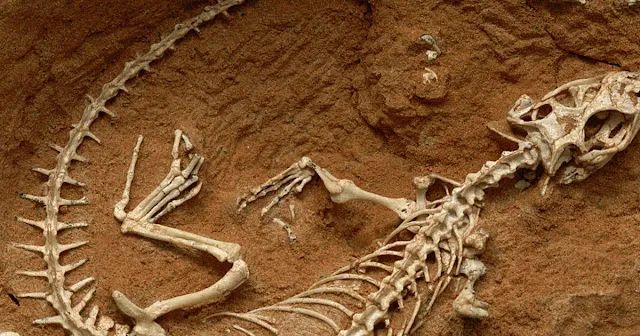
well preserved giant dinosaur fossil
Paleontology is a very interesting and fascinating field that allows us to learn about the animals that once lived on the same planet where we are currently living.
Paleontology also unfolds the secrets of our plant’s past. Be it the biggest dinosaur or the tiniest ancient micro-organism, paleontologists research all of them to know what existed before us. These researches may also help to explain how we came into existence and many more things that we are still unaware of.
History Of Paleontology
In ancient times, people thought of fossils as the remains of some ancient mythical creatures while in some place it was taken as ill omen for catastrophic events.
Renaissance and Early Modern Era (15th - 18th Century)
In this era, some scholars laid down the path for Paleontology, not entirely but they worked on the ancient remains or skeletons that were buried under the Earth.
These scholars are :
Leonardo da Vinci : He was the first among his times to think logically about the fossils and observe them scientifically. But due to the lack of scientific knowledge at his time he wasn’t able to go much further.
Nicolaus Steno : He was a Danish Naturalist and Geologist. He laid down the foundations for modern geology by concluding that fossils were the remains of organisms that once lived on this land.
Georges Cuvier : He was a French Naturalist and made significant contributions to paleontology by studying and classifying fossils. He also proposed the concept of extinction.
The Birth Of Paleontology (Late 18th - 19th Century)
The period between late 18th and 19th century was marked as the birth of paleontology in the discipline of science.
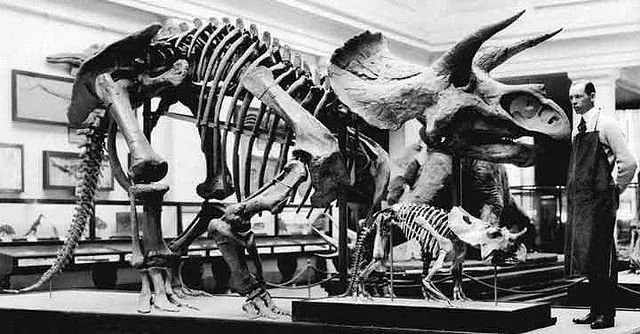
A black and white photo of two well preserved Triceratops dinosaur fossils.
Some great discoveries and contributions in this time were :
Discovery of Jurassic Coast of England, including the first complete Ichthyosaurus skeleton by British paleontologist Mary Anning.
“Recherches sur les ossements fossiles”, research paper by French anatomist and paleontologist Baron Georges Cuvier, it explains many crucial principles of vertebrate paleontology.
In 1859, Charles Darwin’s theory of evolution had a great impact on paleontology since it gave us a framework for understanding the diversity of life through time.
The fossil records confirm the gradual changes that were predicted by Darwin’s theory, providing the physical evidence of how natural selection works.
Bone Wars (Late 19th Century)
Bone Wars refers to the period of intense fossil discoveries in North America. It happened between paleontologists Edward Drinker Cope and Othniel Charles Marsh. Their competition helped to discover many new ancient species and discoveries.
The Rise of Dinosaur Paleontology (Late 19th - 20th Century)
What do you generally think if we talk about “Paleontology” or “fossils”, for most of the people it is giant skeleton of dinosaurs buried under sand. Is it true for you or not?
During the search of ancient remains or fossils, we generally get dinosaur skeletons of different species all around the world. And also these big skeletons creates curiosity and awe in people, thus the term - dinosaur paleontology became famous and now a days paleontology is compared with dinosaur fossils.
With the help of various technological advancement, and using techniques such as radiometric dating, we were able to know the exact age of fossils and rocks.
Modern Paleontology (20th Century - present)
There are also a lot of fossils which have delicate parts that can’t be taken out easily otherwise the whole fossil will be destroyed and can’t be analyzed. But it can’t be analyzed if it is not taken out first.
Modern technologies solved this problem such as Computed Tomography (CT) scanning to map the surface of a fossil in detail and 3D printing to build a polymer model based on the blueprint. Paleontologists study the models that these techniques make and give their discoveries.
Fossils And Their Importance In Paleontology
Fossils are very important in Paleontology because they give evidence of past life. By studying the fossils, Paleontologists can find - how life, landscape and climate have changed over time. Fossils also provide information about :
Extinct animals and plants
How living things responded to changes in their environment
The adaptation of plants and animals to their environments
The evolutionary relationships between different groups of organisms
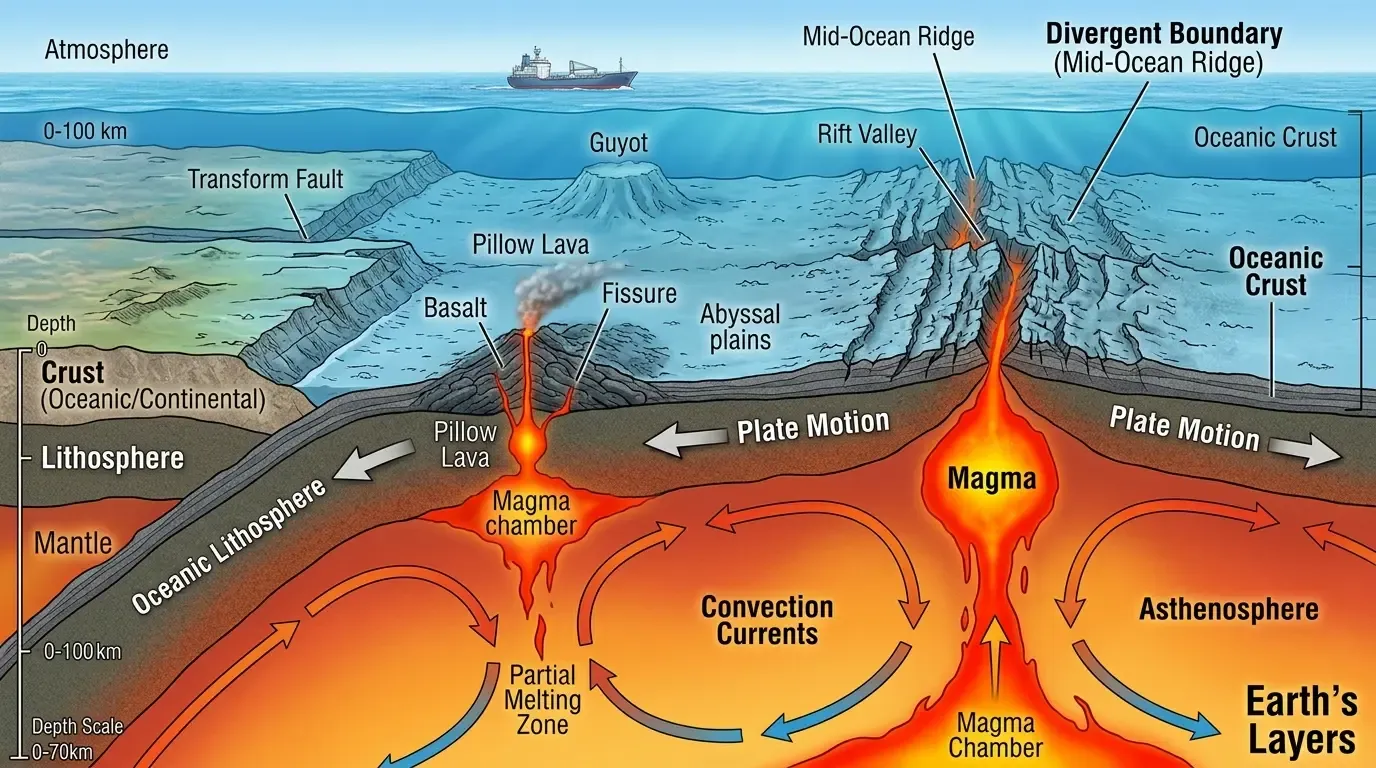
One important thing to notice is that how identical fossils ended up on continents separated by vast oceans? It means that the continents were connected in the past which provides early proof for plate tectonics.
various tools used in fossil excavation.
The study of paleontology also reveals the process of evolution and how particular species have evolved and under what condition and time as well.
Fossils are of two types :
Body fossils, which include the body, unaltered or altered, hard or soft parts, naturally formed molds and casts.
Trace fossils, which include foot prints, trails, burrows and tubes, and coprolites (fecal matter).
Methods And Techniques Used In Paleontology
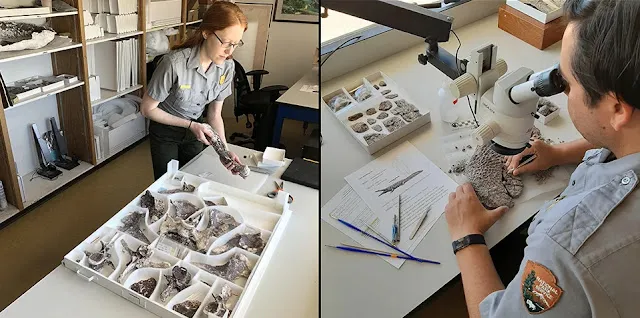
Paleontologists use a variety of methods and techniques to extract the fossils and examine it to discover useful and new information from the fossils and rocks. Here are some few methods and techniques :
Fieldwork and Fossil Collection
Stratigraphy
Radiometric Dating
Morphological Analysis
Microscopy
X-Ray and CT Scanning
Chemical Analysis
DNA Analysis
3D printing and digital modeling
Geographic Information System (GIS).
How Fossils Are Formed?
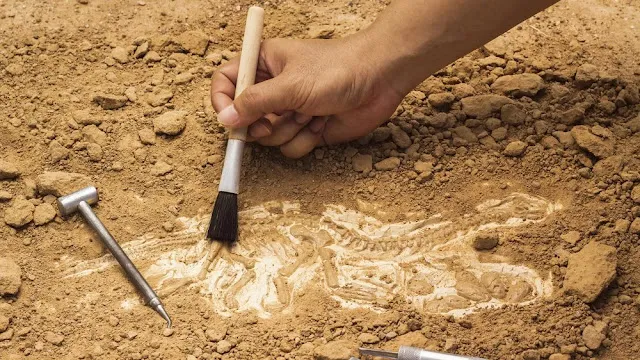
clearing the baby dinosaur fossil using brush.
Fossils are formed when a living organisms dies and is preserved by some natural process over millions of years. It can be plant, animal, micro-organism or even their traces. There are a lot of ways in which fossils are formed but there’s one thing in common that it takes enormous amount of time, here I have explained some ways of how fossils are formed :
Death of an Organism : Naturally it all starts when a plant of animal dies or gets buried under layers of Earth.
Rapid Burial : We know if a plant or an animal dies, it starts to decompose. So for fossilization to occur, the dead body needs to be preserved quickly i.e. naturally it gets buried and slows down the decomposing process and a very few of them get successfully fossilized and travels millions of years ahead.
Sediment Accumulation : When time passes more layers of soil or sand comes over and compacts the buried organism, creating more pressure and aids in its prevention.
Mineralization : It is one of the most common process of fossilization. We know water contains different kinds of minerals, especially groundwater. This water percolates under the Earth and reaches the dead organism thus petrifying it’s shape and structure. Most famous of this kind is the petrification of wood.
Compression : This generally happens in plant and leaves fossils. In this the accumulation of sand or soil on the upper layers compress the plant or leaf body, flattening it and preserving some of it’s parts from getting decomposed, thus creating a plant or leaf fossil with the help of compression.
Impression and Carbonization : This happens when the dead organism is being is tight contact of a rock or mineral rock. The rock get imprinted by the structure of dead organism and some carbons also gets attached as well while the dead body decomposes but it’s structure and a very small amount of carbon is preserved through the Impression on the rock.
Freezing or Drying : This generally happens with the organisms that live in cold regions or during the ice age on the Earth. Although it is very rare to be found, but paleontologists have found quite a few of these such as baby mammoths and ancient human remains. They have quite a detailed preservation because due to freezing and drying their skin might be preserved as well as some other soft parts of the body.
Amber Encasement : Amber is a hardened resin that comes from trees. Suppose some small insects or may be even small vertebrates gets inside of amber from an ancient tree, the amber will harden and it will preserve the dead organism in a very remarkable detail.
Fossilization is not an easy process, it’s a complex process that takes million of years to get done. And not all the organisms from the past get fossilized but rather a very small portion of them. There may be a lot of species that never get fossilized and of course we have no way to know who they were! That’s why fossils are invaluable for us to know a fraction of our past or the life that existed very long before us on this same planet.
Branches In Paleontology
taphonomists are preserving and studying to understand the life cycle of fossils.
We know that Paleontology is the study of ancient remains or fossils. But there a various kinds of fossil and each type is studied in a different way, so here are some categories in Paleontology based on what they study :
Vertebrate Paleontology : study of fossils of animals with backbone.
Invertebrate Paleontology : study the fossils of animals without backbone.
Micropaleontology : study the microscopic fossils, such as tiny marine protists, diatoms and pollen grains. These fossils are important for the understanding of ancient environments, climate change and stratigraphy on a small scale.
Paleobotany : It focuses on the study of fossils of ancient plants.
Ichnology : study of trace fossils. Trace fossils include footprints, burrows, tracks and coprolites (fossilized feces).
Taphonomy : It is the study of the process that affect the preservation of dead organisms as fossils. Taphonomists analyze the conditions and events that lead to fossilization.
Paleoecology : As per evidences and assumptions, Paleoecologists reconstruct ancient ecosystems and study the interaction between organisms and environment of that time. This is like the simulation of ancient Earth.
Paleobiology : An interdisciplinary branch that combines principles from paleontology, biology and other fields to study the ancient life through fossils.
Evolutionary Paleontology : focuses on the evolutionary process through examining various fossil records according to their timeline and environment.
Human Paleontology : also known as Paleoanthropology, specially focuses on the study of human evolution and our ancestors. They study the fossils of human ancestors to get evolutionary history of Home sapiens.
All these branches work together to give conclusions on Earth’s past, how climate have changes over millions of years and how life have evolved.
Famous Paleontological Discoveries
There have been many discoveries in paleontological world in the last few centuries. Every discovery has uncovered a new line of history of Earth that we have never explored before. Here I have given some famous paleontological discoveries :
Archaeopteryx (1861)
Burgess Shale Fauna (early 20th century)
Tyrannosaurus rex (1902)
Lucy (Australopithecus afarensis) (1974)
Spinosaurus (2020s)
Ichthyosaurs and Plesiosaurs (early 19th century)
Fossil Hominids in the Great Rift Valley (research is still going on the site)
Siberian Mammoths
Pterosaur Fossils
Homo Naledi (2013) in the Rising Star Cave in South Africa.
Challenges And Controversies
Like any other scientific domain, paleontology also faces challenges as well as controversies in many ways. Below I have discussed a few of them.
Challenges In Paleontology
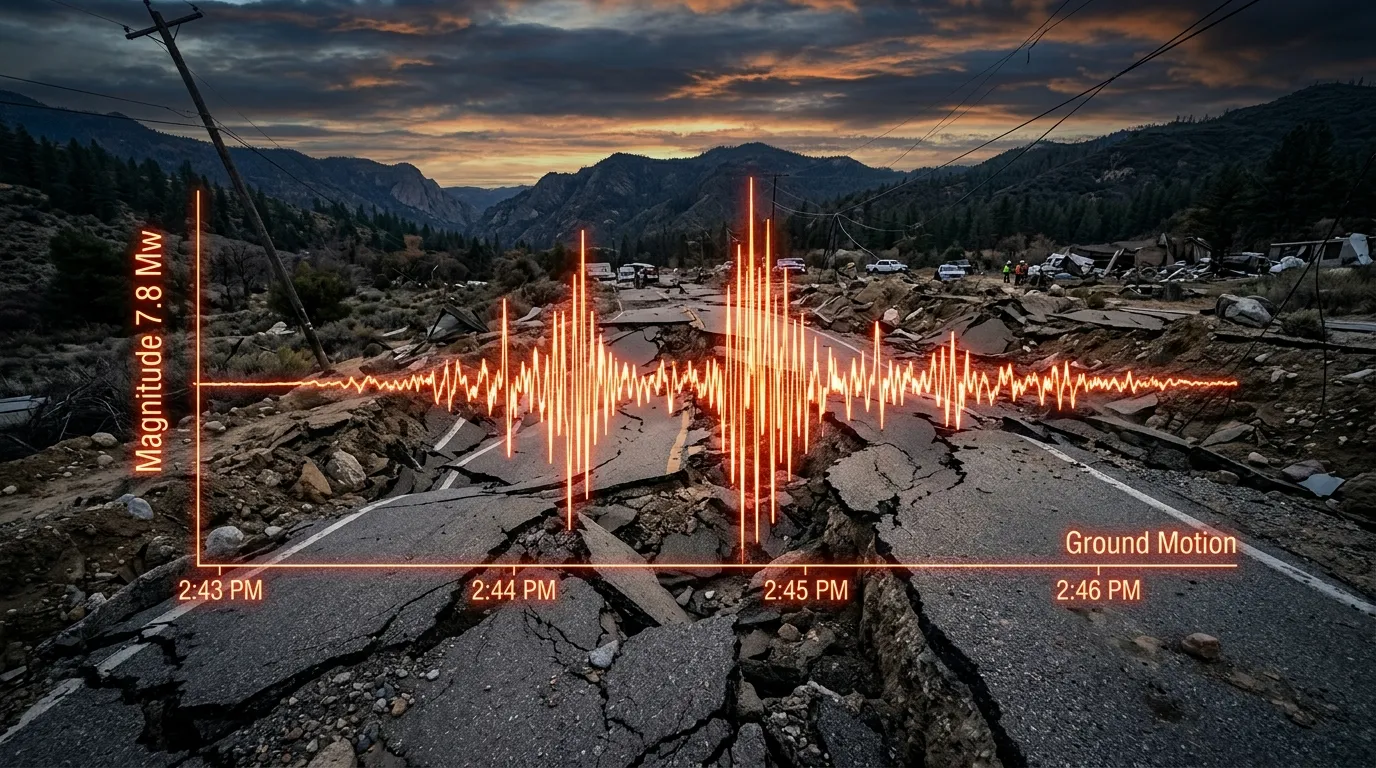
First of all, finding fossils is a big challenge. They are often buried deep underground and only exposed when tectonic plate shifts, faults, and earthquakes push the hidden ancient rock layers on to the surface.
Incomplete Fossil Record.
Taphonomy Challenges.
Identification and Classification.
Destruction of Fossil Sites due to urbanization and construction everywhere.
Funding and Resources.
Integration of multidisciplinary approaches.
Controversies In Paleontology
There are various controversies among scientists and paleontologists, I have noted down a few of them below :
When the first feathered dinosaur was discovered in China, paleontologists started to give many hypothesis and there are still controversies going on about “how flight came into existence”. Some say that feathers were widespread among theropod dinosaurs, while others maintain that feathers were primarily a feature of birds.
Debates were also very frequent on mass extinction cause. Although the most widely accepted theory is of comet falling down on Earth is the cause of dinosaur extinction but some researchers have other opinions.
Many new discoveries in molecular paleontology are accompanied by controversy.
Some times paleontologists assume wrong regarding the kind of fossil and it became a topic of debate among researchers.
Controversies also often arise in relation to the ethics of fossil collecting and trade such as dispute of ownership, sale and much more.
We all know that controversies exist everywhere, since people with different mindset exist everywhere.
Additional Resources
Books :
“The Princeton Field Guide to Dinosaurs” by Gregory S. Paul
“The Rise and Fall of the Dinosaurs: A New History of a Lost World” by Steve Brusatte
“Your Inner Fish: A Journey into the 3.5-Billion-Year History of the Human Body” by Neil Shubin
“Wonderful Life: The Burgess Shale and the Nature of History” by Stephen Jay Gould
“The Fossil Hunter: Dinosaurs, Evolution, and the Woman Whose Discoveries Changed the World” by Shelley Emling (About Mary Anning)
Websites and Online Resources :
Paleontological Society (https://www.paleosoc.org/): Offers resources, publications, and news related to paleontology.
We use cookies to ensure you get the best, fastest experience on our website and to show you content you actually care about. By clicking "Accept All", you consent to our use of cookies.
Cookie Preferences
Strictly Necessary
These cookies are essential for the website to function properly and cannot be disabled in our systems.
Analytics Cookies
These cookies allow us to count visits and traffic sources so we can measure and improve the performance of our site.
Advertising Cookies
Used by our advertising partners (like Google AdSense) to build a profile of your interests and show you relevant ads.