The Incredible 100,000-Year Journey of Sunlight
Follow the fascinating journey of a photon from its birth in the nuclear furnace of the Sun's core all the way to Earth.
Follow the fascinating journey of a photon from its birth in the nuclear furnace of the Sun's core all the way to Earth.
When you step outside on a bright summer day and feel the warmth of the sun on your face, you are experiencing the end of a journey that is far more epic and ancient than you might realize.
We are often taught in school that it takes light exactly 8 minutes and 20 seconds to travel from the Sun to the Earth. While this statement is technically true for the journey across the vacuum of space, it ignores a much more dramatic story.
The photon of light that just hit your skin did not begin its journey 8 minutes ago. It was actually born over 100,000 years ago, long before the first human civilizations even existed.

The journey of sunlight begins deep within the core of our star. The Sun is not a solid object; it is a giant sphere of superheated, ionized gas called plasma. At its very center, the temperature reaches a staggering 15 million degrees Celsius (27 million degrees Fahrenheit), and the pressure is hundreds of billions of times greater than the atmospheric pressure on Earth.
Under these extreme conditions, hydrogen atoms are stripped of their electrons and smashed together so violently that they fuse. This process is known as nuclear fusion, specifically the proton-proton chain reaction.
When four hydrogen protons fuse to form one helium nucleus, a tiny amount of mass is lost. According to Albert Einstein’s famous equation, , this lost mass is converted directly into pure energy.
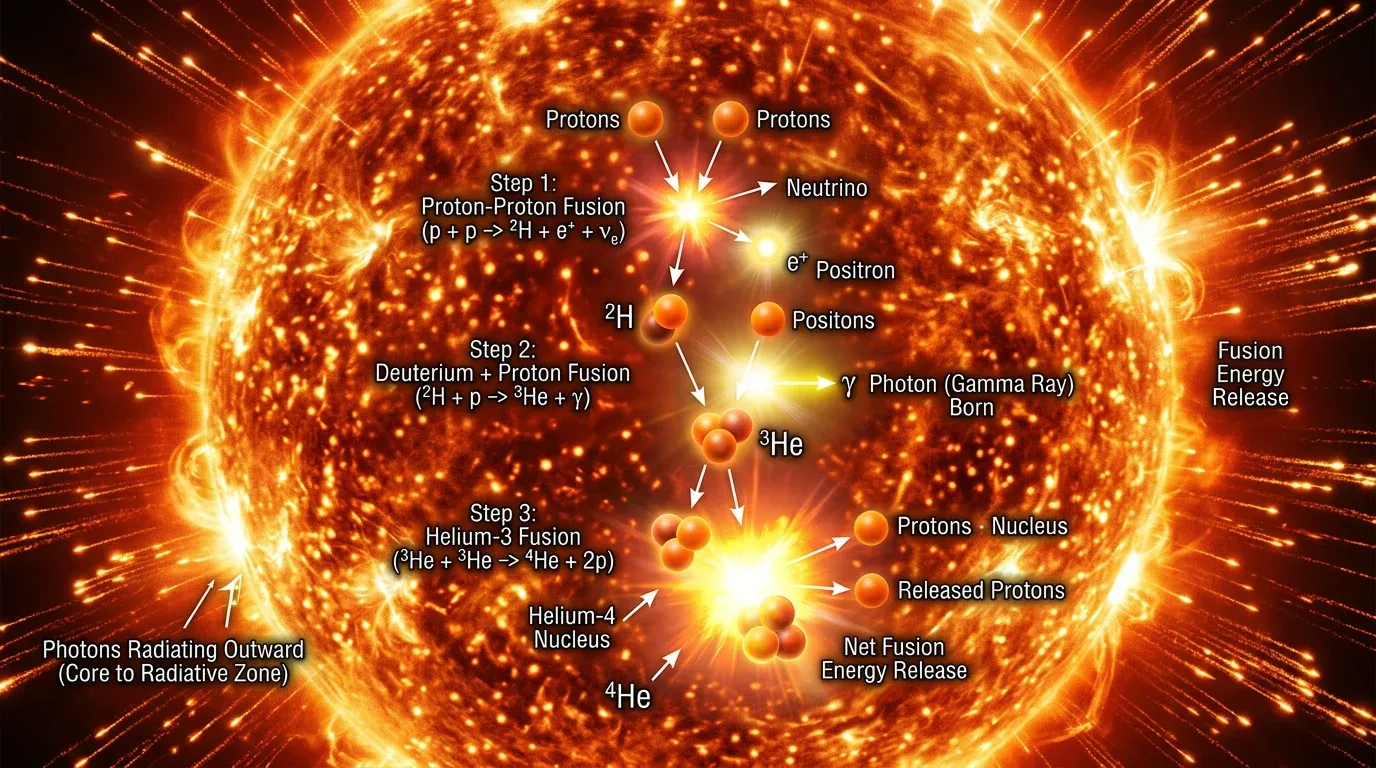
This energy is released in the form of a high-energy light particle—a gamma-ray photon. At this exact moment, the photon’s epic journey begins.
If the Sun were completely empty, the newly born photon would shoot straight out and reach the surface in just two seconds. But the Sun’s interior is anything but empty.
Immediately surrounding the core is the Radiative Zone. This region is so incredibly dense that a photon cannot travel more than a fraction of a millimeter before it crashes into a hydrogen or helium ion.
When this collision happens, the photon is absorbed by the ion and then instantly re-emitted in a completely random direction. It travels another fraction of a millimeter, crashes into another particle, gets absorbed, and is spat out again in yet another random direction.
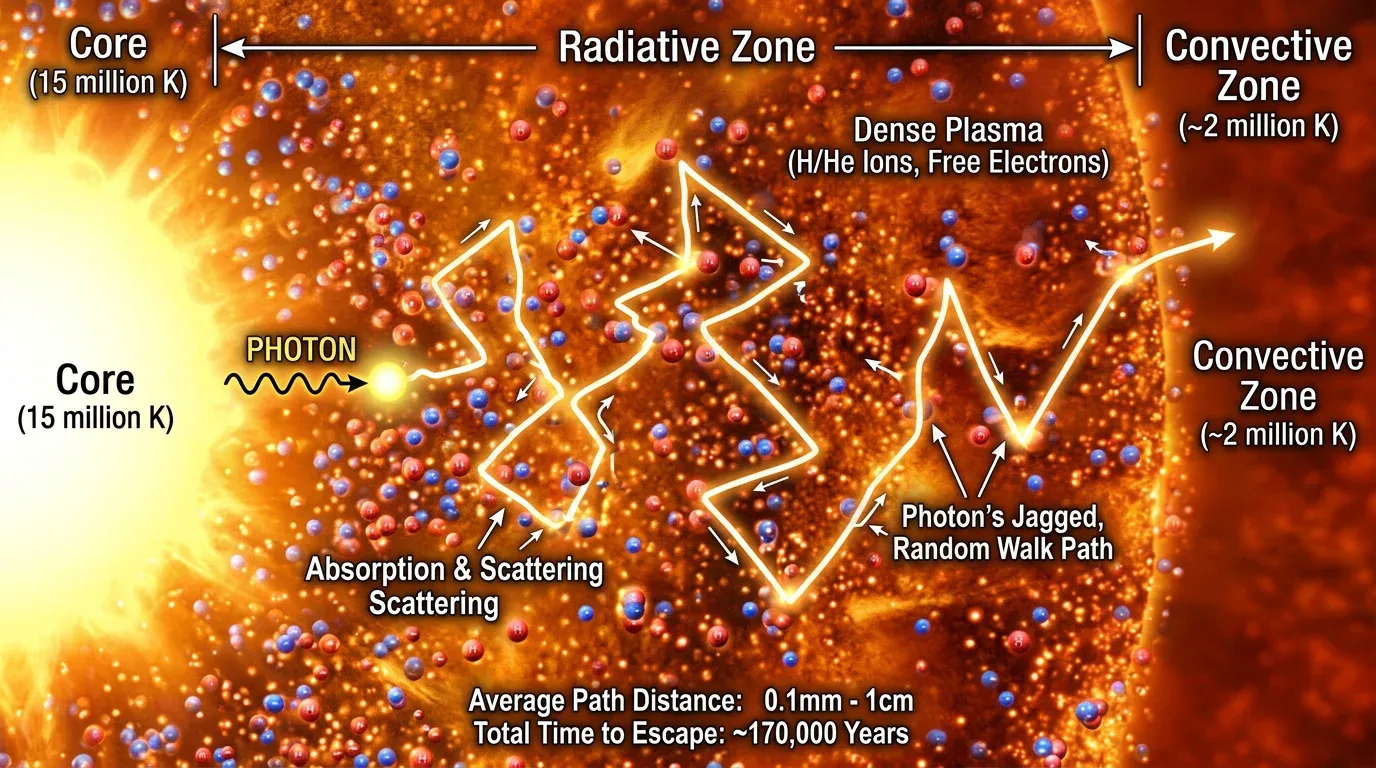
In physics, this chaotic, zig-zag path is called a Random Walk. Because the photon is constantly bouncing back and forth, side to side, and sometimes even backward towards the core, its net progress outward is agonizingly slow.
The mathematical formula for a random walk shows that the distance traveled is proportional to the square root of the number of steps multiplied by the step length :
Because of this chaotic bouncing, it takes the average photon anywhere from 100,000 to 170,000 years just to escape the Radiative Zone. During this time, the photon gradually loses energy, shifting from a deadly, high-energy gamma ray down into an X-ray, and eventually into the visible light and ultraviolet spectrum.
If it takes a photon 100,000 years to escape the Sun’s interior, that means if the Sun magically stopped producing energy in its core right now, the surface would continue shining brightly for another hundred millennia before we noticed any difference on Earth!
After an eternity of bouncing through the Radiative Zone, the photon finally reaches the Convective Zone, the outermost layer of the solar interior.
Here, the density of the plasma drops significantly. Instead of bouncing through a dense fog of atoms, the photon hitches a ride on massive, rolling currents of boiling plasma. Hot plasma from the bottom of the convective zone rises rapidly to the surface, carrying the photons with it, much like bubbles rising in a pot of boiling water.
This part of the journey is incredibly fast compared to the Random Walk. It takes only a few weeks for the plasma currents to carry the photon to the very surface of the Sun.
Finally, the photon breaks through the Photosphere—the visible surface of the Sun.

“At last, the photon enters the vast vacuum of the universe and goes for its infinitely endless journey.”
For the first time since its birth 100,000 years ago, there is nothing in the photon’s path to absorb or scatter it. Free from the dense plasma, it immediately accelerates to the cosmic speed limit: the speed of light ( meters per second).
It shoots across the 149.6 million kilometers (93 million miles) separating the Sun and the Earth. Because space is a near-perfect vacuum, the photon travels in a perfectly straight line, covering the massive distance in just 8 minutes and 20 seconds.
When the photon finally arrives at Earth, it encounters our atmosphere. If the photon is in the ultraviolet spectrum, it might be absorbed by the Ozone layer, protecting life on the surface from harmful radiation.
If it is visible light, it passes through the atmosphere and completes its journey. It might strike the retina of your eye, allowing you to see a beautiful sunset. It might strike a solar panel, generating electricity. Or, it might strike the leaf of a plant or tree, where it will be converted into chemical energy via photosynthesis, and gets permanently involved into the food chain on Earth.
Once light leaves the surface of the Sun, it takes approximately 8 minutes and 20 seconds to cross the vacuum of space and reach Earth.
The Sun's interior is so dense that a newly created photon is constantly absorbed and re-emitted by atoms in a process called a 'Random Walk.' This chaotic, zig-zag path traps the photon inside the Sun for over 100,000 years.
Yes. Photons are born as highly energetic gamma rays in the core. As they bounce around during their 100,000-year journey, they gradually lose energy, eventually emerging from the surface mostly as visible light and infrared radiation.