Dive into the physics of electric dipoles, their fields, and how they behave in uniform and non-uniform electric fields.
Scroll to read
Definition Of Electric Dipole
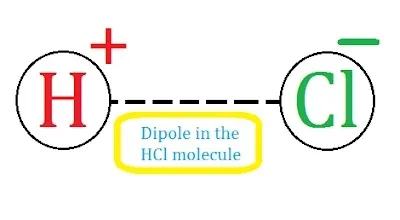
An electric dipole as the name suggests, is a system of two charged particles. The charge particles are equal in magnitude and opposite in nature. It is a stable system of two charged particles, placed at a very tiny distance apart.
For ex: HCl molecule.
Electric Dipole Moment
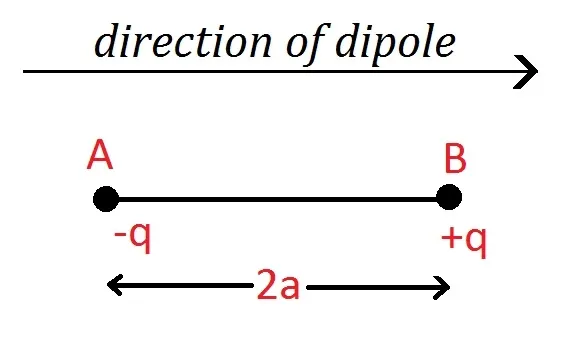
Electric dipole moment of an electric dipole is defined as the product of the magnitude of one of the two charges and the small distance between two charges.
Electric Dipole Moment = charge x Dipole length.
It is a vector quantity and is always directed in the direction from -q to +q along the line joining the two charges. It is also known as the direction of the dipole axis.
Unit: Cm (Coulomb Meter).
Dimensional Formula:[p]=[q][2a]
[p]=[AT][L]=[LTA]
Note that net charge on an electric dipole is always zero(0).
Electric Field due to a Dipole
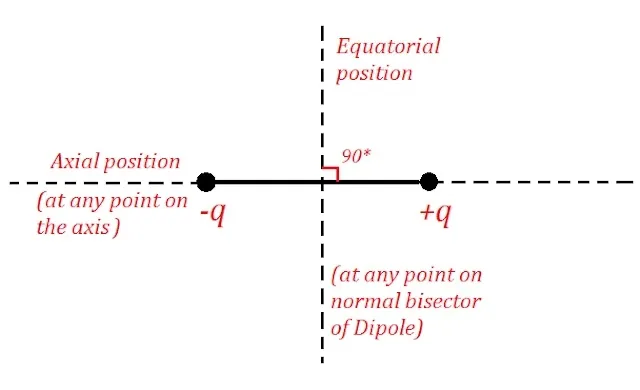
At Axial Position
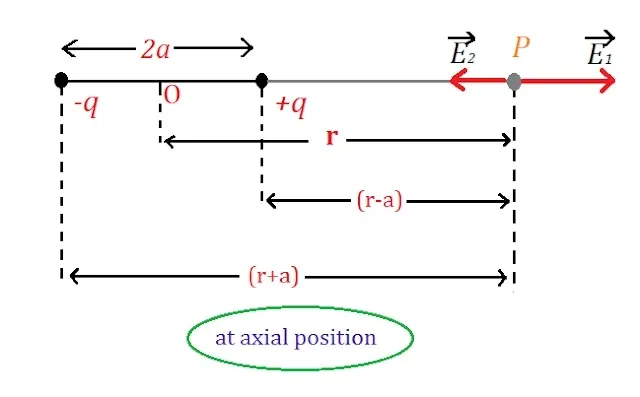
Consider Electric Dipole AB having +q and -q at a distance 2a.
O : center of dipole
P : point on axial position at distance ‘r’ from ‘O’ where Electric Field is required.
Dipole is kept in dielectric medium having constant : K
AB=2a
OA=OB=a
OP=r
AP=(r+a)
BP=(r-a)
Electric field at P due to charge +q : E1=(r−a)2kq—eq(1)
It is directed along BP or along AB, same as the direction of p (dipole moment).
Electric Field at point P due to charge −q : E2=(r+a)2kq
directed along PA or opposite to AB, along −p.
Since, E₁ and E₂ are in opposite directions.
Net electric field at P : E=E1+E2
Magnitude of electric field : E=E1−E2as E1>E2
Therefore,
E=4πϵ0Kq[(r−a)21−(r+a)21]
E=4πϵ0Kq[(r+a)2(r−a)2(r+a)2−(r−a)2]
E=4πϵ0Kq[[(r+a)(r−a)]2(r+a+r−a)(r+a−r+a)]
E=4πϵ0Kq[(r2−a2)22r⋅2a]
or E=4πϵ0K1[(r2−a2)22(q⋅2a)r]
Hence,
E=4πϵ0K1[(r2−a2)22pr] …in the direction of dipole moment.
If r≫a E=4πϵ0K1[(r2)22pr] E=4πϵ0K1(r32p)
For air or vacuum K=1
Therefore, E=4πϵ01(r32p) ⇒Eaxial∝r31
At Equatorial Position or Equatorial Plane
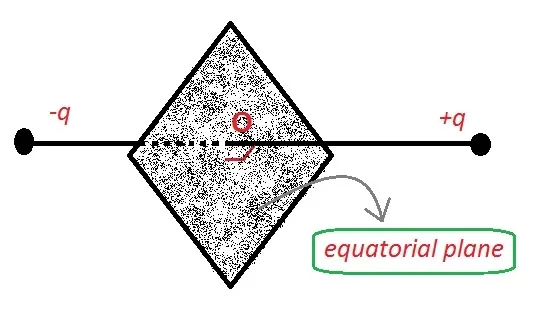
There’s a plance normal (90 degrees) to dipole axis AB and is passing through the mid point ‘O’ of the dipole. Any point on the equatorial plane is said to be in equatorial position.
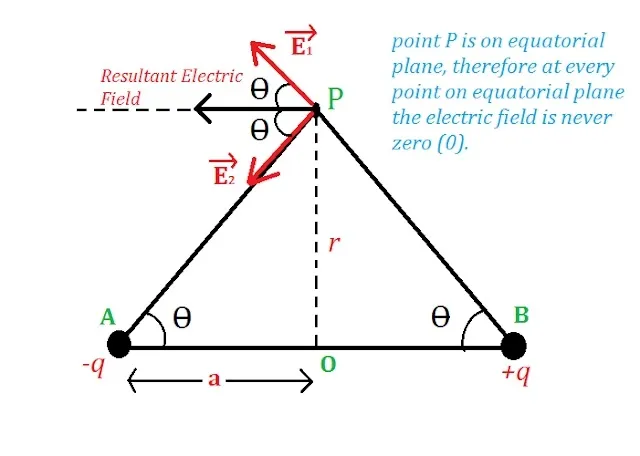
Consider Electric Dipole AB consisting of two charges -q and +q, separated by a small distance AB=2a. P is a point at distance ‘r’ from midpoint ‘O’ of dipole length AB and at equatorial position in the surrounding medium of dielectric constant K.
AB=2a
OA=OB=a
OP=r
AP=BP=√(r²+a²)
and let ∠PAB=∠PBA=0⁰ (zero degree).
Electric field at P due to charge +q:
E1=4πϵ0K1[(r2+a2)2q]along BP
or E1=4πϵ0K1[r2+a2q]along BP
Similarly, electric field at P due to charge −q:
E2=4πϵ0K1[(r2+a2)2q]along PA
or E2=4πϵ0K1[r2+a2q]along PA
Method 1
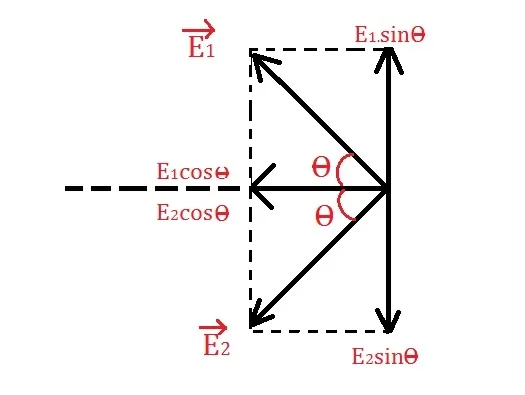
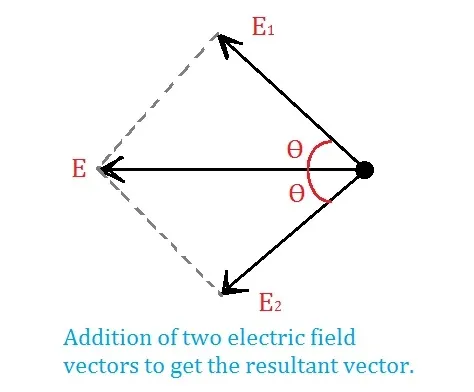
Now E1=E2 and both are at angle θ with the direction parallel to dipole axis.
Resolving E1 and E2 into components along dipole axis and normal to dipole axis.
The components E1sinθ and E2sinθ i.e. normal to dipole axis are equal in magnitude.
E1sinθ=E2sinθ
and are opposite in direction, so cancel each other, while the components along the dipole axis are also equal in magnitude and are in the same direction so these add up to give resultant intensity of electric field at P.
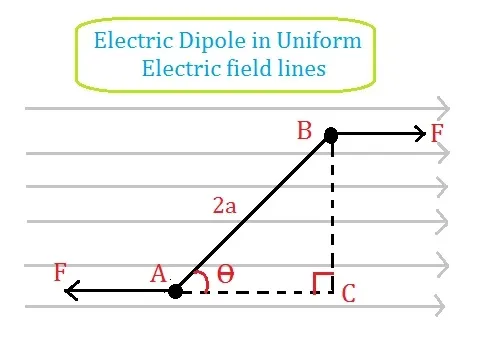
When a uniform electric field acts on an electric dipole, it creates different forces on the two charges of dipole, thus creating a torque. This torque tends to align the dipole along the direction of the uniform electric field in the region.
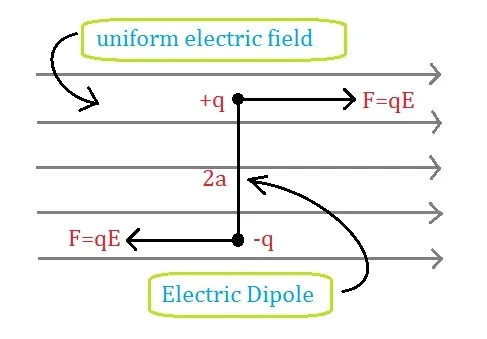
Consider an electric dipole AB consisting of charges +q and -q at small distance 2a, and is kept in a uniform electric field of intensity E.
Dipole moment p makes angle 0 with direction of E (electric field).
+q charge experiences force due to the electric field (F=qE) along the direction of E.
-q charge experiences the same magnitude of force i.e. qE but in the opposite direction of the vector(E).
Two forces on a dipole are equal in magnitude and opposite in direction and have “parallel lines of action.”
Net translation on dipole =
F+(-F) = qE-qE = 0
Therefore, there’s no translational motion of dipole in uniform electric field, rather the torque rotates the dipole and align it with the direction of uniform electric field.
Torque acting on dipole = moment of dipole Torque=F⋅couple arm Torque=F⋅Bc Torque=qE⋅2asinθ Torque=(q⋅2a)Esinθ τ=p×E
When Dipole is Parallel to Field
p is in the same direction of E. θ=0∘ Torque=pEsin(0∘) Torque=0
“It is a stable equilibrium.”
When Dipole is Anti-Parallel to Field
p is in the opposite direction of E. θ=180∘ Torque=pEsin(180∘) Torque=0
We use cookies to ensure you get the best, fastest experience on our website and to show you content you actually care about. By clicking "Accept All", you consent to our use of cookies.
Cookie Preferences
Strictly Necessary
These cookies are essential for the website to function properly and cannot be disabled in our systems.
Analytics Cookies
These cookies allow us to count visits and traffic sources so we can measure and improve the performance of our site.
Advertising Cookies
Used by our advertising partners (like Google AdSense) to build a profile of your interests and show you relevant ads.