What Are Rogue Planets? The Dark Wanderers of the Milky Way
Venture into the pitch-black space between stars to learn about rogue planets—worlds that wander the galaxy without a sun—and the tantalizing possibility of life in the dark.
Venture into the pitch-black space between stars to learn about rogue planets—worlds that wander the galaxy without a sun—and the tantalizing possibility of life in the dark.
When we imagine a planet, we almost instinctively picture it bathed in the warm, life-giving light of a parent star. In our solar system, the Sun is the gravitational anchor and the ultimate source of energy for Earth and its neighbors. But what happens when a planet is cast out of its celestial family, or never had one to begin with?
Rogue planet are also known as a free-floating planet, interstellar planet, or orphan planet. Generally, exoplanets orbit a distant host star, but rogue planets are a unique class of planetary-mass objects that roam the pitch-black void of interstellar space, disconnected from any star system. They do not orbit a sun; instead, they orbit the galactic center directly, much like the stars themselves.
Recent astronomical surveys suggest a staggering reality: rogue planets might not be rare anomalies. In fact, some astronomers estimate that there could be billions—perhaps even trillions—of rogue planets wandering the Milky Way alone, potentially outnumbering the stars.
If you were floating in space near a rogue planet, you wouldn’t see it until you were right on top of it. Without a sun to illuminate it, a rogue planet is practically invisible to the human eye, drifting in eternal night.
The existence of planets without stars challenges our traditional understanding of planetary formation. Astrophysicists generally point to two primary mechanisms responsible for the creation of rogue planets: violent ejections and isolated formations.
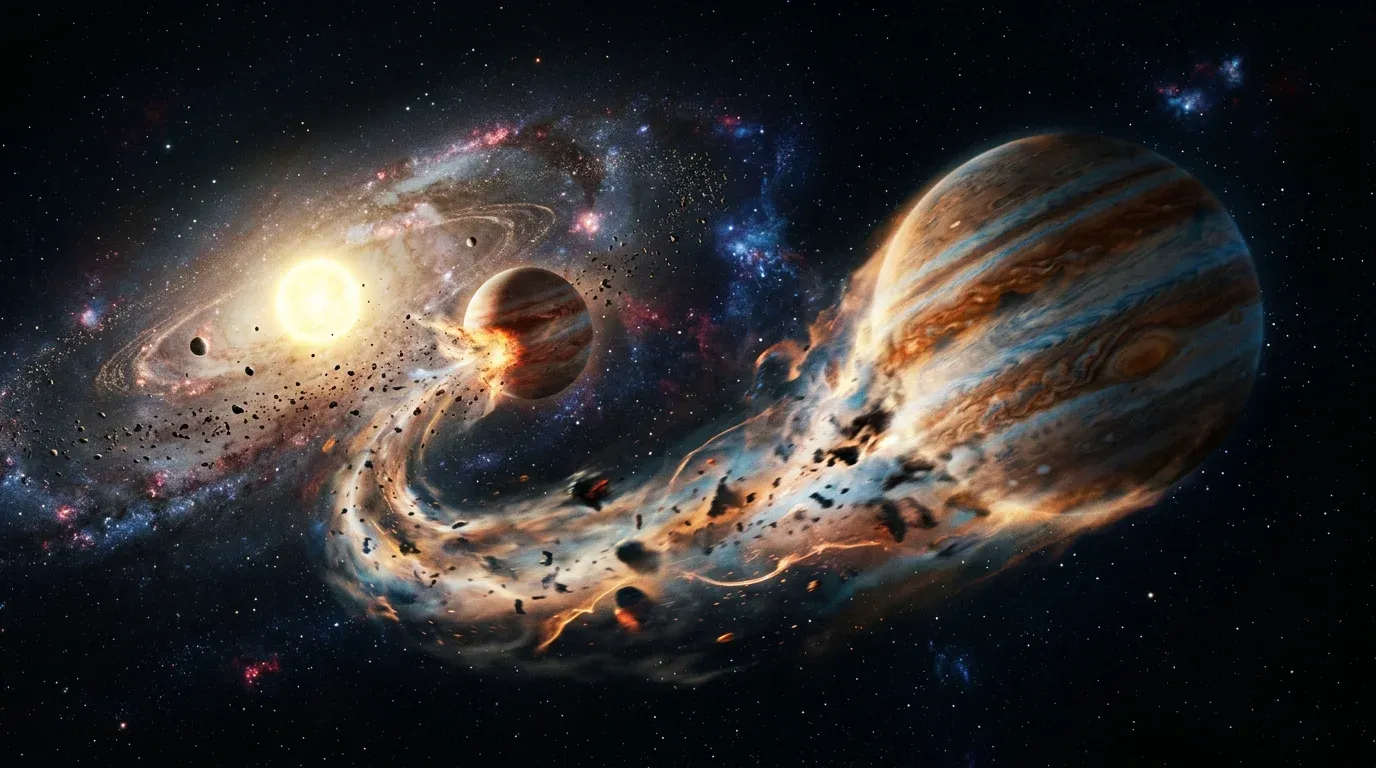
The most widely accepted theory is that the vast majority of rogue planets were born in a normal star system. Planets coalesce from the protoplanetary disk of gas and dust surrounding a newborn star. However, the early millions of years of a star system are incredibly chaotic.
As planets grow and their gravitational fields interact, their orbits can become highly unstable. If two massive gas giants pass too close to one another, the gravitational interaction can act like a cosmic slingshot. One planet may be hurled outward with such tremendous velocity that it escapes the host star’s gravitational pull entirely. Once it crosses that threshold, it becomes a rogue planet, cast into the freezing void of interstellar space forever.
Not all rogue planets are exiles. A secondary theory proposes that some free-floating planets are born in isolation. Just as a star forms from the gravitational collapse of a dense cloud of interstellar gas and dust, a smaller fragment of such a cloud could collapse to form a planetary-mass object.
Because the collapsing cloud lacks the mass to ignite nuclear fusion in its core, it never becomes a star. Instead, it becomes a sub-brown dwarf or a rogue gas giant. These objects are born in the dark, having never known the warmth of a parent star.
Finding a rogue planet is one of the most difficult challenges in modern astronomy. Traditional methods of discovering exoplanets rely on a host star. The transit method looks for the slight dimming of a star’s light as a planet passes in front of it, while the radial velocity method looks for the star “wobbling” due to the planet’s gravitational tug.
Because rogue planets have no star to dim or tug on, and because they emit no visible light of their own, they are essentially invisible to standard optical telescopes. To find them, astronomers have to rely on extraordinary techniques.
The most successful method for detecting rogue planets is gravitational microlensing, a phenomenon predicted by Albert Einstein’s Theory of General Relativity.
Massive objects warp the fabric of spacetime around them. If a rogue planet passes exactly between Earth and a distant background star, the planet’s gravity acts like a magnifying glass, bending and amplifying the light of the distant star for a brief period (usually a few hours to a few days). By carefully analyzing this temporary spike in brightness, astronomers can calculate the mass of the invisible object passing by.
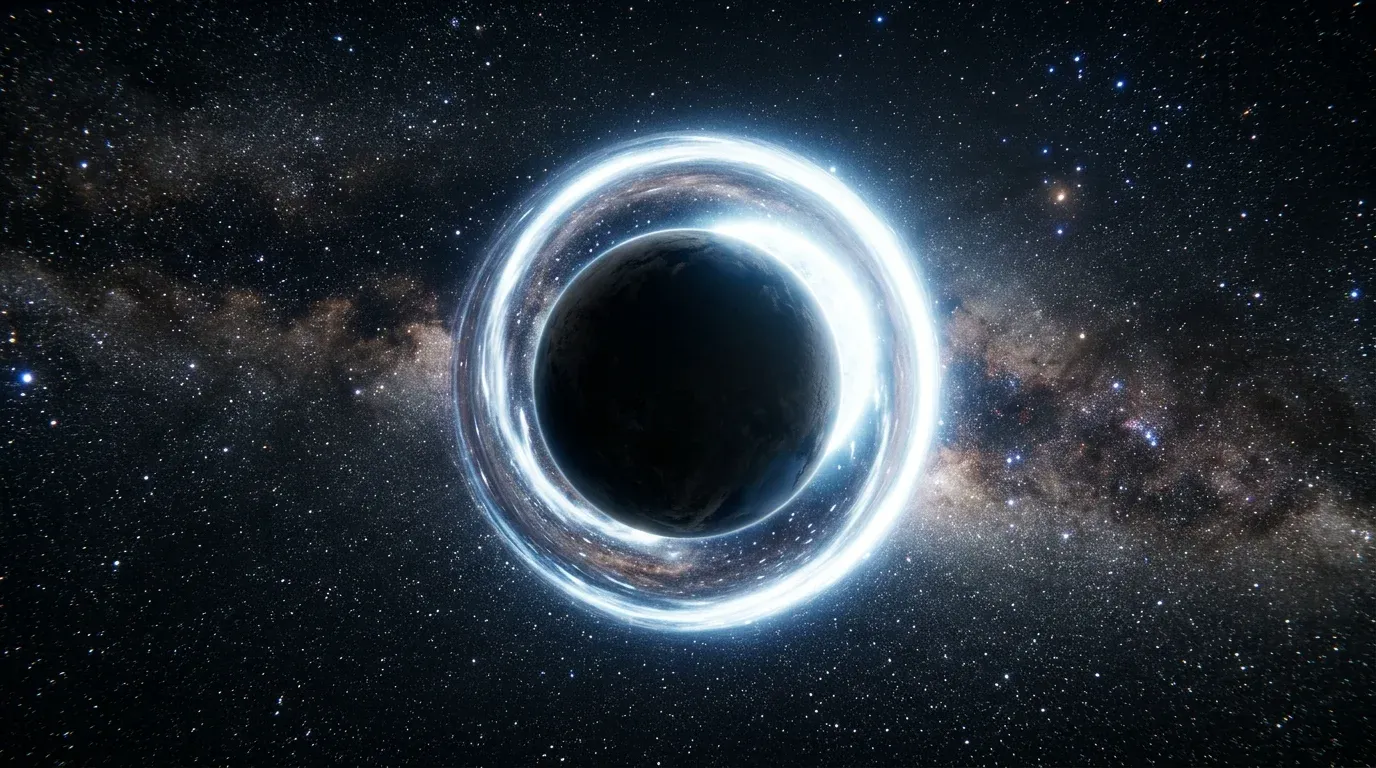
For very young, massive rogue planets (gas giants several times the mass of Jupiter), astronomers can occasionally use direct imaging. When a planet first forms, it is incredibly hot due to the immense pressure and the heat generated by gravitational contraction. While it doesn’t emit visible light, a young rogue planet glows faintly in the infrared spectrum. Powerful observatories like the James Webb Space Telescope (JWST) can spot this faint heat signature if the rogue planet is relatively close to Earth.
It seems impossible. How could a world plunged into the absolute zero temperatures of deep space, devoid of a sun, possibly support life?
To answer this, we have to stop looking up at the sky and start looking deep underground.
A star is not the only source of energy available to a planet. Earth, for example, generates a massive amount of internal heat. This heat comes from two sources: the primordial heat left over from the planet’s violent formation, and the radioactive decay of heavy elements (like uranium and thorium) deep within the mantle and core.
If an Earth-sized rogue planet has a similar rocky composition, it would possess a molten core and active volcanism for billions of years, entirely independent of a host star.
If a rogue planet was ejected from its star system very early in its formation, it might have retained a thick, primordial atmosphere composed of hydrogen and helium. Hydrogen is an excellent greenhouse gas. If the atmosphere is thick enough (thousands of times denser than Earth’s), it could trap the planet’s internal geothermal heat, potentially allowing liquid water to exist on the surface.
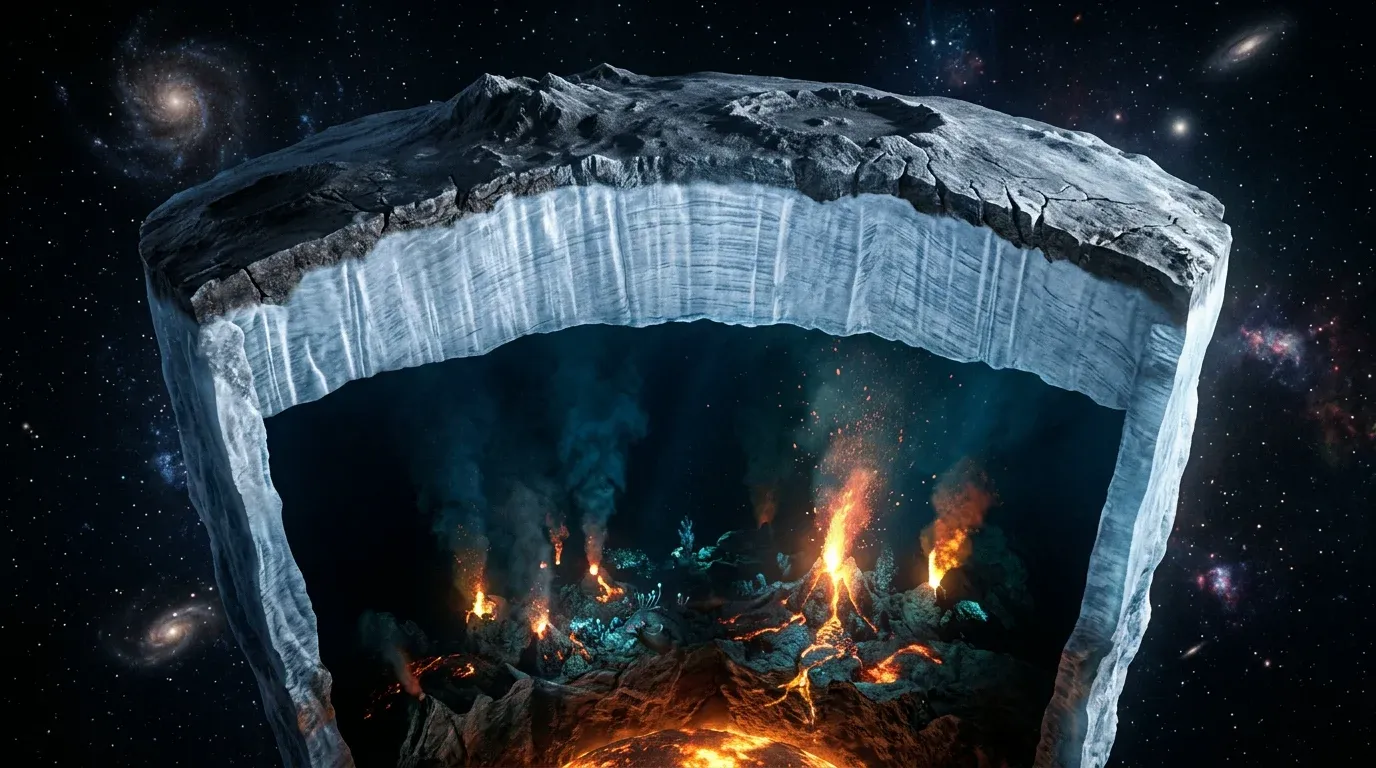
More likely, however, is the scenario of a subsurface ocean. Imagine a rocky rogue planet with abundant water. In the freezing vacuum of space, the surface of this ocean would immediately freeze, forming a crust of ice miles thick. This ice crust acts as a perfect thermal insulator. Beneath the ice, the geothermal heat from the planet’s core could keep a global ocean in a liquid state.
At the bottom of these pitch-black, subsurface oceans, hydrothermal vents could spew superheated, mineral-rich water into the sea. We know from studying Earth’s own deep oceans that sunlight is not a prerequisite for life. Around Earth’s hydrothermal vents, entire ecosystems thrive in absolute darkness, relying on chemosynthesis rather than photosynthesis. Bacteria extract energy from the chemical reactions of hydrogen sulfide, forming the base of a food web that supports tube worms, crabs, and fish.
If life can emerge in the crushing, sunless depths of Earth’s oceans, there is no biological reason it could not emerge around a hydrothermal vent on a rogue planet drifting through the Milky Way.
Our understanding of rogue planets is still in its infancy, but the next decade promises a revolution in discovery.
NASA’s highly anticipated Nancy Grace Roman Space Telescope (scheduled to launch on August 30, 2026) is designed with a massive field of view specifically suited for gravitational microlensing surveys. Astronomers expect the Roman Space Telescope to discover hundreds, if not thousands, of new rogue planets, ranging from Jupiter-sized gas giants down to rocky worlds smaller than Mars. Similarly, the European Space Agency’s Euclid mission is mapping the dark universe and may also capture microlensing events.
These dark wanderers challenge our definition of a planetary system. They remind us that the universe is dynamic, chaotic, and unimaginably vast. As our telescopes peer deeper into the void, we may find that the dark spaces between the stars are not empty at all, but teeming with hidden, wandering worlds.
A rogue planet is a planetary-mass object that does not orbit a star. Instead, it wanders through interstellar space, orbiting the galactic center directly.
While exact numbers are unknown, statistical models based on microlensing observations suggest there could be billions, or even trillions, of rogue planets in our galaxy, potentially outnumbering the stars.
Living on the surface of a rogue planet would be impossible due to the near absolute-zero temperatures and lack of solar energy. However, if a rogue planet had a geothermally heated subsurface ocean, a highly advanced civilization could theoretically build habitats beneath the ice crust, utilizing nuclear or geothermal energy.
References: