Formation of the Moon
Uncover the prevailing scientific theories on how Earth's Moon was formed billions of years ago from a cataclysmic collision.
Uncover the prevailing scientific theories on how Earth's Moon was formed billions of years ago from a cataclysmic collision.
When you look up at the night sky, the Moon seems like a peaceful, silent guardian. It has been a constant companion to Earth for billions of years, driving our ocean tides and stabilizing our planet’s wobble. But how did it get there?
Unlike the moons of Jupiter or Saturn, which are relatively tiny compared to their host planets, our Moon is unusually massive. For centuries, this puzzled astronomers. Did Earth capture a passing asteroid? Did it form alongside Earth from the same cloud of gas?
Let’s discuss about the formation of moon and why is it going away from us even this very moment.
The most widely accepted explanation for the creation of our Moon is the Giant-Impact Hypothesis.
According to this theory, roughly 4.5 billion years ago, the early solar system was a chaotic, crowded place filled with protoplanets smashing into one another. The young Earth (often called proto-Earth or Gaia) shared its orbital neighborhood with a Mars-sized protoplanet that scientists named Theia.
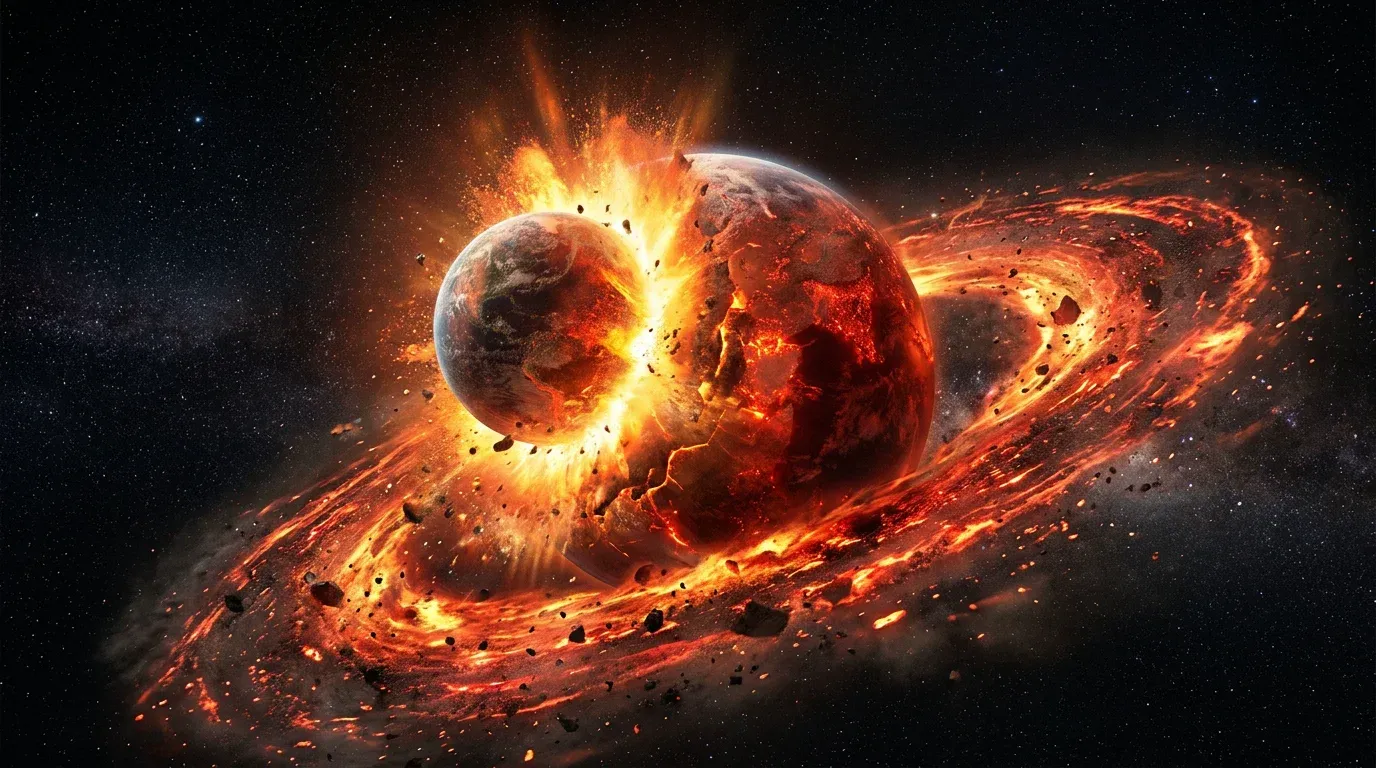
Eventually, the gravitational dance between the two bodies failed, and Theia crashed into Earth at an oblique angle. The colossal impact was so incredibly violent that it completely shattered Theia and vaporized a massive chunk of Earth’s crust and mantle.
This superheated, molten debris was blasted into space, forming a glowing, fiery ring around the Earth—similar to the rings of Saturn. Over a surprisingly short cosmic timeframe (some modern supercomputer simulations suggest it could have taken just a few months, or even hours), gravity caused this ring of debris to accrete and clump together into a single spherical body. That molten sphere cooled to become our Moon.
If Theia had hit the Earth dead-on instead of at a glancing angle, the impact would have likely annihilated both planets entirely, turning them into an asteroid belt. Our existence today is owed to the precise angle of that primordial collision!
During the history of the Apollo missions in the late 1960s and early 1970s, astronauts brought back 382 kilograms (842 pounds) of lunar rocks and dust. When geochemists analyzed these samples in laboratories on Earth, they made a shocking discovery: the Moon’s chemical signature was nearly identical to Earth’s. These Apollo samples provided the smoking gun that was critical in developing and validating the Giant Impact Hypothesis.
Specifically, they looked at isotopes (variants of elements like oxygen, titanium, and silicon). Every planet in our solar system has a unique isotopic “fingerprint” based on exactly where it formed. However, the oxygen isotopes in the lunar rocks perfectly matched the oxygen isotopes found in Earth’s mantle.
This undeniable chemical link strongly suggests that the Moon did not form independently in deep space; it was literally forged from the shattered pieces of our own planet.
Before the Apollo missions provided the smoking gun for the Giant-Impact Hypothesis, scientists heavily debated three other models:
When the Moon first coalesced from the ring of debris, it was situated incredibly close to Earth—perhaps just 15,000 to 20,000 miles away (about 4 Earth radii).
Because of this extreme proximity, it would have dominated the sky, appearing up to 15 to 20 times larger than the Moon we see today. Furthermore, the newly formed Moon was still covered in a global magma ocean, meaning it would have glowed with a furious, dull red heat in the night sky.
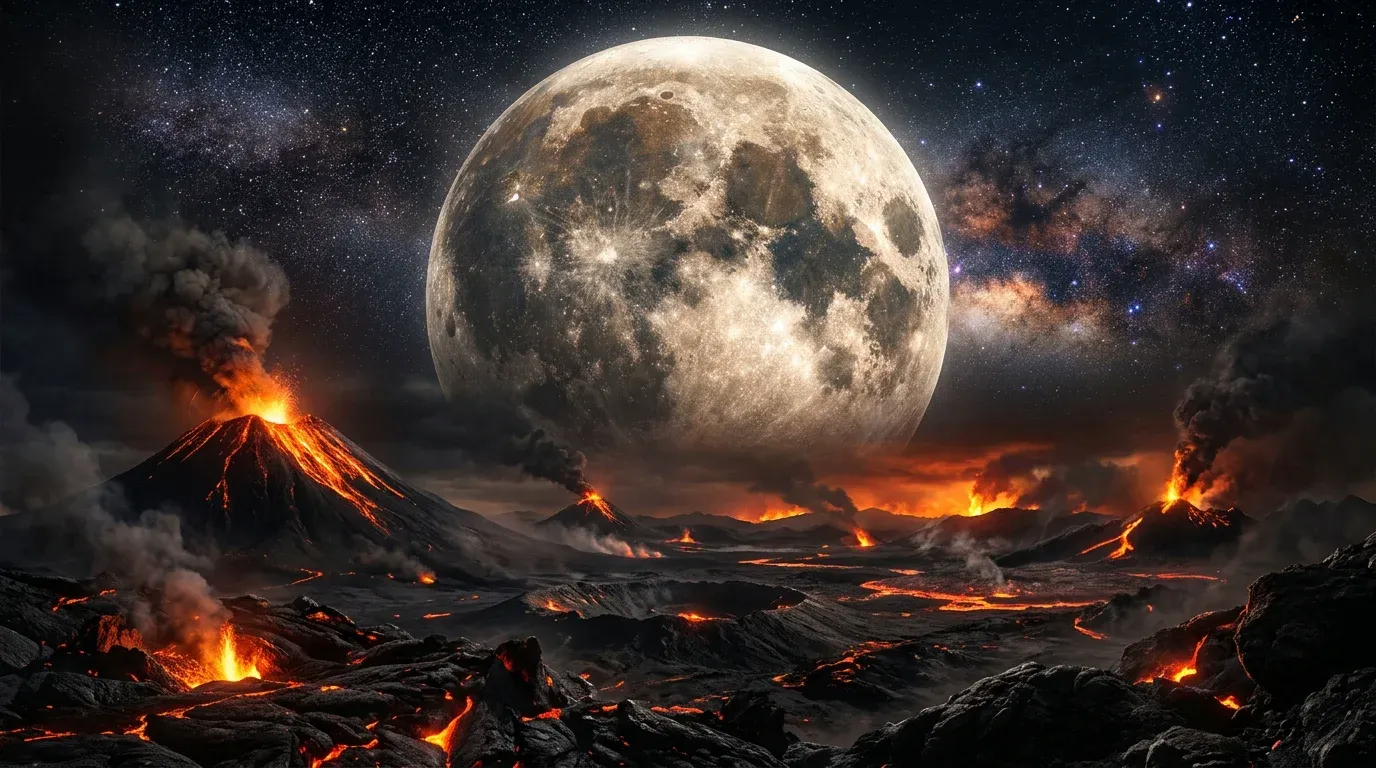
The gravitational pull of a Moon this close would have been terrifying. It would have generated towering tsunamis and massive tidal waves that scraped the early continents, mixing chemical nutrients into the ocean—a process that some scientists believe was crucial for the origin of life!
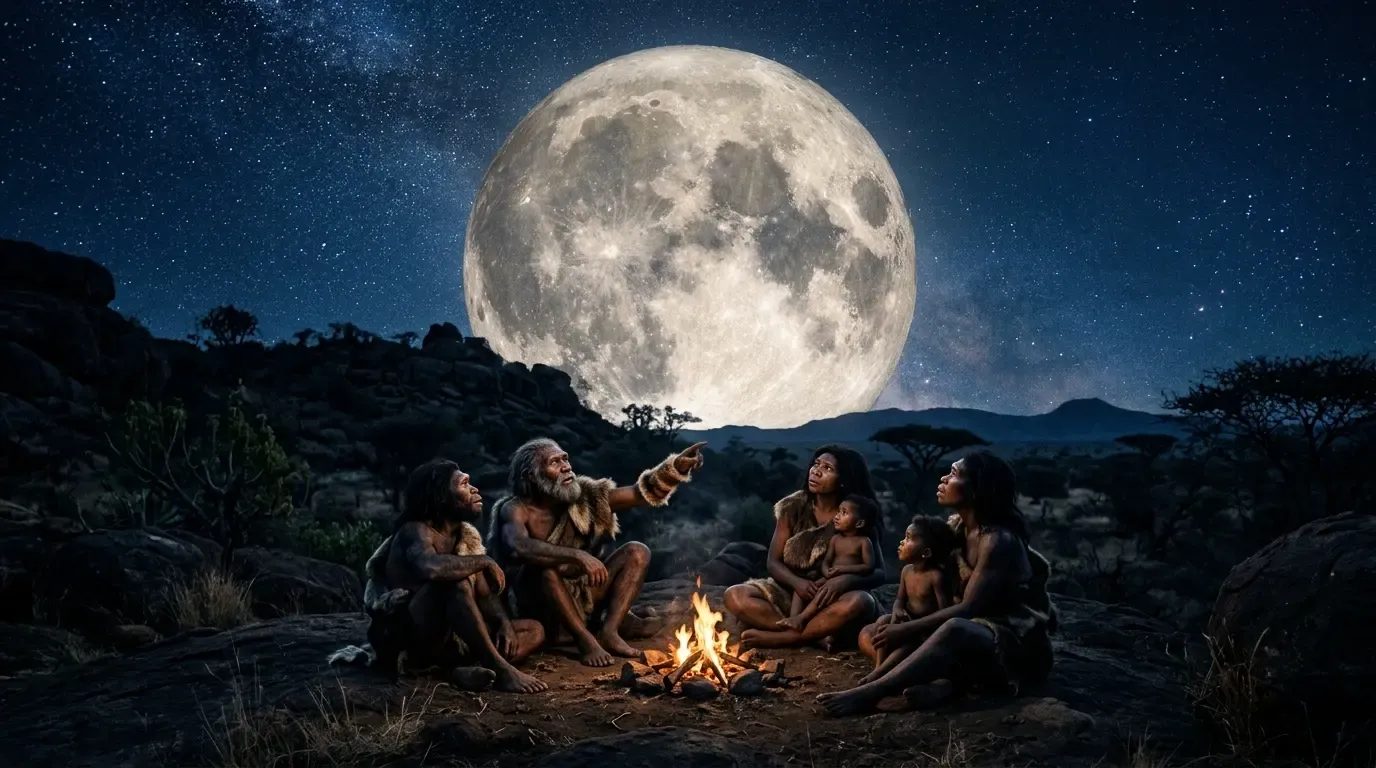
Today, the Moon sits at a comfortable average distance of about 238,855 miles (384,400 kilometers) from Earth. But it isn’t staying there.
By bouncing lasers off the retroreflectors left on the lunar surface by Apollo astronauts, scientists have proven that the Moon is drifting away from Earth at a rate of exactly 3.8 centimeters (1.5 inches) per year.
This is due to a phenomenon known as tidal friction. As the Moon’s gravity pulls on Earth’s oceans, it creates tidal bulges. Because Earth rotates faster (once every 24 hours) than the Moon orbits (once every 27 days), the friction of the rotating Earth drags the ocean bulge slightly ahead of the Moon.
The gravity of this massive water bulge acts like a slingshot, pulling the Moon forward and accelerating it. In orbital mechanics, if you add speed to an orbiting body, it moves to a higher, wider orbit. Conversely, this interaction drains angular momentum from Earth, meaning that our planet’s rotation is gradually slowing down, and our days are getting slightly longer!
Currently, the theory behind the origin of our Moon is mostly credited towards the Giant Impact Hypothesis. The Apollo mission also favors this because the moon samples were found similar to Earth’s crust. In the coming years, we are going to explore the moon once again via the Artemis program, specifically targeting the lunar south pole for new sample returns. It will definitely help us to get the full picture of the moon’s past and its origins.
Theia was completely destroyed in the collision. The intense heat vaporized the planet. The heavy iron core of Theia likely sank and merged with Earth's core, while its lighter, rocky mantle mixed with Earth's mantle and was blasted into space to form the Moon.
No. Although it is drifting away at 3.8 cm per year, this process will eventually stop. In about 50 billion years, Earth's rotation will have slowed down so much that it matches the Moon's orbital period. They will become 'mutually tidally locked,' permanently facing each other, and the drifting will cease.
Life would look very different. The Moon's gravity stabilizes Earth's axial tilt at 23.5 degrees, which gives us stable, predictable seasons. Without the Moon, Earth's tilt could wildly fluctuate over time, causing extreme, catastrophic climate shifts.