Origin Of Life On The Earth
Trace the origins of life on Earth, exploring early biological theories, the primordial soup, and how simple molecules evolved into complex organisms.
Trace the origins of life on Earth, exploring early biological theories, the primordial soup, and how simple molecules evolved into complex organisms.
How did non-living chemistry suddenly wake up and become biology? It is arguably the single greatest mystery in the history of science.
Approximately 4.5 billion years ago, the Earth was a violent, molten wasteland bombarded by meteorites and bathed in deadly radiation. Yet, fast forward a billion years, and the oceans were teeming with microscopic, single-celled organisms that could eat, replicate, and evolve. The transition from lifeless rock to a living planet is a puzzle that has consumed biologists, chemists, and astronomers for centuries.
To understand how life began, we first have to look at the environment where it originated. When the Earth formed roughly 4.54 billion years ago, it was nothing like the blue marble we know today. Scientists call this geological period the Hadean Eon—named appropriately after Hades, the Greek god of the underworld.
The young planet was subjected to constant bombardment by asteroids and comets. During this intense heat, the planet underwent differentiation into distinct layers—a process essential for understanding the structure of the earth. Volcanic activity was ubiquitous, spewing massive amounts of gases into the atmosphere. Unlike today, there was zero free oxygen () in the air. Instead, the atmosphere was likely a toxic, choking mixture of methane, ammonia, water vapor, and carbon dioxide.
As the planet slowly cooled, water vapor in the atmosphere condensed, leading to centuries of torrential, non-stop rain. This immense deluge eventually filled the impact basins, creating the first primitive oceans. These warm, chemical-rich waters would become the crucible in which the first chapters of life were written.
Before modern biochemistry, humanity struggled to explain how life appeared. For thousands of years, the answer was rooted strictly in mythology and theology.
The prevailing belief was Divine Creation—the idea that a deity or pantheon of gods actively sculpted humans, animals, and plants out of nothingness. Furthermore, up until the 19th century, many prominent thinkers believed in Spontaneous Generation. They observed that maggots seemingly appeared out of rotting meat or frogs out of mud, and concluded that complex life could spontaneously erupt from inanimate matter on a daily basis.
It wasn’t until scientists like Louis Pasteur definitively proved that “life only comes from life” (Biogenesis) that the question shifted: If life today only comes from existing life, where did the very first life come from?
In the 1920s, scientists Aleksandr Oparin and J.B.S. Haldane independently proposed a radical new idea: Abiogenesis. They hypothesized that the early Earth’s oceans were a “primordial soup”—a rich broth of simple chemicals. Under the influence of powerful energy sources like lightning strikes and intense ultraviolet radiation, these simple chemicals combined to form more complex organic molecules.
The energy required to forge the first chemical bonds of life was immense. Early Earth had no ozone layer, meaning raw ultraviolet radiation blasted the surface. Combined with thousands of lightning strikes per minute from hyper-storms, the oceans were constantly energized, forcing molecules to combine in new, complex ways.
Oparin and Haldane’s theory was brilliant, but it lacked experimental proof. That changed in 1953 when Stanley Miller and Harold Urey conducted one of the most famous experiments in biological history.
They created a closed system of glass flasks to simulate early Earth. They filled it with water (the ocean) and a mixture of methane, ammonia, and hydrogen (the early atmosphere). They then fired electrical sparks through the gas to simulate lightning.
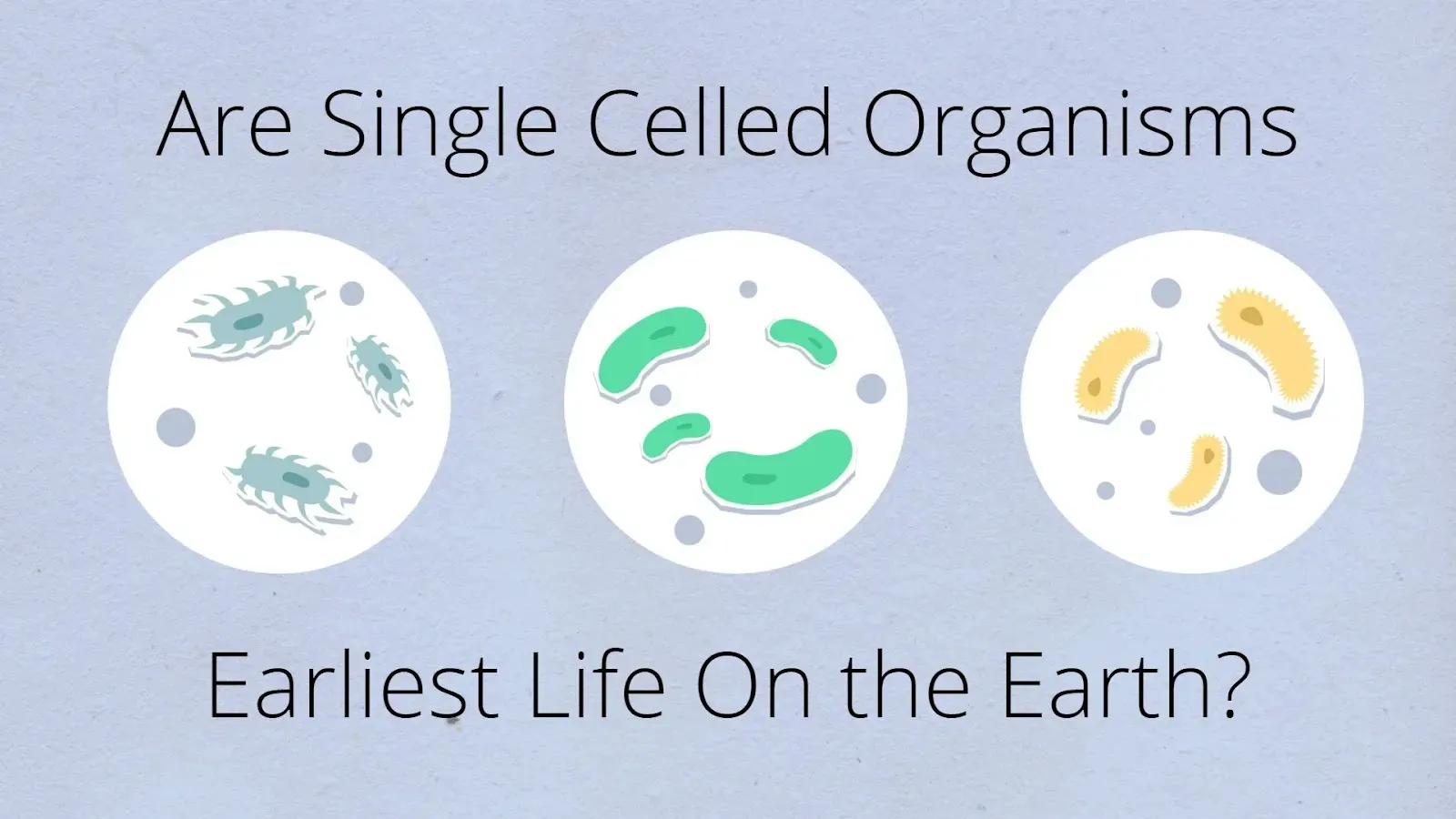
After just one week, the water turned a deep, murky red. When they analyzed the liquid, they found amino acids—the fundamental building blocks of proteins. They had successfully proven that the basic ingredients of life could arise spontaneously from non-living chemistry.
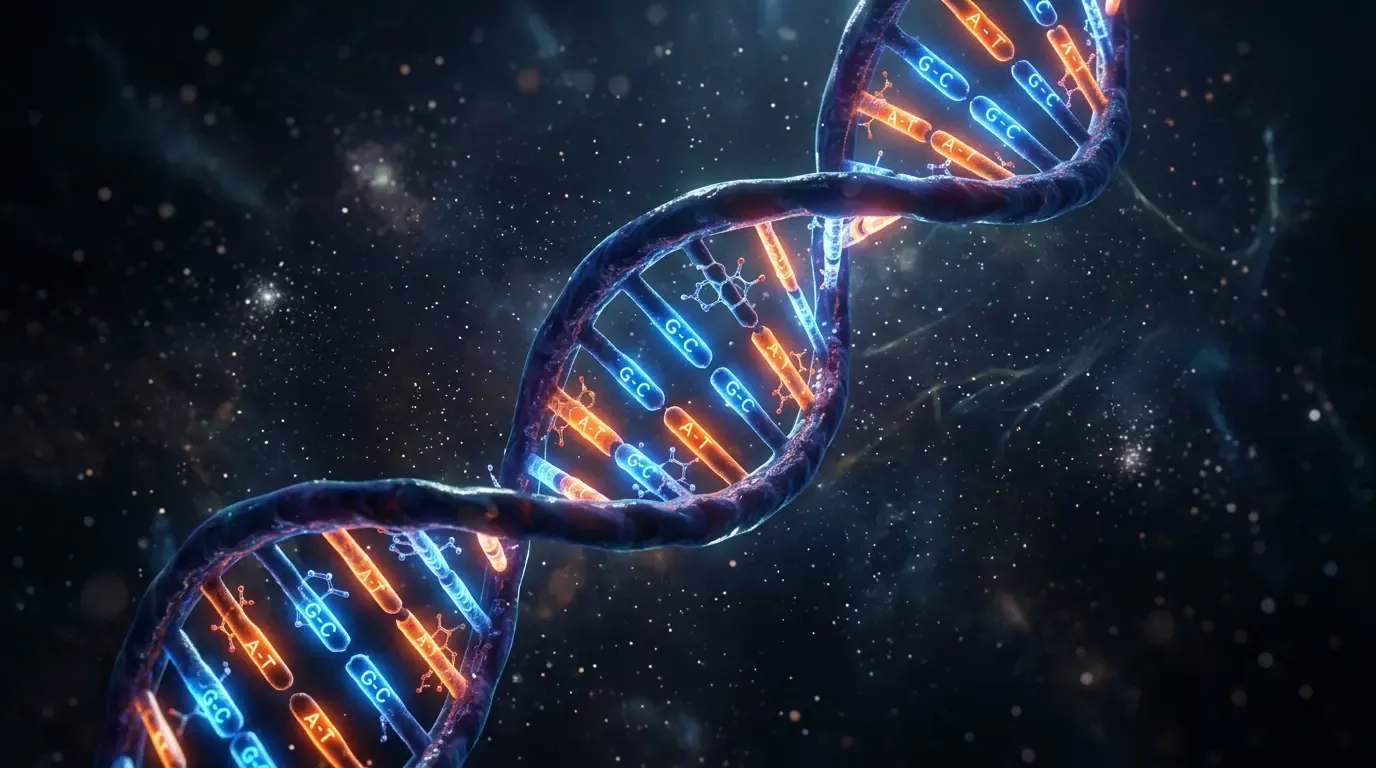
While the Miller-Urey experiment explained how the parts of a cell were made, it didn’t explain how those parts came together to actually live. A living cell needs two things:
This creates a massive “chicken or the egg” paradox. You need proteins to read and replicate DNA, but you need DNA to provide the instructions for making proteins! How could they have possibly evolved at the exact same time?
The answer, currently accepted by most evolutionary biologists, is the RNA World Hypothesis.
RNA (Ribonucleic Acid) is DNA’s single-stranded cousin. Scientists discovered that RNA is incredibly versatile. Not only can it store genetic information (like DNA), but it can also fold up into complex 3D shapes and act as a chemical catalyst (like a protein).
According to the RNA World Hypothesis, the very first life forms were just simple, self-replicating strands of RNA floating in the primordial oceans. Over millions of years, these RNA strands began building proteins to help them replicate faster, and eventually evolved into double-stranded DNA, which is much more stable for long-term information storage.
While the primordial soup and RNA world theories are highly favored, there are two other leading hypotheses regarding exactly where this chemistry took place.
Many scientists argue that the surface of the early Earth was far too violent and bombarded by lethal UV radiation for fragile RNA to survive. Instead, they look to the pitch-black bottom of the ocean. Deep-sea hydrothermal vents (black smokers) spew scorching hot, mineral-rich water into the freezing ocean. The gradient between the hot, alkaline vent fluid and the cold, acidic ocean creates a natural battery. This continuous flow of chemical energy could have provided the perfect, stable sanctuary for the first cells to organize.
The most exotic, yet mathematically plausible theory is Panspermia.
This theory suggests that life did not actually begin on Earth at all. Instead, it posits that the building blocks of life (or perhaps fully formed, dormant microbial spores) formed elsewhere in the universe — perhaps on Mars, which cooled down and had liquid water millions of years before Earth did. This is why studying Mars helps us understand abiogenesis by looking for ancient biosignatures. When massive asteroids struck Mars, chunks of Martian rock containing these microbes were blasted into space, eventually crashing into Earth and “seeding” our oceans.
While it sounds like science fiction, astrobiologists have found complex organic molecules and amino acids inside meteorites that have crashed on Earth, proving that the universe is teeming with the ingredients for life.
We may never know with 100% certainty exactly how the first spark of life ignited on our planet. The evidence has been erased by billions of years of tectonic plate shifts and erosion. However, through brilliant experiments and deep-space observations, science has proven that the universe naturally favors the creation of complex chemistry. From a molten, lifeless rock to a vibrant biosphere, the origin of life is a testament to the incredible resilience of nature. If abiogenesis would have been very common event, the universe should be teeming with life; however, if it is exceptionally rare, it might act as a “Great Filter”, a concept which is central to the fermi paradox.
The most recent common ancestor of all life on Earth is known as LUCA (Last Universal Common Ancestor). LUCA was not the absolute first life form, but rather a single-celled organism that lived about 3.5 to 3.8 billion years ago from which all current life—bacteria, fungi, plants, and animals—ultimately descended.
Not completely. While scientists can synthesize DNA, create synthetic cells, and replicate the building blocks of life (like amino acids and lipids), nobody has yet been able to mix raw chemicals in a beaker and have a fully functioning, self-replicating cell emerge on its own.
Statistically, it is highly likely. With billions of galaxies, each containing billions of stars and planets, the conditions required for abiogenesis likely exist elsewhere. Astrobiologists are actively searching for microbial life in our own solar system, particularly on Mars and the icy moons of Jupiter and Saturn (Europa and Enceladus). Beyond our local neighborhood, the search for biosignatures on Earth-like exoplanets is one of the primary goals of next-generation telescopes.